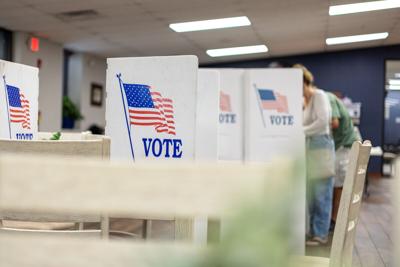

Every county in Oklahoma trended left in the U.S. midterm election last Tuesday night. Oklahoma still elected a batch of Republicans to national offices, but far more narrowly than the Sooner state is used to — one race even by 1.3%.
Democrats took a slew of wins in both battleground and traditionally Republican states, gaining control of both the House and Senate. Oklahoma is one of a handful of solid red states left, but political analysts told OU Daily the national story is unfolding here too.
“(It) is a once-in-a-generation kind of thing,” Andy Moore, founder of Oklahoma’s civic engagement organization Let’s Fix This, said. “That is highly unusual. I think this national environment, this blowback against Republican policy and leadership, was felt here as well.”
Oklahoma has double the number of registered Republicans as it does Democrats — 1.28 million to 609,000 — but turnout this year was low. Moore said Republicans frustrated with current leadership stayed home instead of voting blue.
Combined with independent votes and more consistent turnout in urban areas, Moore said Black and Hispanic voters in Oklahoma drove seat flips in the state legislature, too.
Though all 77 counties moved toward Democrat candidates, most still landed firmly on the right.
“The votes trended towards Democrats, but not enough, really, to turn over any of the statewide or congressional races,” Michael Crespin, director of OU’s Carl Albert Center, said.
Crespin said Oklahoma’s behavior is significant in an election year where Democrats undermined multiple Republican strongholds.
“(Tuesday) night was the high-water mark for Democrats,” Crespin said. “It's a tsunami across the country.”
Across the Red River, Democrat Gina Hinojosa defeated incumbent Texas Gov. Greg Abbott, marking the state’s first Democrat governor since 1995. Democrats also saw notable Senate wins in Texas, South Carolina and Kansas, all of which are historically red.
“The current establishment is probably wiping their brow, grateful that they didn't have the same kind of rout in Oklahoma,” Moore said.
Governor
Cyndi Munson, a Democrat, ran for governor and lost to Mike Mazzei, a Trump-endorsed businessman and former Oklahoma senator, by about 6% of the vote.
In 2022, the governor’s election had a winning margin of nearly 14% — more than double this year’s.
“It’s a tough night for Republicans across the country, but thank the Lord for Oklahoma,” Mazzei said in his acceptance speech.
Munson won one more county than 2022 Democrat nominee Joy Hofmeister did, taking a total of four: Oklahoma, Cleveland, Tulsa and Payne counties. 55% of the vote in Cleveland County went to Munson and 43% went to Mazzei. In 2022, Hofmeister won the county with 52% of the vote, and Gov. Kevin Stitt received 45%.
“Even though (Munson) didn't win, I think it still is important to highlight that she came closer than any Democrat has for 24 years,” Moore said.
Crespin agreed Munson performed significantly better than expected and said with about 600,000 registered Democrats in the state, the 500,000 votes Munson received couldn’t have been solely from them.
“It's unlikely that 90% of the Democrats turned out. That seems unlikely,” Crespin said. “So it's very possible some of her support came from probably some from Republicans, some from independents.”
Senate race
Moderate Democrat candidates like Munson saw closer margins than Oklahoma’s self-proclaimed democratic socialist candidate. N’Kiyla Jasmine Thomas lost her Senate bid against Kevin Hern by about 18%.
Hern, a Republican with eight years in the U.S. House, earned 57% of the vote. It was a closer race than Hern was used to, who won his last three elections by 60% of the vote or more.
Thomas narrowly took Cleveland County, earning 48.7% of the vote, while Hern garnered 47.6%.
Though moderates tend to fare better in Oklahoma, Moore said Thomas’ poor performance couldn’t be blamed solely on socialism. He said Thomas didn’t have much campaign funding or name recognition with it being her first race.
“Hern just didn't have as heavy of a lift as Thomas did,” Moore said.
House races
House District 5 was Oklahoma's closest race, with a margin of 1.3%.
Republican incumbent Rep. Stephanie Bice defended her seat against Democrat Jena Nelson by just 3,364 votes. U.S. House District 5 includes north Oklahoma City and Shawnee.
In 2021, the Oklahoma Legislature redrew House District 5, breaking apart Oklahoma County and including a rural area to the northeast. Critics called it gerrymandering, and said it decreased minority voters' sway.
“The drawing of that district for Republicans worked as expected, and I think absent that, maybe Nelson wins,” Crespin said.
Moore agreed that without redistricting, House District 5 likely would have sent a Democrat from Oklahoma to Washington. Crespin said District 5 may not be considered “safe” as a red seat come 2028.
Moore said 2021 redistricting also impacted the race in U.S. House District 1, which covers Tulsa and its suburbs. Still, Republican Mark Tedford defeated Democrat John Croisant by only about 4%, a thinner margin than Rep. Hern did in his four elections in that district.
Crespin said candidates will need to learn from results, and Republicans must change their strategy to avoid a reprise next time.
“Any Republican who who won by close margins ... nationally certainly needs to think about, ‘okay, what do I need to do going into 2028?’”
This story was edited by Spencer Windholz. Parker Newman and Larkin Bock copy edited this story.


