
Editor's note: This story was updated at 2:15 p.m. on Dec. 3 to reflect the correct spelling of Smart-T.
OU and University of North Texas researchers have designed an app focused on drinking behaviors of adults experiencing homelessness.
The Smart-T app is a collaborative effort between Michael Businelle, head of the OU Health Sciences Center Businelle Research Lab; Jason Oliver, professor at OUHSC; and Scott Walters, professor at the University of North Texas Health Science Center.
According to Walters, while treatment options are available at many homeless shelters, people may have difficulty complying with treatment schedules.
According to a 2017 study by researchers at the University of Southern California, the majority of people experiencing homelessness had access to a cell phone. Oliver believes this number has increased in recent years.
“It became a question of, ‘How can we make treatments more readily accessible for this population?’” Oliver said.
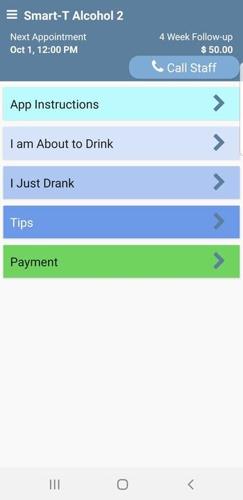
According to Walters, the app allows users to manage alcohol use in real time. Five times per day, users receive question prompts and a tailored message based on the answers.
The one-sentence message is based on the individual's mood, environment or other factors, such as if people around them are drinking. If a person is feeling depressed, Walters said the program could offer words of affirmation and other practices so they can feel better.
“We think this app is unique because it provides real-time treatment messages, which is really different,” Oliver said. “It can intervene even before people begin to drink. It's not a treatment after people have already had problems.”
Question prompts include how participants would rate their mood, cravings and the extent people around them are drinking. The app can then predict how likely the individual is to drink.

The Smart-T app interface.
“After calibrating it, we were able to identify more than 80% of drinking episodes just based on people's responses,” Walters said.
The app’s predictions use machine learning to analyze situational factors.
“When you do a search on Amazon for one book, it tells you about other books you might be interested in. It’s using what it knows about you to recommend a product you will likely also be interested in,” Walters said. “That's machine learning.”
The app was beta tested in a 2022 pilot study, and it will be implemented in homeless shelters in Oklahoma City and the Dallas-Fort Worth area.
Hayedeh Jahansouz, homeless management information system manager and research analyst, described the app’s implementation at the Bridge Homeless Recovery Center in Dallas.
The Bridge Homeless Recovery Center was founded by the city and provides comprehensive services for people experiencing homelessness.
“We provide day shelter services such as showers, meals and laundry,” Jahansouz said. “We also work with recovery services, connecting people with healthcare providers and behavioral health services.”
The center’s primary role in the study was to refer clients to the program and have them download the app. Jahansouz said she would recommend the app to other homeless shelters.
“It’s always very helpful to know the experiences that (researchers) have with our guests,” Jahansouz said.
Funded by a grant from the National Institutes of Health and the National Institute on Alcohol Abuse and Alcoholism, the app will enter a full-scale clinical trial in January with a larger group of 600 people.
“If we can prove that this actually works in a randomized trial, we could then roll it out to larger audiences,” Walters said.
Though the trial will be conducted in Oklahoma City and the Dallas-Fort Worth area, Oliver hopes to expand to other cities in the long term.
“For the next five-ish years, we'll be focused on these particular locations. Assuming we're successful, the next step would be an implementation study, also known as an effectiveness trial. It’s meant to be a bit more real-world than what we're doing now,” Oliver said. “That’s when we'd look into ways to make it publicly available.”
Businelle initially created the Smart-T app to intervene with smoking behaviors whereas Walters focused more on alcohol behaviors.
“We have a long history of collaboration, and both of us have done work with people experiencing homelessness. It seemed like an interesting synergy to take his expertise in app development and my expertise in alcohol abuse,” Walters said.
Walters is interested in studying people experiencing homelessness and addressing systemic factors that contribute to their challenges. While working toward his doctorate, he began to research excessive drinking on college campuses.
“Over the years, that area felt more and more built out, so I began to look for other populations. People who are homeless are definitely a more difficult population,” Walters said. “There's just layers of mental health, physical health, trauma, homelessness, joblessness and substance use — like an onion.”
According to Walters, researchers often prefer studying college drinkers because their drinking habits are mostly episodic and less complex. He said researchers often shy away from working with people experiencing homelessness because of the difficulty interacting with and understanding the population.
“Many people experiencing homelessness do have problems with substance use, and this is a known issue. It's also a population that, frankly, because of all the obstacles they face in life, is often dealing with profound amounts of stigma,” Oliver said. “The financial resources to obtain traditional treatments are not necessarily readily available or as easily accessible to this population.”
Walters has also researched drinking behaviors of people in the criminal justice system and the military. He expressed a desire to continue studying alcohol use in these under-researched populations.
Oliver explained OU provided the technology infrastructure for programming the app, and connections in Oklahoma City and Dallas allowed for its implementation.
“At my core, I hope that it works,” Oliver said. “I think we're doing our due diligence to make sure that the app is as effective as we can make it.”
This story was edited by Anusha Fathepure, Ana Barboza and Ismael Lele. Riley McDaniel, Grace Rhodes and Avery Avery copy edited this story.


