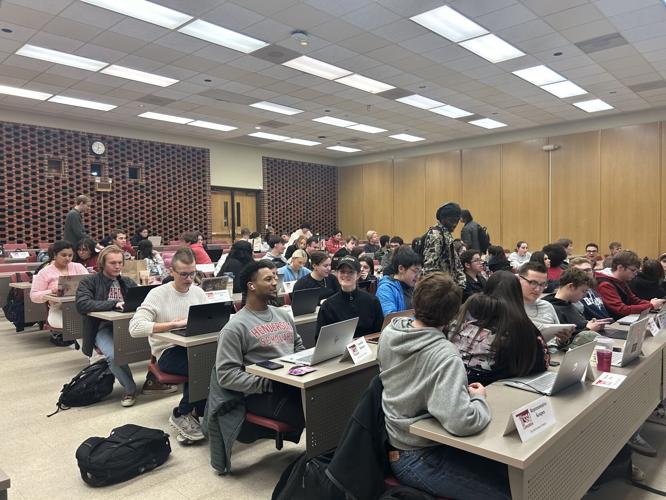


The Undergraduate Student Congress elected its vice chair, amended the election procedure for congressional representatives and laid plans for Higher Education Day funding during its Tuesday evening meeting.
Electing the vice chair
The news: The Undergraduate Student Congress voted to approve Rep. Aaron Gilson-Bond as vice chair. Gilson-Bond, who previously served as sustainability chair, was nominated by Rep. Kyle Oler and seconded by Rep. Cody Walker at the Jan. 28 meeting.
Following the unanimous removal of Rylee Houston from the position during a vote of no confidence at its last meeting, congress received nominations for Gilson-Bond and Rep. Marilou Bento. Bento, who was nominated by Rep. Hudson Harris and seconded by Rep. Leo Carter, currently serves as external affairs committee chair.
What they’re saying: During the presentation of candidate platforms, Gilson-Bond said he plans to connect members with leadership through office hours, host monthly workshops for professional leadership development, and create an anonymous feedback form as vice chair.
“I am focused on growth,” Gilson-Bond said. "So by investing in professional development, we will help congress members achieve their personal and collective potential.”

Rep. Aaron Gilson-Bond and Rep. Marilou Bento answering questions about their platforms for vice chair.
Gilson-Bond also noted the importance of creating lasting structures for future members during his time as a leader in SGA.
“Whenever I leave or walk away, I'm still going to be working for you,” Gilson-Bond said. “And so I want to come back to you (and) have something for you so you can continue doing what you actually love.”
During her presentation, Bento said she would be hands-on with committee projects, maintain consistent availability, and restore transparency as vice chair. Bento also said she would work to increase bookkeeping, implement an anonymous concern box and revive the SGA instagram as vice chair.
“When you work hard towards something, you get richly rewarded,” Bento said. “I think that putting the deep amount of effort that I have into the projects with my members has not only inspired the members around me to work harder, but has also inspired me to work harder.”
In response to a question about what makes Gilson-Bond a great candidate, Bento praised Gilson-Bond’s communication skills.
“All the members in (sustainability) trust him a lot because he has such clear communication and is able to give them clear goals and expectations,” Bento said.
The vote: With a roll call vote of 18-17-0, Gilson-Bond was elected vice chair, defeating Bento.
Revising election procedure
The news: The Elections Revision Act of Spring 2025 amended the SGA Code Annotated to add closing times for elections and changed the election procedure for congressional representative seats.
Congressional representatives previously needed a simple majority of 50% plus one vote to win their election, consistent with SGA presidential, Student Bar Association and Campus Activities Council races. The act changed the Code Annotated’s language so that each seat will be popularly elected, and a runoff will only be conducted if the candidates winning the least votes tie for an open seat.
Election Commissioner Baylor Savage, who authored the bill, accepted a friendly amendment from Rep. Shrey Kathuria to include standard opening times for elections in the bill as well.
What they’re saying: Savage said the change will help new election commissioners and streamline communication during the election process.
“From one year to the next — while I might know I can set up everything on my end — I'm not the only one sending out announcements,” Savage said. “So there's a chance for miscommunication.”
The vote: The Undergraduate Student Congress approved this bill with a vote of 33-0-0. Secretary Chloe Harris did not hear Rep. Delia Benitez-Mendoza’s vote. Rep. Jeffrey Ogle left the meeting prior to the vote.
Planning for Higher Education Day
The news: The Higher Education Day Act of 2025 requested support for increasing funds for Higher Education Oklahoma.
Higher Education Day is an annual event where college students meet with legislators at the Oklahoma Capitol to lobby for funding and discuss issues facing them and their universities.
Rep. Ava Burnett, who co-authored the bill, accepted a friendly amendment from Rep. Thomas Richardson to send the bill to more federal government leaders, including U.S. Rep. Kevin Hearn and U.S. Rep. Tom Cole.
What they’re saying: Burnett said that she and co-author Associate Jeriah Wilson collected statistics that highlight the importance of higher education to use in discussion with representatives on Higher Education Day.
“We have a lot of statistics that we go off of (when) highlighting the importance of higher education and how that can go back into the state and revenue that the state makes,” Burnett said.
Burnett said the previous year's resolution was more based on DEI, but they decided to shift focus given current events. On Monday, dozens of employees at the Department of Education were put on paid administrative leave with many anticipating the Trump administration to begin taking action in line with his campaign promise to close the department.
“Because of the circumstances surrounding DEI, we decided to change it to more focus on OU SGA’s stance on The Department of Education through a higher education lens.”
The vote: The Undergraduate Student Congress approved this bill with a vote of 33-0-0.
This story was edited by Anusha Fathepure.


