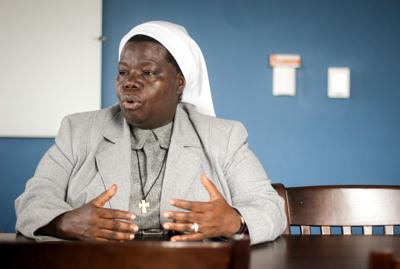
A humanitarian responsible for changing the lives of abducted women in Uganda is getting her doctoral degree this semester at OU.
Sister Rosemary Nyirumbe, a Catholic nun from Uganda, is working to get her doctorate in instructional leadership and academic curriculum. While on campus, Nyirumbe has been staying at Dunham Residential College, immersing herself in the OU community through presentations and connecting with her fellow students.
She said for many years she has dedicated herself to creating a safe space for women who have been abducted in her country. It didn’t start off as a school, just a place where the women can have a family again.
“We need to let these young women and children live in hope, knowing that their future can be rebuilt, knowing that someone cares for them,” Nyirumbe said. “It’s very important that they live in a family and find acceptance, and they are not judged. Then, eventually, we bring in the idea of education.”
Muneeb Ata, a biology and letters junior who is friends with Nyirumbe, said she brings hope to everyone she meets, including him.
“I don’t really know how to describe our relationship — probably hanging out. But how do you hang out with a 62-year-old nun who does the most important work in the world?” Ata said. “But we would just talk about things, so she’s a really good friend.”
Ata said Nyirumbe is very sincere, and that talking to her and hearing about everything she does shows him there is a bigger picture to everything.
“She’s super humble, and she lives a super simple life. She’s the type of person to go about not telling people the stuff that she has done because, to her, it’s not a duty, but it’s something that should be done, so she doesn’t really take credit,” Ata said. “It was so incredible meeting her. I feel that if any of the students at OU see her, they should say, 'Hi,' and don’t let the fact that she’s a little different be daunting.”
Josephine Kim, a first-year doctorate student studying instructional leadership and academic curriculum, specializing in English education, said she and Nyirumbe are very close friends.
“She impacted my idea of education because she thinks of it different than other people,” Kim said. “Other people think of education as something that can get them that higher paycheck or they take it for granted, but in her country, it is quite different — they have to learn, and it's very hard.”
Nyirumbe said she has never been formally educated as a teacher, but she knew the standard Ugandan curriculum was not what they needed at her school. When it came to teaching these women, she drew from things she had learned throughout her life.
She drew on her experiences from babysitting, being a trained as a midwife and her hobbies of cooking and sewing to teach these women the practical skills that they needed.
“Education is just giving them some skills which can help them support themselves and support their children,” Nyirumbe said. “When they come home, people find it so difficult to accept these girls, so they didn’t know who to fall on. Giving these girls some education and skills was very important to let them be self-reliant.”
When Nyirumbe talked about first starting the school, she said they may have bitten off more than they could chew because the need for it was so great. There was a large number of women who had escaped from captivity, and not a lot of room for all of them. Nyirumbe said she wanted to be able to create the school by themselves and get it running before looking to other people for help.
However, after the school had been started and was running, Nyirumbe met a man from Oklahoma: Reggie Whitten. His son had recently passed away, and he was introduced to Nyirumbe after coming to Uganda in 2002.
“When this man saw what I was doing with the children, caring for them and giving them a little bit of hope, he felt the pity and saw that this wasn’t something he could ignore, and it went above the pain he felt from losing his son,” Nyirumbe said. “He said, 'I need to do everything I can to support this system.'”
Whitten then returned to Oklahoma, gathered a group of professionals and went back to Uganda to help Nyirumbe. The group was composed of mostly athletes but also other professionals who wanted to give back. Many of them had gone to the University of Oklahoma.
“That is what started my relationship with the University of Oklahoma and Oklahoma itself,” Nyirumbe said.
For this reason, she chose to come to OU to work toward her doctorate. To Nyirumbe, OU was a home away from home for her.
“It has been a long history of relationship and partnership with OU, and I enjoy it, and I like very much that OU became a family for me,” Nyirumbe said.


