
Colleges and universities in Oklahoma give inconsistent reasons for releasing student parking tickets. That’s because of neither OU, Oklahoma State University or the University of Central Oklahoma will release the names of students issued parking tickets, saying their names are educational records protected under the Family Education Rights and Privacy Act and that the Oklahoma Open Records Act allows them to release student names.
Parking tickets provide a $2 million-revenue stream to Oklahoma’s four largest colleges and universities, but so far it’s been impossible to learn which students are getting those tickets, how much each of them are paying in fines and whether any students are getting preferential treatment at three of those schools.
Though most individual tickets amount to $3 to $100 depending on the college or university, the lack of transparency raises concerns in some quarters, especially considering past precedent for such behavior.
“Schools have withheld tickets because they knew the tickets would show that athletes were getting preferential treatment or were driving suspiciously expensive cars,” said Frank LoMonte, executive director of the Student Press Law Center in Washington. “So it is a fair suspicion that the Oklahoma colleges are fearful of that type of scandal coming to light on their campuses.”
LoMonte cited two examples in Maryland and North Carolina. In 2011, students at the University of North Carolina sued the university for access to student parking tickets and were joined by outside media, including the Raleigh News & Observer, the Charlotte Observer, the Associated Press and broadcast outlets.
The parking ticket disclosures along with other records showed an ongoing investigation into academic and athletic misconduct at the university. Holden Thorp, University of North Carolina chancellor, fired football coach Butch Davis in July 2011 in the midst of an NCAA investigation.
Several players lost their eligibility after the NCAA found they had improperly accepted benefits from sports agents. Those North Carolina students seeking parking tickets were following the examples of student journalists at the University of Maryland, who in the 1990s unearthed a parking ticket fixing scandal involving student athletes.
In Oklahoma, the process is playing out differently. I’m seeking parking ticket records by suing OU with the help of two attorneys working pro bono on his behalf.
The attorneys are Nicholas Harrison, an OU alumnus based in Washington D.C. and another lawyer, Kevin Taylor, based in Oklahoma City.
Unlike in North Carolina, no other media has joined my lawsuit seeking access to the parking tickets. Harrison said other media outlets haven't joined the case for two reasons.
“We put out some feelers, but we didn't get any interest,” Harrison said. "Money was also a big consideration. Other plaintiffs might have wanted to sue other schools. And, it's best to take on one Goliath at a time."
The case is pending in Oklahoma federal court. The move from a state to a federal court was granted OU’s request.
While the case is pending, I continued to gather what information I could regarding the parking tickets. The three schools maintain FERPA and the Oklahoma Open Records Act allow them to withhold student parking ticket information. The schools would give out parking ticket records for university administrators, faculty and staff.
No one disputes students are entitled to privacy regarding their education records, such as transcripts, GPA, grades, social security number and academic evaluations.
But parking tickets are typically public records.
“It's completely possible to disclose student parking tickets without violating FERPA, since such disclosures take place all the time, harmlessly,” LoMonte said.
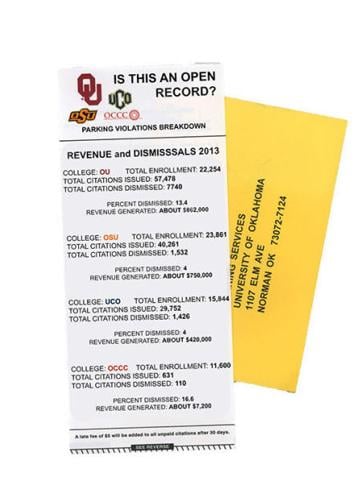
Some records have been made available and I was able to learn the following:
- OU generated nearly $862,000 from a total of 57,478 parking tickets issued in 2013, with 7,740 — or 13.4 percent — dismissed. There are 22,254 students enrolled at OU.
- OSU took in more than $750,000 from a total of 40,261 parking tickets issued in 2013, with 1,532 — or 4 percent — dismissed. There are 23,861 students enrolled at OSU.
- UCO generated nearly $420,000 from a total of 29,752 parking tickets that were issued in 2013, with 1,426 — or 4 percent — dismissed. Total enrollment at UCO is 15,844 students.
- Oklahoma City Community College took in just over $7,200 from a total of 631 parking tickets issued in 2013, with 110 tickets — or 16.6 percent — dismissed. Total enrollment at OCCC is 11,600 students.
Records requested
The parking ticket records requested from these schools were made over a two-month period in November and December 2013, These requests included information about electronic parking citations for the university or college president, athletic coach, student newspaper adviser and students over a four-year period.
Staff and faculty parking tickets are considered open records, The Daily requested and received parking ticket records from the following: OU President David Boren, football head coach Bob Stoops and journalism professor Christopher Krug.
Both Boren and Stoops received no tickets during the time period requested. Krug received several tickets during the time period requested.
However, OU’s Open Records Office does not release student parking ticket records. OU’s general counsel cites both FERPA and the Oklahoma Open Records Act as reasons to withhold student parking tickets.
At OSU the request sought the parking tickets of OSU President Burns Hargis; head football coach Mike Gundy; Barbara Allen, the Daily O’Collegian student newspaper adviser and students.
Gary Shutt, director of communications at OSU, said Allen received no tickets issued during the time period. Shutt said both Hargis and Gundy had tickets issued and some were dismissed. Gundy received two warnings, and two out of nine of Gundy’s tickets were dismissed.
“Gundy had a valid permit at the time but did not move it to the vehicle he was driving. Our permits may be transferred from one vehicle to another. It is common practice to void this citation or reduce it to $5 for failure to display the ticket,” Shutt said. Hargis received one ticket during this period and his ticket was dismissed. Shutt said Hargis was on university business and should not have been ticketed.
While information on faculty and staff parking tickets were given promptly, OSU officials declined to release student tickets, citing FERPA and the Oklahoma Open Records Act section 24A.16.
Section 24A.16 is known as the Confidential Records of Public Educational Institutions citation, which allows public universities allows universities to release certain information. Shutt offered to turn over student tickets if those students would agree to their release.
Otherwise, Shutt said, “We clearly believe Oklahoma law allows us discretion to keep confidential individual student records.”
The request at UCO sought the parking tickets of UCO President Don Betz; head football coach Nick Bobeck; Ted Burch, The Vista student newspaper adviser, and students.
Betz received no tickets issued during the time period. Burch had one ticket issued and dismissed. Bobeck had three tickets issued and dismissed. Raul Martinez, director of transportation at UCO, said Burch appealed the citation, and the university’s parking appeals board waived it. In Bobeck’s case, Martinez said the provider that issued Bobeck’s one-day parking pass inadvertently left off the expiration date.
“Ticket was waived since error was through no fault of Mr. Bobeck,” Martinez said.
Bobeck’s other two tickets were invalid because they were given during a grace period after a glitch in the parking decal ordering system prevented customers from order decals for a few days, Martinez said.
While faculty and staff parking tickets were given promptly, Elizabeth Kerr, legal counsel for UCO, declined to release student tickets. Kerr cited FERPA and the Oklahoma Open Records Act section 24A.16 as reasons to deny the request.
“Under FERPA, an institution may release directory information,” Kerr said. “Under the Oklahoma Open Records law, the institution shall release directory information. In both (cases), directory information is clearly defined. Traffic tickets are not included in the definition."
OCCC officials said they honor requests to inspect student parking tickets. Records are available for inspection during business hours, OCCC spokesman Cordell Jordan said.
OCCC files parking citations in a file cabinet, not in an electronic database. Jordan said citations are tracked through an electronic database.
“[That] is why we can quickly look at the number of citations but do not know specifics about them without looking at each ticket,” Jordan said. Reasons for ticket dismissals are not available because of ARMS — the system OCCC uses to track parking tickets — does not list the reason for voided parking tickets.
The request at OCCC sought parking tickets of OCCC President Paul Sechrist; Eric Watson, sports and recreation specialist; Ronna Austin, the Pioneer student newspaper lab instructor and students.
‘This is not a question of can’t. It’s a question of won’t’
OSU and UCO officials gave several different responses when they learned student parking tickets at OCCC are considered open records.
OSU’s stance on the release of student parking tickets did not change. Shutt said information on student parking tickets is without a doubt a student record, citing the Open Records Act.
“OSU enforces those [parking tickets] through the Bursar system — they are educational records and, in our opinion, also FERPA records,” Shutt said. “Even if you remove FERPA and educational records from the equation, OSU believes student’s tickets are individual records covered under the state’s Open Records Act.”
Kerr’s said UCO already responded to the open records request.
LoMonte said each college or university I sought records from were public entities supported by taxpayers. The difference between them is that OCCC releases information about student parking tickets without receiving sanctions from the federal government under FERPA.
“This is not a question of can't. It's a question of won't,” LoMonte said. “These colleges (that refuse to provide ticket information) are simply manipulating and abusing FERPA to serve illegitimate purposes of concealment, which raises real questions about what must be revealed by those tickets.”
Currently the Oklahoma Attorney General doesn’t have an opinion on whether tickets are protected by Oklahoma Open Records Act, said Diane Clay, spokeswoman for Oklahoma Attorney General Scott Pruitt.
Joey Senat, an Oklahoma State University journalism professor and former FOI Oklahoma president, said the bottom line is universities aren’t going to provide student parking tickets unless they are forced.
FOI Oklahoma is a statewide organization actively supporting those organizations and individuals working to get open records or provide access to meetings that might otherwise be closed.
If universities can’t cite a case with an Attorney General opinion for closing records, then there’s no reason to keep the records closed, Senat said.
“It’s a disingenuous excuse,” Senat said.
Rep. Jason Murphey, R-Guthrie, was the winner of the 2011 FOI Oklahoma’s sunshine award.
Murphey said the spirit of the law says the parking ticket records should be open.
“It’s mighty frustrating that the current law isn’t being adhered to. This might be where the legislators step in,” Murphey said.


