
Down Sixth Street in Oklahoma City, the salmon-colored building houses an eclectic assortment of video games, instruments and artwork. Behind a pingpong table in the center of the main room are framed three words, the principles of The Spero Project: "Welcome. Partner. Advocate."
Founded in 2009 by Kim and Brad Bandy, The Spero Project, originally intended to be a six-week conversational English class provided to the Burmese community, expanded into multiple partnerships and programs for resettled refugees across Oklahoma City. The Spero Project partners with Catholic Charities, the resettlement agency for the state of Oklahoma.
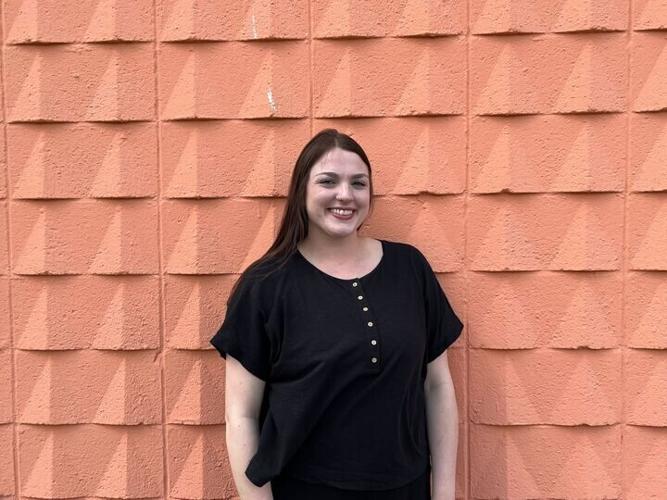
Abby Cain, an adult education specialist at The Spero Project, said the foundation of the organization is to welcome resettled refugees to Oklahoma City by providing a sense of community.
“Our mission is to connect our new neighbors to people, resources and learning opportunities that make Oklahoma City a place of belonging,” Cain said.

Abby Cain, an adult education specialist at The Spero Project.
Oklahoma’s history of welcoming refugees goes back to the mid-1970s when a vast population of Vietnamese refugees immigrated to the state after the communist government of North Vietnam captured Saigon. In the present day, more than 8% of Oklahoma City is foreign-born.
Cain first got involved with Spero during her undergraduate years at Oklahoma State University as a volunteer and then an intern. In 2018, she came on staff and has been working full time since then.
Cain said since she started at Spero, her role as well as the organization’s programming and resources are always changing for the needs of the community.
“If we go back to the history of Oklahoma, the needs that were present here in the mid-70s changed over time, and even in the last year the needs have changed in terms of what the resettled community needs resources and support for,” Cain said.
Spero offers a variety of resources and programs. For adults, the organization provides free weekly classes for English language learning, citizenship and driving. It also offers trauma-informed therapy services. Spero hosts daily after-school programs, and serves as liaisons for parents to understand the school system so they can be involved in their child’s education. Spero conducts its programs in a way that is considerate of culture of origin and language barriers.
Sang Rem, director of student support at The Spero Project, originally came to Oklahoma as a refugee. Born in a small village in Burma, Rem and her family left the country when she was roughly 5 years old after a military group would continuously attack the village. Rem's family first landed in North Carolina before moving to Oklahoma City to settle down.
“Without Spero, I could not graduate with my college degree,” Rem said. “They have supported me in many different ways that I didn't know then, but I just really started to realize more and more … they are very encouraging on what you want to do in life.”
She said that she first got involved because she had already been serving her community as someone who could speak English, so she naturally began volunteering with Spero. The project eventually offered her a position and she has been working with them since.
“Sometimes I think I'm the luckiest person in the community … I get to do what I want to do in life and just develop. … It's just pretty amazing working with them,” Rem said.
Eric Muhizi, a motivational speaker, was born in the Congo and left the country in 1998 as a toddler due to multiple civil wars and genocide occurring in his village. His family fled to another city in the Congo before moving to Burundi. He lived in Burundi for four years until he moved to Uganda because of conflicts within the country. He lived in Uganda for another four years until he was granted a United States refugee status visa in September 2008. Since then, he has called Oklahoma his home.
Muhizi said there was a large culture shock coming to the United States.
“When we were back home, thinking about the word ‘USA’ felt like it was a different planet because we didn’t know what to expect … just the experience, the culture, the language, the food, the tradition, it is way different and you just have to adjust as the years go by,” Muhizi said.
Despite the differences at first, Muhizi said eventually he got used to it and realized that the United States is just like any other country.
“Of course, there is more opportunity here, there is more freedom here than back home, but there is no replacement for home. Home is home. … It’s great knowing your background, where you come from and also adjusting to this new environment and culture and just bringing them together to make a puzzle,” Muhizi said.
Adil Bayraktar, a program director at The Spero Project, has a similar story to Rem and Muhizi. Bayraktar, a Turkish immigrant from Russia, came to Oklahoma in 2006 as a teenager about to enter high school. Bayraktar’s family had fled Russia after experiencing discrimination and oppressive behavior due to anti-Turkish sentiment.
Bayraktar said one of the first people he met in Oklahoma was Brad, a co-founder of Spero.
“Brad used to just come in (and) hang out with us at the apartment complex we all used to live in, and then one summer, I just kind of hung out with him, pass(ing) out food to people that needed it, pass(ing) out clothes that people needed, just community work,” Bayraktar said. “I would just talk to Brad and my English would get better. I learned about the culture, I learned about how things are here in the United States and we just kind of became friends.”
Muhizi described Brad as his big brother. His family has even bestowed their tribe’s name on him because of how much he means to Muhizi’s family.
“Being with Brad, seeing the way he moves, the way his time is consumed, his effort, that’s when I realized language does not define us, but love. It’s what unites us. For us, love is the one language we can understand and all speak,” Muhizi said.
Muhizi shared an anecdote about when Brad first approached his family about starting Spero.
“I asked him, ‘What does Spero mean to you?’” Muhizi said, “(Brad) said ‘It’s a symbol of hope.’ Right then, I knew Oklahoma was where I belonged.”
Cain said the relationship she has with the people she works with is a mutual one where they learn from one another’s experiences.
“We're both basically helping each other by having that connection and learning from each other's experiences and also being able to support each other in different things,” Cain said. “To me, that's a real human connection.”
According to Cain, it’s crucially important that when people resettle to a new place they are able to integrate into a community.
“We really do need each other to both survive and thrive. And I think that human connection is irreplaceable,” Cain said. “Even if you have the best resources, without community (you) don’t have the real human connection.”
For Muhizi, Spero is more than an organization that helps welcome resettled refugees.
“It’s more of a community, environment, culture and a place where you feel like you belong here, you are loved by the community,” Muhizi said, “No matter the circumstance, whatever you need, we will be here.”
This story was edited by Teegan Smith and Peggy Dodd. Grace Rhodes and Mary Ann Livingood copy edited this story.


