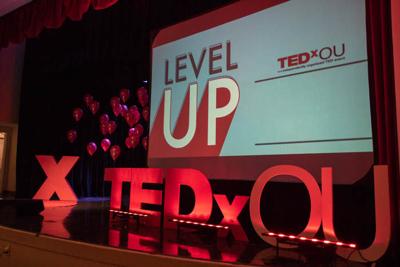

TEDxOU will host 16 student speakers in its return to campus March 6.
This year’s theme is “Disruption,” which will explore moments of challenge and growth through students' original research and lived experiences.
From medical technology and artificial intelligence to mental health, this year’s speakers represent a wide range of topics, backgrounds and perspectives.
TED is a nonprofit organization dedicated to discovering, debating and spreading ideas that spark conversation, typically through short-form talks covering a wide range of topics, according to the official TEDxOU website.
Among this year’s speakers is senior Thea Massi, whose talk explores how social media can quietly shape and sometimes limit personal identity.
Massi is pursuing an undergraduate degree in management information systems and an accelerated master’s degree in management information technology, both of which she is expected to complete in December.
Massi said social media can place people into what she describes as “subcultural communities,” which can shape identity through constant exposure to certain messages and expectations. After immersing herself in online self-improvement content, she quickly began to feel the pressure it created.
“It became too much, where I felt like I was a failure if I wasn't productive 24/7,” Massi said.
Instead of encouraging people to reduce their screen time, Massi emphasizes the importance of replacing digital habits with intentional real-world experiences. She aims to highlight the importance of “third places,” spaces outside of home, school or work, where people can form meaningful connections.
“When I started doing jiujitsu and MMA, I fell in love with it,” Massi said. “It made me more confident in who I was. I was off my phone, really connecting with people, and that was my third place.”
Massi said her talk will not be criticizing social media, but it will encourage listeners to be more intentional about how they spend their time.
“It’s not just about ‘don’t get on your phone’ or ‘limit your screen time,’” Massi said. “It’s like, what you can replace it with that’s intentional.”
Another speaker, OU industrial and systems engineering graduate student David Colindres, will focus on the quiet struggles many students carry and the impact small acts of kindness can have within a community.
Colindres said his talk is shaped by his experience running “OU Love Letters,” an anonymous online submission platform where students share personal confessions and vulnerable messages since its creation in 2020.
“You never truly know the impact you're having on people,” Colindres said.
While managing the platform, he reviewed thousands of anonymous submissions. He noticed many were sent late at night, revealing patterns of loneliness, vulnerability and emotional struggle among students.
“What I realized is that people can be struggling in silence,” Colindres said. “You never truly know the weight that someone is carrying with them.”
Colindres said the experience changed how he understands connection and community. He said small, simple gestures, such as checking in on someone or offering a kind message, can create a meaningful impact and open the door for deeper connection.
“It can take 20 seconds to reach out to someone you haven’t talked to since high school, and suddenly they want to get coffee,” Colindres said.
For Colindres, the stories shared through OU Love Letters revealed a deeper truth: even the smallest moments of kindness can remind someone they are not alone.
“Small acts of kindness is the simplest way to leave an impact,” said Colindres.
OU computer science junior Akshay Singh will explore in his talk how artificial intelligence and early prevention could reshape the way people understand long-term health risks.
Singh said his student research was inspired by the sudden cardiac arrest of a close family friend during his first year at OU, an experience that shifted his academic focus toward cardiovascular research and prevention.
Singh said the experience showed him how unpredictable cardiovascular disease can be, since warning signs are often overlooked until it is too late.
“We didn’t know what exactly was the cause of death, …” Singh said. “They performed an autopsy report, they found it was sudden cardiac arrest … because of his lifestyle.”
After the death, Singh began developing an AI-driven platform designed to predict an individual’s risk of cardiovascular disease based on factors such as blood pressure, cholesterol and lifestyle habits. He said the goal is to help people identify risks early and take preventive action before serious symptoms appear.
Singh believes prevention will play a major role in the future of health care, particularly as artificial intelligence becomes more integrated into the health care industry.
“I think everybody in today’s day and age needs to learn how to utilize AI, regardless if you’re pro-AI or anti-AI, …” Singh said. “It’s being incorporated into almost every sector, every industry in the world.”
His talk will also emphasize the importance of lifestyle choices, especially for young adults who may not yet see the long-term effects of their habits. Singh said many health risks develop later in life, making early prevention and consistent habits essential.
Singh said his goal is to help people become more aware of their health now so they can better protect their future.
“Most of the audience will be from ages 18 to 28, and so I think this is the time when it’s absolutely essential that we prioritize our health,” said Singh.
As TEDxOU approaches, speakers like Massi, Colindres and Singh will bring a range of ideas shaped by research, experience and personal perspectives.
The event will take place from 9 a.m. to 5 p.m. March 6 at Meacham Auditorium in the Oklahoma Memorial Union, according to organizers.
This story was edited by Natalie Armour and Macey Thaxton. Kylie Caldwell and Sophie Hemker copy edited this story.


