OKLAHOMA CITY — A budget deal state leaders struck on Wednesday will boost funding for Oklahoma public schools and raise the ceiling on teacher pay in the 2026 fiscal year.
After giving a similar increase last year, Gov. Kevin Stitt and legislative leaders agreed to pour another $25 million into public education funding, but this time with a caveat from House Bill 1087. Accompanying the extra $25 million will be a one-day increase to the minimum length of an Oklahoma school year. Students must have at least 166 days of instruction rather than 165.
HB 1087 also extends the teacher salary schedule by 15 years, meaning public school teachers will receive annual step raises for up to 40 years instead of reaching their maximum salary at 25 years.
A classroom teacher with a bachelor’s degree must earn a salary of at least $64,021 after 40 years, under the bill.
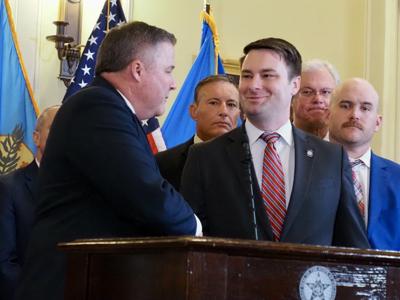
“What we have been saying again and again repeatedly is what we need to invest in (and) focus on in public education is making sure we’re recruiting and retaining quality educators and making sure we’re having as much quality time in front of those educators as possible,” House Speaker Kyle Hilbert, R-Bristow, said at a news conference Wednesday where the budget deal was revealed.
Senate Minority Leader Julia Kirt, D-Oklahoma City, said $25 million is “not adequate” to help public schools counteract rising costs from inflation, especially while the cap for tax credits supporting private school students is prescheduled to increase by $50 million.
“Twenty-five million dollars is not enough to do the transformative change we need to have in the classroom,” Kirt told reporters on Thursday.
The Oklahoma State Department of Education budget, which covers most appropriations for K-12 schools, will increase by 3.15% to $3.98 billion.
That’s an even larger funding boost than the Education Department’s head, state Superintendent Ryan Walters, requested. But in doing so, lawmakers and the governor discarded several of Walters’ ideas.
The agency’s budget includes no funds for Bibles, despite Walters’ request for $3 million to buy a copy for every public school classroom. His ask for $500,000 to give educators concealed-carry firearm training, $1 million for a new teacher induction program, and $1 million to recruit military veterans and former law enforcement officers to the teacher workforce also went unheeded.
An Education Department spokesperson declined to comment Thursday.
Another $1 million in “efficiencies” from the agency, which has lost dozens of employees over the past two years, will transfer from the Education Department to public schools.
The Legislature dedicated $5 million to a high-dosage tutoring program inspired by a similar initiative Walters established at the Education Department. Both the House and Senate have advanced legislation to pay reading and math tutors to meet with struggling students multiple times a week.
Lawmakers agreed with Walters’ request to boost the state’s teacher maternity leave fund by $4 million. Walters advised that demand for the $2.5 million fund has been high and the number of participating districts is growing.
Another major incentive for longtime teachers made the cut in the state’s budget for higher education. The Legislature will dedicate an extra $740,310 to the Oklahoma’s Promise college scholarship program to include children of classroom teachers with 10 or more years of experience.
Members of the state’s largest teacher union, the Oklahoma Education Association, are feeling “optimistic” after seeing lawmakers prioritize teacher benefits this year, the organization’s president, Cari Elledge, said.
She said the 15-year increase to the salary schedule “will hopefully give people a reason to stay” in the classroom.
“This might help keep some people in the profession longer, which could benefit students because these are people who don’t have to be trained and know what they’re doing,” Elledge said.
Education Department loses control of asthma inhaler funds
The new state budget moves a $250,000 asthma inhaler fund away from the Education Department to the University Hospitals Authority and Trust, the entity that oversees hospitals on the University of Oklahoma medical campus.
The state Legislature created the $250,000 fund in 2023 to distribute asthma inhalers to all public schools. Lawmakers became openly frustrated last summer after more than a year had passed without the agency disbursing any of the money.
Attorney General Gentner Drummond, who was asked to investigate the matter, found the Education Department was “neither speedy nor responsible” with the program and showed a “lack of understanding of basic purchasing procedures.”
The Education Department still has not spent the $250,000, said the Senate’s budget leader, Sen. Chuck Hall, R-Perry. In the meantime, he said the University Hospitals Authority and Trust has been working with the Brendon McLarty Memorial Foundation to provide inhalers to schools.
“We now have experience with them and their ability and their desire to be part of this program,” Hall said of the hospitals authority. “So we’ll just take that money and put it over there and let them administer the program.”
Oklahoma Voice is an affiliate of States Newsroom, a nation 501(c)(3) nonprofit supported by grants and donations focused on delivering state government news. The Voice maintains full editorial independence. For more stories by Oklahoma Voice go to oklahomavoice.com.


