
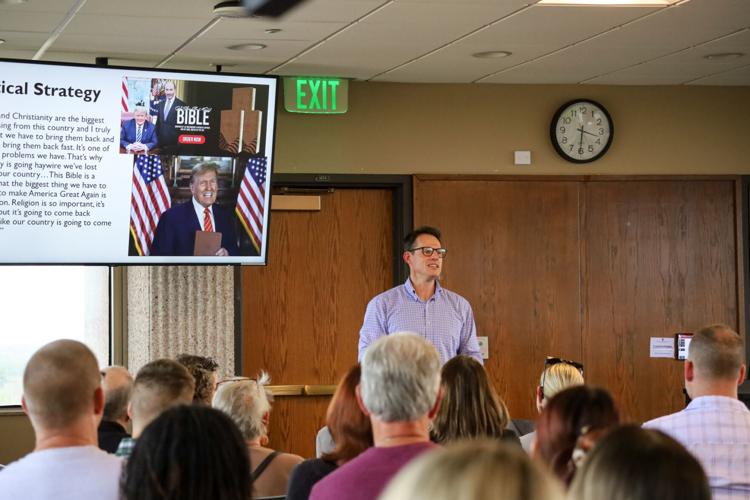



An OU sociology professor discussed white Christian nationalism and its effects on local and national politics during a public talk Tuesday afternoon, urging Norman residents and OU members in attendance to get involved in politics and engage with diverse perspectives.
Samuel Perry, a professor in the OU Department of Sociology, gave the talk, titled "White Christian Nationalism: What it is, Why it Matters, and How to Respond." The talk was sponsored by the sociology department and was held on the top floor of Dale Tower.
Perry is one of the nation's leading experts on Christian nationalism and its impact on U.S. politics — a topic he said is particularly relevant heading into the 2024 election.
"People want pastors to stay in their lane, people want politicians to stay in their lane and they don't want the influence of religion in politics like it has been," Perry said, adding the U.S. has increasingly become more ethnically and religiously diverse.
"This is why it matters," Perry said. "And this is why I hope you care."

Dr. Perry during talk on white Christian nationalism on April 9.
What is white Christian nationalism?
White Christian nationalism is the belief that the U.S. is, and should remain, a Christian nation and U.S. laws and policies should reflect this idea.
Perry said it's called white Christian nationalism, rather than just Christian nationalism, because studies show white people identify more with the idea's principles than Black and Hispanic Americans.
Oftentimes, Perry said, people define the term "white Christian nationalism" too broadly or narrowly, either placing the label on all politically active Christians or on a minority of Christian extremists who self-identify as white Christian nationalists.
"I don't think that gets us anywhere," Perry said. "I think we would agree that the only racists in the world aren't just people who call themselves racists, right?"
To understand what white Christian nationalism is, Perry said it is first important to distinguish what it is not.
When talking about white Christian nationalism, Perry said he is not referring to Christian patriotism, the recognition of positive Christian influences in the U.S., Christians involved in politics or white evangelicals, a common misconception.
Instead, Perry said white Christian nationalism can be looked at in three ways: as a political ideology, an identity and a political strategy.
An ideology is a set of beliefs and values that shape one's attitudes and behaviors, including how a person or group engages in politics.
"(White Christian nationalism) is a political ideology that can mobilize, that can activate certain kinds of values and shape our values and motivate certain kinds of action," Perry said. "It is increasingly becoming an identity that people are rallying to and openly saying that 'this is who I am, this is what we're about.' But even more importantly, I think it is a political strategy that aims to activate and mobilize that ideology and that identity for political purposes."
Oklahoma Sen. Dusty Deevers (R-Elgin) is one such self-identified Christian nationalist. He, along with other outspoken Christian nationalists, co-wrote the Statement on Christian Nationalism and the Gospel, which was published in May.
In the statement, the authors wrote that "nations are commanded to honor God by officially affirming the orthodox Christian faith" and "every political thought must be taken captive to the obedience of Christ."
Deevers and the others listed a Christian nationalist agenda, which includes the recognition of Christian Orthodoxy as a Christian consensus under Jesus Christ and the establishment of the Ten Commandments, a set of Biblical principles, as the foundational law of the U.S.
Former President Donald Trump, who is closely tied to the white Christian nationalist movement, recently stated he would defend Christianity should he be reelected in the fall.
Last month, in an advertisement for his “God Bless the USA” Bibles posted on Truth Social, Trump also said “religion and Christianity are the biggest things missing from this country," blaming dysfunction in the U.S. on the absence of Christianity and a return to religion as the solution.
Ryan Walters, state superintendent of public instruction, has similarly advocated for a return to Judeo-Christian values. In January, Walters pushed for a bill requiring the Ten Commandments to be displayed in Oklahoma public school classrooms.
The bill, House Bill 2962, was coauthored by Rep. Jim Olsen (R-Roland) and David Bullard (R-Durant) and was referred to the Appropriations and Budget Education Subcommittee in February.
Walters is also a staunch supporter of anti-2SLGBTQ+ legislation, a common thread among Christian nationalists. These efforts came under renewed scrutiny following the death of Nex Benedict, a 16-year-old nonbinary student who died by suicide in February after experiencing a fight in their high school bathroom.
An open letter signed by hundreds of organizations supporting 2SLGBTQ+ rights called for Oklahoma legislators to remove Walters from office and investigate his department for "fostering a culture of violence and hate against the 2SLGBTQI+ community in Oklahoma schools."
Perry emphasized there is a difference between a politician promoting their religion and a white Christian nationalist who is pushing legislation that benefits one group — white evangelicals — over others to return the country to its "religious roots."
Perry told OU Daily after the event that common characteristics among white Christian nationalists include xenophobia, or prejudice against people from other countries, the belief that white Christians are superior to others and that violence is a suitable way to solve problems.
"They're the most likely to say, 'The best way to stop a bad guy with a gun is a good guy with the gun,'" Perry said.
While the term "white Christian nationalist" has existed for some time, Perry said it has gained renewed popularity in recent years, particularly after the Jan. 6 Capitol riot.
On Jan. 6, 2021, the U.S. Capitol was attacked by a mob of Trump supporters, including white Christian nationalists, seeking to interfere with the certification of electoral votes from the 2020 presidential election. In 2022, Perry was among those invited to provide expert testimony to the Jan. 6 committee on the role of Christian nationalism in the Capitol Riots.
"(White Christian nationalism) is not something that is hidden anymore," Perry said. "It's something that people are openly embracing and advocating for and it's become something that people identify with."

Dr. Perry during talk on white Christian nationalism on April 9.
Why Perry says it matters
The U.S. is becoming more ethnically and religiously diverse, with Christianity on the decline, Perry said.
A 2019 Pew Research report found during telephone surveys 65% of American adults described themselves as Christians when asked about their religion, down 12 percentage points over the past decade. Comparatively, the percentage of people who describe their religious identity as atheist, agnostic or "nothing in particular," rose from 17% in 2009 to 26%.
"Most Americans want less influence of religion on politics, not more," Perry said. White Christian nationalists are shrinking, so they are finding ways to maintain their political hold, Perry said.
There are a few ways that white Christian nationalists do this, Perry said. One is to distract away from the root causes of issues, such as problems in health care and education, by placing the blame on other communities.
"I think most of the politicians, their goal is to use cultural war language to generate fear and anger and distract," Perry said. "But (they) also have to make it so (they) can maintain control without electoral majorities."
To do this, Perry said white Christian nationalists make it harder to vote through voter suppression, election rigging and changes to voter laws, such as ID requirements, which disproportionately impact voters of color.
Individuals who lack government-issued identification are more likely to be younger, less educated, impoverished and nonwhite, according to the American Bar Association.
"I think people should know when they're being manipulated," Perry told OU Daily after the event. He said that is why he decided to hold the public talk, to increase awareness of white Christian nationalism and its effects at both the national and local levels.
How to respond
To address white Christian nationalism, Perry said people need to have a deeper understanding of politics and to get involved, particularly younger generations.
"Young people, you have unlimited potential to change things locally and nationally," Perry told the audience. "And yet, you're the least involved in politics."
Perry said he often takes polls in his social problems class, which has some 100 students, to see how involved college students are in politics, asking them questions like "How important is politics to you?" and "How much are you involved in politics?"
"The vast majority say, 'Not a lot,'" Perry said, partly because they believe they don't have political influence.
Another reason is many people hold the misconception that politics is only national — Trump, the Supreme Court and the like — which discourages people from participating, Perry said, but politics exist on the local level as well.
"We don't know who our city council people are. We don't know who's on the school board," Perry said. "That actually is something that we can absolutely have influence on, and that matters a lot."
Perry said people need to rethink what it means to be politically active. Scrolling on social media and reading a few national headlines is politics as a hobby, whereas real political action involves interacting with others, joining organizations and voting, Perry said.
Part of this is talking with people who hold different beliefs, or building "cross-pressures." Perry said one way he does this is by getting involved with church groups where he holds different political views than most of the people around him.
Social media algorithms, neighborhood choices and schools often group like-minded people together, which allows certain ideologies, such as white Christian nationalism, to have a stronger hold, Perry said.
"I want us to push back against that. I want us to make proactive steps to resist the sorting pattern, find people who are different from you, and build cross-pressures in your own life," Perry said.
Perry concluded his talk by encouraging those in the audience to demand more from politicians, particularly heading into the 2024 election. Perry said how 2024 pans out will depend on how effective white Christian nationalists' messaging is at the polls.
"If this bothers you, if you feel like this is something that is unhealthy for our country, I want you to demand more from politicians," Perry said. "This is not what people want. We want to hear about issues. We want to hear about policies, we want to hear about building communities, we want to hear about unifying to solve our common problems. … It matters."
This story was edited by Anusha Fathepure and Peggy Dodd. Natalie Armour and Grace Rhodes copy edited this story.


