
Update: On May 5, The Facebook Oversight Board upheld the original decision to suspend former President Donald Trump's Facebook account, with a requirement to reassess the penalty within six months of the decision.
When Judge Arthur Gajarsa was going through the confirmation process for one of the highest courts in the nation, he received a voicemail.
Gajarsa was appointed to the U.S. Court of Appeals for the Federal Circuit by former President Bill Clinton in January 1997, and was not yet confirmed when he received a message from Evelyn Aswad — then an associate at Arnold & Porter, one of the most prestigious law firms in Washington, D.C. She left the message introducing herself in Italian, as Gajarsa was born in Norcia, Italy.
Aswad — who would go on to hold positions within the State Department, Georgetown’s School of Foreign Service and finally OU Law in 2013 — was his first hire, once confirmed to the court. Over 24 years later, Gajarsa said she remains one of the best legal minds who clerked for him.
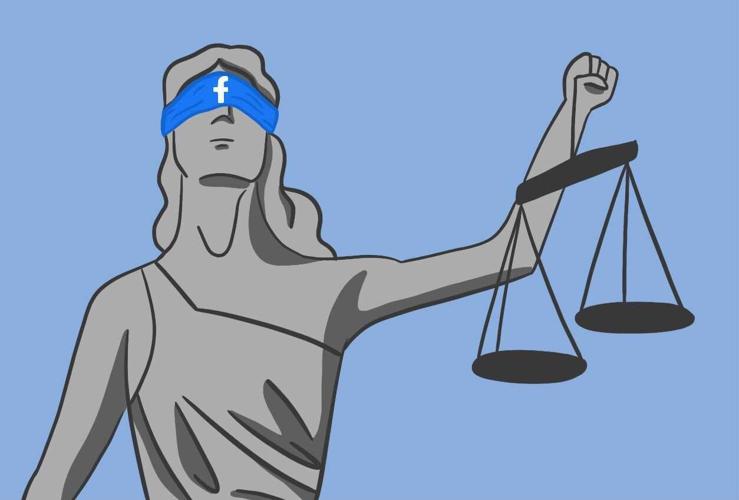
Now, she’s tackling a new position as one of 20 members worldwide on Facebook’s Oversight Board, the platform’s recently developed justice system that began operations in 2020, which is a part of the decision on whether to allow former President Donald Trump’s return to the social network that boasts over 2.8 billion average monthly users.
“She was superb. Good thinker, good strategic thinker, one of the nicest (people) you’d ever want to meet,” Gajarsa said of the legal scholar specializing in freedom of expression and international human rights law. “I believe she will be a leader on that board. … She will be able to hold her own and argue for the positions that she believes in.”
Aswad and the Board

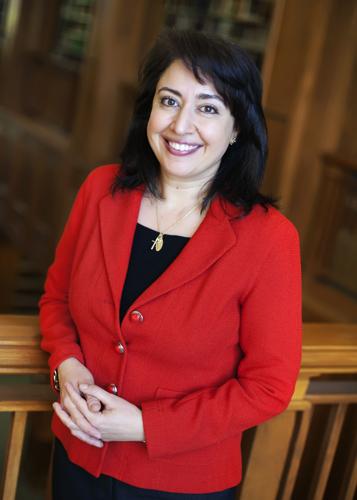
Evelyn Aswad poses at the OU College of Law.
Around 24 years after her work with Gajarsa and after 14 years as an attorney in the Legal Bureau at the U.S. Department of State, Aswad serves as a professor and Herman G. Kaiser Chair in International Law for the OU College of Law. She was appointed to the Facebook Oversight Board in May 2020, after vetting from an international law firm and multiple interviews.
Aswad wrote in an email she’s been focusing on issues of online expression since joining OU’s law school. In 2019, while serving as the director of OU’s Center for International Business and Human Rights, she hosted a town hall meeting at OU Law on the formation of the Oversight Board, which she said attracted her to apply.
“I have been very concerned for many years about the rising concentration of power over human discourse in corporate entities and what that means for the future of freedom of expression online,” Aswad said in an email from October 2020. “I have been writing and speaking about how platforms need to be more transparent in their content moderation and why they need to respect freedom of expression and other human rights in their operations, so this position was of interest to me as the Oversight Board will be seeking to achieve these types of goals and I wanted to be a part of that.”
Envisioned as a “Supreme Court”-like structure by founder Mark Zuckerberg in a 2018 interview, the Facebook Oversight Board is “empowered to select content cases for review and to uphold or reverse Facebook’s content decisions,” according to its website. The goal of the board is to rule on “select cases” that are “highly emblematic” to determine if content review decisions were made in accordance with the social media giant’s outlined policies — not as an extension of Facebook’s existing content review process, which already employs 15,000 people to moderate millions of posts from its billions of users.
Aswad wrote in an April 2021 email the board deliberates with a panel of five members for each case, with the composition of each panel remaining confidential. However, all board members are allowed to comment on a case’s drafted opinion after its designated panel has come to a decision and before the finalized opinion is issued.
“The idea is to create a separation of powers,” Zuckerberg said in a 2019 discussion. “So that while Facebook is responsible for enforcing our policies, we aren’t in the position to make so many decisions about speech on our own. This board will be tasked with upholding the principle of free expression while ensuring we keep our community safe.”
Kate Klonick, a St. John’s University assistant professor of law, “spent over 100 hours interviewing and researching the Governance Team at Facebook which created the Board from May 2019 to May 2020,” according to her website. In an article on this research published in the Yale Law Journal, Klonick explains that the board has “great potential” to inform similar decisions in the governance of other private internet platforms.
“Global events demonstrate that freedom of speech can no longer be separated into two separate worlds — one online, the other offline,” Klonick stated in the article’s conclusion. “The Oversight Board marks the first platform-scaled moment of transnational internet adjudication of online speech. It signifies a step towards empowering users by involving them in private platform governance and providing them with a modicum of procedural due process.”
Gajarsa agreed that the new board has the potential to set the tone for other areas of internet governance.
“I think it's one of those areas where we're still trying to function and determine the total parameters that we need to have — what are the safeguards in something like that?” said Gajarsa, who has kept in touch with Aswad over the years. “We need some guardrails, and those guardrails have to allow for the appropriate dissemination of information, but at the same time maintaining eligibility, maintaining propriety, maintaining truth.”
The Oversight Board has been a cause for controversy in recent weeks, with the Board’s decision on whether to permit Trump’s return to the platform expected May 5.
Trump was indefinitely suspended from Facebook and Instagram on Jan. 7, a day after his account was given a 24-hour post block the day of the Capitol riots, with Zuckerberg stating in a Facebook post “the risks of allowing President Trump to continue to use our service during this period are simply too great.” The case was referred to the Oversight Board on Jan. 21, with Facebook Vice President of Global Affairs Nick Clegg explaining the organization felt it was important — given the suspension’s significance — for “the board to review it and reach an independent judgment on whether it should be upheld.”
Although Aswad cannot say what cases she’s worked on, she said she’s enjoyed the work so far.
“It’s been really interesting to work with people from around the world on the Oversight Board and to launch a new institution in the midst of a global pandemic when we can’t even travel to meet in person,” Aswad said. “Our cases so far have involved regions and conflicts from around the world. It’s been fascinating to learn more about Facebook’s content moderation practices, situations around the world, and to try to apply an international human rights framework to all this with a very talented group of professionals.”
Before the Board
As one of 20 members from across the globe on the Oversight Board, Aswad is one of only five members from the United States.
Members on the board vary from a Nobel Prize Laureate and a former prime minister of Denmark to academics from various backgrounds — but Aswad is no stranger to working with diverse people with varying expertise. Before coming to OU in 2013, she spent 14 years as an attorney with the U.S. Department of State, most recently as the director of the Office of Human Rights and Refugees.
According to her OU College of Law bio, she served as a State Department legal adviser for U.S. delegations in multiple forms, including the U.N. Commission on the Status of Women and the U.N. Human Rights Council, among others.
Aswad has taught previously at the State Department’s Foreign Service Institute for U.S. Diplomats, along with her time as an adjunct at Georgetown’s School of Foreign Service as well as its Law Center, where she completed undergrad in 1992 and received her law degree in 1995.
“I went to law school knowing in my gut that I wanted to practice in the field of international human rights law given there is so much injustice in the world and I wanted to make a positive impact,” Aswad said. “When I worked in the human rights law office at the State Department, a growing issue involved how to deal with powerful multinational corporations that were not subject to human rights law because they were private actors (rather than governments). I really enjoyed working on those issues about the intersection of private corporate power and human rights law. While at State, I also got to work on a lot of negotiations at the UN to protect freedom of expression worldwide, which I found really fulfilling.”
She worked as an associate at Arnold & Porter after law school, eventually coming to clerk for Gajarsa in 1997. There, she met Joseph Cianfrani, a fellow clerk who now serves as a partner at intellectual property and technology law firm Knobbe Martens in Orange County.
“She is always smiling. She always has a positive attitude, things like that, that made her a pleasure to work with,” Cianfrani said. “(One thing) that struck me was her empathy and compassion for the litigants, and this is while we were clerking that very first year. She had a way of approaching legal problems that were very human-centric … but even for patent cases, I was always impressed at how she approached the problem by looking at the person behind the case, and that was an eye-opening approach that I haven't forgotten to this day.”
Teaching to Tech Law
After years of service at the State Department, Aswad pivoted to teaching some of the issues she spent her career mediating — something Gajarsa said she’d always been drawn to. Pursuing the interests of corporate responsibility and freedom of expression in her scholarship, along with teaching and service at OU Law, is how her multifaceted career led her to the Oversight Board, she said.
“I was interested in coming to OU because the students and faculty seemed really great and because of the opportunity to grow programming on human rights and corporate responsibility standards,” Aswad said of the OU College of Law, which tied for 67th in U.S. News and World Report’s Law School Rankings. “I was also interested in having the chance to think more deeply about the international human rights issues that I was exposed to when I worked as a lawyer at the State Department.”
OU President Joseph Harroz, former dean of the OU College of Law, was part of the team that first recruited Aswad to come to OU. During a May 2020 meeting of the OU Board of Regents, Harroz recognized her appointment to the Oversight Board.
“She brings so much in the classroom, so much to the research she does and now so much in her service to society in this important role,” Harroz said. “She is also a terrific person. If you get a chance, you ought to meet her. She is a stunning example of who we are.”
While maintaining her professorship and her position on the board, Aswad is a member of the Council on Foreign Relations and the American Law Institute, while also serving on the Advisory Committee on International Law to the U.S. Department of State’s Office of the Legal Adviser — all making for a busy schedule that has required her to stay organized.
This semester, Aswad has been teaching two courses: International Business, Human Rights and Corporate Responsibility along with a Human Rights Practicum. Luckily, the work in her classes has been pertinent to some of the work she does with the Oversight Board, with her students this semester tackling research on deep fakes and the monetization of personal data, among other issues.
“Board members are expected to have full-time jobs outside of their board duties so the workload is structured to reflect that expectation,” Aswad said. “Working as an Oversight Board member has kept me sharp on technological issues that help me in teaching experiential courses at the intersection of technology and human rights. … It’s been a blast to see all the great insights our law students bring to this emerging field of business, technology and human rights.”
In being appointed to the board, Aswad said she’s remembered many lessons from her days clerking for Gajarsa, “especially regarding having the courage of one’s convictions.”
“We’ve kept in touch over the years all the time, speak about life in general, about the law, some of the issues that have come up in the legal community, ethics and character needed to provide for the development of legal skills,” Gajarsa said. “It’s been a very very good relationship with Evelyn, I’d say she’s one of the finest teachers of not only privacy but also human rights.”
With the massive implications the governing board has in serving a platform of over 2.8 billion average monthly users, Gajarsa believes his former law clerk will add an important perspective to the group.
“What she brings to the board, I believe, is a moral compass. And she will be able to go toe to toe with anyone else on that board because she is intelligent, she will review (the issues) and consider them properly on both sides,” Gajarsa said. “She’s a great people person who brings balance to the board.”


