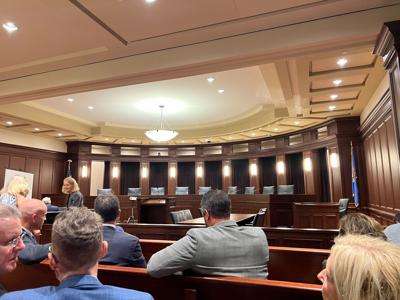

Pike Off OTA and the Oklahoma Turnpike Authority attorneys presented their arguments to an Oklahoma Supreme Court referee Tuesday morning during a hearing regarding OTA’s request to approve a $500 million bond issue.
The bonds, if approved by the court, will support preexisting turnpikes and all projects included in ACCESS Oklahoma, a 15-year, $5 billion infrastructure project that includes the construction of new turnpikes and updates to current roads.
Referee Kyle Rogers heard from both sides’ attorneys along with any objections from the public. Rogers will consider documents filed with the court and Tuesday’s presentations and deliver an opinion to the nine Oklahoma Supreme Court justices who will later announce their decision in the case.
In a lawsuit filed in May, Pike Off OTA, an anti-turnpike grassroots organization claimed in a lawsuit that the OTA is in violation of State Statute 69 Section 1705, which authorizes where the OTA can propose a toll road. Later that month, over 150 Cleveland County residents filed a separate suit claiming the OTA violated the Open Meeting Act.
Lawyers for plaintiffs in both cases spoke to Rogers, though the majority of the discussion was focused on the Pike Off OTA’s claims, which were centered around three ACCESS Oklahoma projects: the Tri-City connector, the East-West connector and the South Extension turnpike, which would run through much of East Norman.
Robert Norman, attorney for Pike Off OTA, argued in the hearing that the Oklahoma state legislature, which grants the ability for OTA to build new turnpikes in specific areas, did authorize the Tri-City and the East-West connectors in 1989 as long as they were completed using funds from that specific bond issue. Only parts of the four turnpike projects were complete.
Norman argued because the South Extension turnpike route would end in Purcell instead of Norman, it isn’t authorized anywhere in the statute or by the legislature, even though it appeared in House Bill 1459 and Senate Bill 371 in 1999. Those bills, according to Norman, failed.
Norman then said David Streb, OTA engineer and current president of Poe and Associates, an engineering firm working on the ACCESS Oklahoma plan, called the South Extension turnpike “dead” in 2000.
The OTA presented before Norman, with attorney Jered Davidson arguing that there was “no question” that the routes were properly authorized by the legislature. Davidson also said the courts and legislature did not require the completion of any project from 1987.
Davidson called Pike Off OTA’s interpretation of the statute “absurd,” saying the OTA has authority to break up projects for feasibility and the sole ability to design routes as it sees fit. He referred to the Supreme Court’s approval of the Kickapoo Turnpike in 2016, which faced similar objections that the Cleveland County projects currently face.
After Davidson, Norman presented a series of newspaper articles dating back to 1987, which showed that the OTA had struggled to complete the four-project plan, as the project became too expensive.
Using these articles, Norman argued that OTA officials understand that they had to complete all four projects within the current bonds, or they would not be complete at all.
Norman then said there was “no question” the routes weren’t authorized, quoting the statute’s description of a turnpike that begins at the H.E. Bailey Turnpike and ends “to a point” within Norman city limits.
On Sept. 8, the city of Norman filed a brief in support of the opposition toward the turnpike project. John Dorman, the city’s attorney from an outside law firm, presented the brief in court. Dorman argued that the issue at hand is actually a “separation of powers” problem.
Ward 5 Council member Rarchar Tortorello, who represents several residents impacted by the turnpike at the city level, told the Daily after the hearing that he believes the city of Norman’s filing impacted the case “tremendously.”
“(The council) was asked to do something to protect our citizens and we produced a protest brief that actually did that,” Tortorello said. “We were there on day one. (The) council, one thousand percent, is behind all the citizens.”
Elaine Dowling, Norman’s co-council, filed an objection on behalf of John McKay, a Norman resident. McKay spoke before Rogers, saying he and his wife moved from Texas to Oklahoma in 2020. Using money he had saved dating back to his service in the Vietnam War, they purchased a home they could “age in.”
“These are the dollars I bled for, physically bled for in Vietnam,” McKay said. “I thought I had fought for democracy, but (Davidson) says I was wrong.”
Other residents also appeared before Rogers, including Pike Off OTA board member and civil engineer Amy Cerato. Cerato asked the court to deny permission to sell bonds, citing the Norman 2025 Land Use and Transportation Plan’s intent to keep east Norman rural.
Former District 91 State Representative Mike Reynolds said at the hearing that while campaigning for his 2002 election, constituents' main concern was a turnpike following the situation in 1999. Reynolds recalled Streb calling the South Extension turnpike “dead,” adding that after attending the hearing today, the project “wasn’t as dead” as he thought, encouraging denial from the court.
Davidson was given time for rebuttal, where he said all arguments from all sides prove the state cannot support the infrastructure it currently has, citing that as a need for this bond issue. Further, he said those requesting for denial are asking the court to overturn 70 years of previous rulings.
After the meeting, Norman and Dowling said no matter how the court may rule, they feel their case has been vindicated.
“We feel we’ve made our point that representative democracy and the rule of law should control, and we’re ultimately confident it will control,” Norman said. “I believe, however this turns out, this has been a signal to the legislature that they need to rein in the OTA.”
There is no date set for when Rogers will give his opinion to the Oklahoma Supreme Court or when a decision will be reached.


