



First-time budgeting tips
Nobody really teaches you how to talk about money in college, so you figure it out alone, usually the hard way.
I still remember blowing through meal points freshman year, scrambling at the end of the week to exchange a pile of leftover swipes before campus dining closed. Once I moved off the meal plan, it got worse before it got better — I'd buy groceries with good intentions, eat out instead and then throw out the spoiled groceries, basically paying for the same meal twice.
Budgeting in college isn't like budgeting anywhere else. Your student loan disbursement or refund might come as one lump sum that has to last four months, and you're supposed to figure all of it out while also going to class. For students with meal plans, budgeting looks different because you're managing points, exchanges and dining hours instead of normal grocery spending.
Here's what we wish someone had told us about stretching a meal plan, when grocery shopping beats campus dining and the small habits that make a real difference by the end of the semester. A dollar saved is a dollar earned, after all.
That's why we're launching this new monthly personal finance newsletter sent to students like you who are early in their college careers. Sign up for our newsletters here.

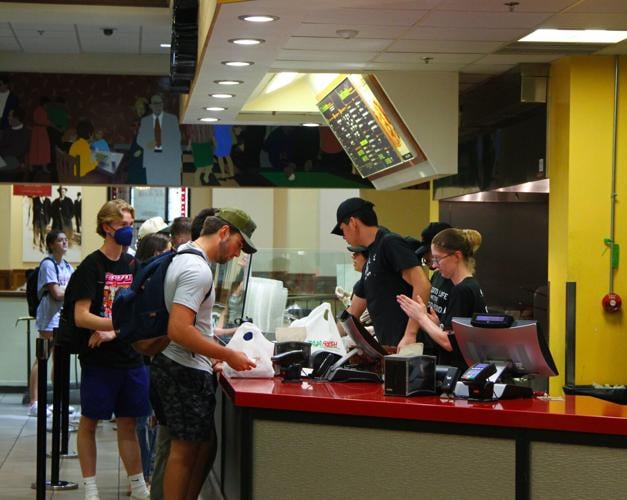
Students order food from Baja Fresh in the Oklahoma Memorial Union.
The OU student guide to not running out of money (or meal points) too early
College money, and meal points, disappear faster than you think. Not every student is in the same boat, though: some are working with a meal plan and swipes, some are buying their own groceries, some have a paycheck coming in and some are living off aid and loans.
Here's how to stay ahead of your spending, no matter which situation you're in:
Know your needs vs. wants (all students)
Before anything else, split your spending into two categories: needs (rent, groceries and gas) and wants (eating out, entertainment and impulse buys).
A simple tool many financial advisors recommend is the 50/30/20 rule: 50% of your income toward needs, 30% toward wants and 20% toward savings.
Realistically, most student budgets skew a lot more toward needs, which is normal, not failure. "Income" isn't just a paycheck. Financial aid refunds and scholarship money count, so factor those in, not just what you make from a job.
If you have a meal plan (on-campus students)
Meal points feel unlimited, until suddenly, they're gone. Many students overspend because they don't pace their points or they avoid dining halls.
What drains points fastest:
• Convenience stores and late-night options: high-cost snacks add up quickly.
• Skipping dining hall hours: using points instead of swipes.
• This is especially easy at the Oklahoma Memorial Union. Spots like Chick-fil-A, Starbucks, Baja Fresh and Quiznos don't accept Meal Exchanges until 2 p.m. on weekdays, so eating there earlier in the day means you're spending points instead of swipes.
• Not checking your balance: you lose track of how fast points are spent.
• Check your balance in the Transact eAccounts app (iOS and Android): it shows your meal points and recent activity. If you've added your Sooner Card to your phone's wallet, the balance shows up there, too.
Habits that make points last:
• Break your points into a weekly budget.
• Divide your total points by the number of weeks in the semester.
• For example, if you have 750 points, that's roughly 44 points per week.
• Use swipes for your biggest meals of the day.
• Breakfast or lunch give you the most value.
• Eat bigger meals earlier in the day and smaller ones later. Dining halls run on set hours, so eating your biggest meal at breakfast or lunch means you're using a full meal ($17 value) instead of a meal exchange ($13 value) later on. A late, heavy dinner can impact sleep quality.
• Save points for snacks or smaller meals later in the day.
• Use the OU Food Pantry.
• Pantry staples help you save points for meals instead of snacks.
Sponsored by OU Federal Credit Union:


Cereal in the Walmart on Classen Blvd and E. Constitution Street.
No meal plan? Meal prep is the way to go (off campus/groceries)
• Use college student discounts.
• Target Circle: Verified students get 20% off one purchase from July 5 to Sept. 12 — good for dorm supplies, groceries, toiletries and cleaning products.
• After that, you still get rotating student-friendly deals through the app.
• Big-box stores like Sam's Club and Costco also offer new-member student discounts if you're splitting a membership with roommates.
• Shop where the prices make sense.
• Look up prices online before you go. Most stores list inventory and pricing on websites or apps.
• Checking first can save several dollars per trip, which adds up over a semester.

OU President Joseph Harroz Jr. speaking to student employees.
If you have income (part-time job, work study)
Budgeting with a student paycheck is hard, with income changing every month, fixed rent and the temptation of spending with friends.
What causes overspending:
• Not tracking paychecks: money feels "extra" until bills hit.
• Subscription traps: forgotten $10/month charges can add up to $120-$240 a year.
• Lifestyle inflation: spending more just because you're earning more.
Habits that help:
• Track your money weekly.
• Avoid borrowing from next week's paycheck.
• Build a small emergency fund. Even $5-$10 a week builds stability over time.
If you don't have income (off campus or no job)
Students without jobs still need to budget, but the "income" often comes from financial aid or student loans.
What makes this tricky:
• Loan disbursements come in lump sums.
• It's easy to overspend early in the semester.
• Overborrowing is common and many students don't think about future repayment.
Habits that help:
• Treat loan refunds like a paycheck.
• Break the semester into monthly budgets so the money lasts.
• Track your spending manually.
Habits that help everyone
No matter your situation, the most important budgeting skill is simple: track your money.
• Once you know where your money goes, you can control it.
Keep your student ID in your wallet or on your phone wallet.
• Places in Norman and Oklahoma City offer student discounts.
• Asking at checkouts: restaurants, coffee shops, hair/nail salons, thrift stores and local retail spots will knock a few dollars off just for showing your ID.
Check for student pricing on entertainment.
• Many venues, streaming services and local spots offer a discount just for flashing your student ID, the same way grocers and retailers do. It's worth asking.
This story was edited by Reagan Rozzi.


