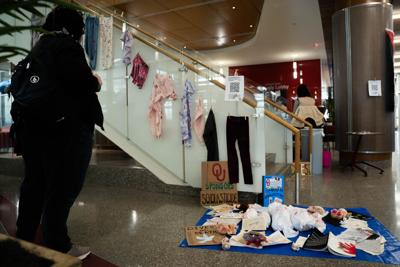

Students for Justice in Palestine held an art demonstration in Gallogly Hall demanding disclosure and divestment from OU on Tuesday. The event was part of a larger day of action called for by the national organization.
OU SJP is a local chapter of the National Students for Justice in Palestine. According to its website, SJP "seeks to empower, unify, and support the Student Movement for Palestinian liberation."
The art demonstration consisted of clothes, stuffed animals, school supplies and other common children’s belongings which were torn and covered in fake blood and sheets. There were also banners and signs calling for OU to divest and for students to avoid working for companies associated with Palestinian genocide and occupation.


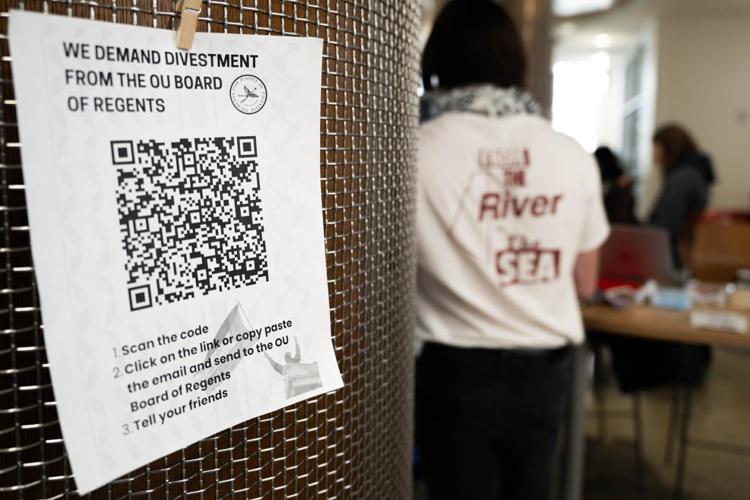
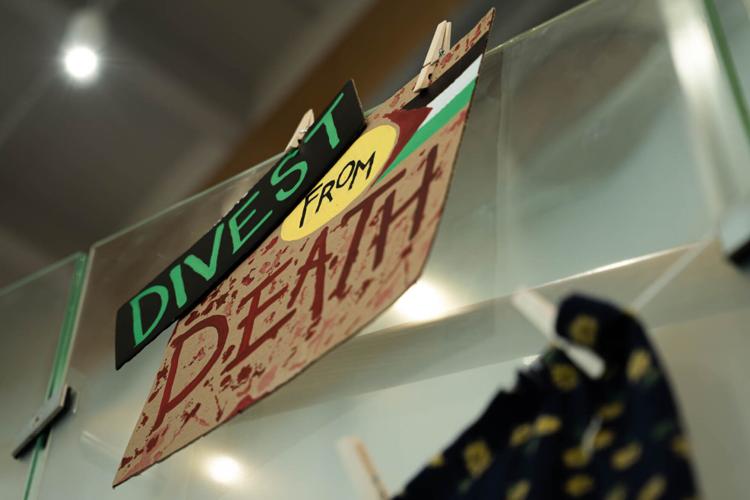

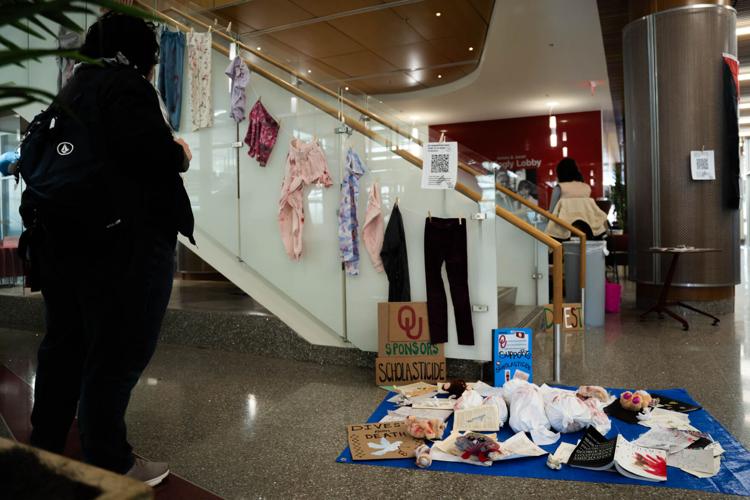


PHOTOS: Students for Justice in Palestine Art Demonstration in Gallogly Hall
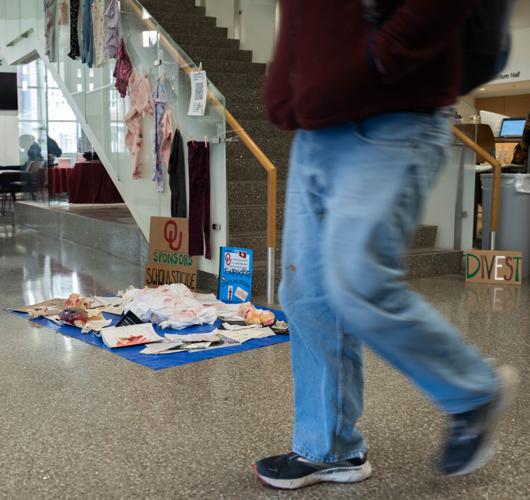
A person walks past the Students for Justice in Palestine art demonstration in Gallogly Hall on Jan. 21.
A health science major and SJP member who asked to only be identified by the name Yasmin said SJP chose to utilize children’s belongings in its demonstration to commemorate the children killed during the war in Gaza.
“This is an attack on children," Yasmin said.
Abraar Hassany, history senior and SJP media liaison, said the goal of the art is to foster visibility and raise OU student and faculty awareness of the connection between the university’s investments and the exploitation of workers and resources overseas. He wants people to see the art demonstration and understand the lives it represents are someone’s colleagues, students and peers. The art was also chosen because of its representation of "scholasticide."
Cruz Richardson, an international studies and Arabic major and SJP member, said scholasticide is “the mass destruction of education institutions.”
According to Richardson, this applies to the harming of universities and schools as well as the deaths of faculty. He said the term is tied to genocide due to its background in the dismantling of education as both an establishment and an idea. Richardson said scholasticide is not only when people are prevented from becoming students but also when they’re harmed if they do become students.
“There are no universities and no schools left in Gaza,” Richardson said.
Hassany said SJP is calling for transparency of university investments, whether the money is coming from student tuition or alumni donations. Hassany shared that they are especially interested in finding out where the money goes when it comes to contracts with certain companies.
“What kind of humanitarian consequences are there for OU money?” Hassany asked.
SJP called on the OU Board of Regents to divest from companies that have supported the genocide and occupation of Palestine. SJP urged the administration to question if its investments are sustainable and to consider the deaths in Palestine and the consequences that the exploitation of overseas resources and workers has on the state of the planet.
Divestment would be gradual, according to Richardson.
“SJP does not expect a 100% divestment from any university,” Richardson said.
Richardson said SJP asks that each year the administration divests a growing percentage of funds from companies like Lockheed Martin and Chevron. Throughout this process, the university would find alternative companies to provide services. These alternative companies would be unrelated to the genocide and occupation of Palestine and would not rely on the exploitation of overseas resources and workers to provide their services.
Hassany is trying to change the idea that OU students and faculty have no ties to what is happening in Gaza. Hassany referenced the materials students and faculty use in university labs, especially in Gallogly Hall, which often come from places like Palestine. He said resources and labor are being exploited for these materials.
Hassany believes Palestine serves as an example of U.S. politicians supporting “ineffective policies” and the misuse of student money. Hassany cites his dislike of the idea that his tuition supports the killing of people he considers his brothers and sisters. The connection between OU students and people in Palestine is deepened by international students who have families in Palestine, he explains.
This day of action follows a ceasefire that was established in Gaza Sunday. However, Hassany said SJP is far from done.
“The fight for colonial liberation across the world is not over, especially not in the Palestinian case,” Hassany said.
On Tuesday, SJP also began an email campaign to the OU Board of Regents, asking all students and faculty to share their thoughts on the war in Gaza while calling for disclosure and divestment.
SJP hopes the email campaign will help the organization play a role in the upcoming regents meeting, in which the regents will be discussing certain portfolio investments. However, SJP members want people to know the work is not only for university leaders, and students also have a responsibility.
“The number one goal we have today is to convince people (they) exist as a larger global community," Hassany said. “These are long struggles and they require a deep sense of solidarity between all students, workers and people of conscience in the United States, Europe and all across the world.”
This story was edited by Anusha Fathepure and Ismael Lele. Kylie Caldwell and Grace Rhodes copy edited this story.


