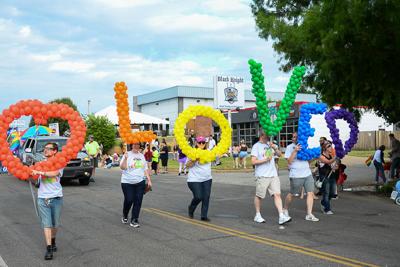

A large crowd of people dressed in all colors and styles attended the Oklahoma City annual Pride Parade Sunday evening. People of all sexualities and gender identities attended hoping to catch a free T-shirt or beaded necklace. For some OU students, however, the Oklahoma City Pride Parade was about more than just signs and freebies. It was about appreciating the history behind Pride.
“It was my first Pride since coming out, which was a really big deal,” Elaina Fees, women’s and gender studies and nonprofit administration sophomore, said. “It was just really liberating. It was really nice to just be out there with people that are like me.”
Dib Quab, incoming OU freshman, said it was their first Pride, as well.
“(Pride was) amazing,” Quab said. “It was so emotional for me, and I’m just so glad that there’s an event like this in OKC that we can all attend.”
The parade featured floats and people carrying signs that said “Celebrate love,” “Black lives matter” and “God loves all his children.”
Among the many floats in the parade — including gubernatorial candidates, local businesses and Miss Gay Oklahoma pageant winners — was an Oklahoma City Public Schools bus decked out in rainbow streamers, accompanied by OKCPS teachers and students.
“Having the public school system involved was very, very, very powerful,” Fees said. “ I had a friend who reached out to me who said — because I posted on Snapchat — that was her old middle school teacher who was right at the front of their march. I think that’s so important.”
Quab said Pride goes beyond celebrating marriage equality.
“My favorite part (of Pride) was seeing that there was so much solidarity within the reminder of ‘Hey, you gotta remember the roots of Pride and Stonewall,’” they said. “Stonewall was a riot, and we’re here because of black trans activists.”
On June 28, 1969, members of the LGBTQ community rioted after a police raid at the Stonewall Inn in New York City targeted especially vulnerable members of the gay community, including transgender people of color. In June of 1970, cities across the country hosted the first Pride marches in commemoration of the Stonewall riot.
“Historically, it’s important to remember that the first Pride was a march against police violence,” Fees said. “It was definitely to stand up for queer people of color and black and brown people who have been historically targeted.”
Fees thinks modern Pride parades have begun to stray from the original intent of the event.
“It is really interesting to kind of see how (Pride has) morphed,” she said. “When you’re at Pride, you’re like, ‘Oh, I love all this gay s—t, I love being able to celebrate and be myself,’ but also you see a lot of police there, and it’s one of those things that’s really difficult.
“I understand that you need to have (police for) safety, but there is a point to kind of understand and take a moment and step back and realize why we’re here and what we’re doing,” Fees said.
Earlier this month, the intersection of race, sexuality and gender identity became a louder conversation when organizers of the Philadelphia Pride parade decided to add a black and a brown stripe to the Pride flag in order to recognize LGBTQ people of color.
“The black and brown stripe was added to Philadelphia’s Pride flag because so much of these events were very white-centric,” Quab said. “There was not a lot of inclusiveness with people of color, even though this movement started with people of color.”
Kieren Alvord, women’s and gender studies sophomore, said many floats at the parade held up signs that said “Remember that the first Pride wasn’t about marriage equality, it was about police brutality” or “Black Lives Matter.” Other groups marched through the parade shouting “Resist!”
“It’s good and important to have a place where you can go and celebrate and be yourself and just have a fun day, because there are a lot of not fun days, but recognizing historically what Pride was and how it has been and its roots and black trans activism (is also important),” he said. “You can blend the two things. You can have a fun Pride parade and also have protest-y and activist-y things in there with it, and it doesn’t detract from (Pride).”
Above all, the Oklahoma City Pride parade was a place for people to feel accepted, be surrounded by a supportive community and bring attention to important issues.
“(Pride is) the one day of the year where I don’t have to feel bad about myself,” Quab said. “Everyone throughout the entire year tells you, ‘You’re not supposed to be this, this is wrong, this is bad,’ but you get this one day out of the whole year to be around people who are like you, who support you, and it’s very uplifting. It helps me get through the year.”


