
If you were to visit any national collegiate debate tournament in the last 50 years, you would probably see many things in common: lawyers-in-training, expensive suits, prickly judges and more.
Unfortunately, you would also find something troubling: racial prejudice.
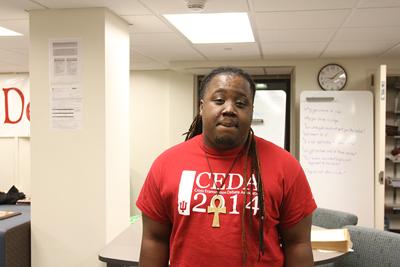
However, at the National Debate Tournament held at Indiana University last month, OU student Rashid Campbell made a stand against the white-dominated collegiate debate society by becoming the first African-American to be named First Speaker in the tournament’s 67-year history.
“(That) means that, out of all the 160 people at the tournament, (Campbell) was ranked No. 1,” said Jackie Massey, the coach of OU’s Shannon Self Debate Team.
However, Campbell’s success has not come easily or without controversy. A recent article in the Atlantic called into question the successful use of non-traditional forms of debate — like poetry, rap or dance — by African American debaters, including Campbell.
“Debate, specifically policy debate, was created by white people and is used in a very 'white' way,” Campbell said. “The problem is that different cultures have different ways of thinking about how things should be done."
“When I did poetry ... people didn’t necessarily think about it as intellectual,” Campbell said. “But there’s a lot of regurgitation in traditional debate ... it’s like the same conversation over and over, and while it may be intellectual, it’s definitely not unique.”
Campbell and his debate partner George Lee were semifinalists at the NDT, losing to the ultimate winner, Georgetown University. However, two weeks before, they had made it to the final round of the Cross-Examination Debate Association Championships, a far less exclusive tournament with more unorthodox participants.
“The article in the Atlantic is a manifestation of how the old, traditional debate community is dealing with the changes that come with the integration of students of color,” Massey said. “There are teams that are used to winning everything, but ... today, their styles are old and archaic. So, this (controversy) exemplifies the fear these schools have of the changes that are occurring.”
Campbell is no stranger to these sorts of struggles. Before attending OU, Campbell attended Skyline High School in Oakland, Calif., a once all-white school that saw an influx of minority students from poorer neighborhoods.
“When kids from the Flats (Oakland’s lower-income neighborhood) started coming to Skyline, it became a pretty rough school,” Campbell said. “You saw a lot of kids coming to school and not worrying about classes because they were more worried about how they were going to eat.”
Campbell understands this better than most — he was homeless for most of his junior year of high school. When a student debate camp opened in the summer, Campbell attended not because of the debate but because of the free food the camp offered.
However, during his senior year, Campbell went to the Bay Area Urban Debate League Championships in Berkeley, where OU alumnus and former debate champion Blake Johnson saw him perform. Johnson told Massey about Campbell’s obvious talent, and Campbell successfully applied for a full debate scholarship to OU.
“(Campbell) went from being homeless in East Oakland to being the top speaker at the most prestigious national tournament in the country,” Massey said. “People like him fight an uphill battle before they even get to the tournament, and then, when they do so well, they’ve got to be exceptional."
Massey said instead of people attributing wins to the fact that they are intelligent, they are discredited by saying the only reason for their win is because they are black.
However, last year, a team from Emporia State University became the first black team to win the tournament. This, coupled with Campbell’s victory, may mean things are beginning to change.
“What policy debates are about, how people think about them — I didn’t change any of that,” Campbell said. “What I think I changed is the perspective of what should be included — people who come from backgrounds similar to mine, they can see themselves as being able to compete.”


