
College students have always been at the forefront of social change. It is no different at OU; in the fall 2016 semester alone, there have been multiple protests and demonstrations against perceived injustice.
On Sept. 22, students planned a die-in in the Oklahoma Memorial Union to protest the shooting of Terence Crutcher by a police officer in Tulsa. They filled the Union food court with chants of “Black Lives Matter” before laying on the floor in silence — living, but playing dead to protest the disproportionate killings of people of color by white police. The students wore all black and carried signs.
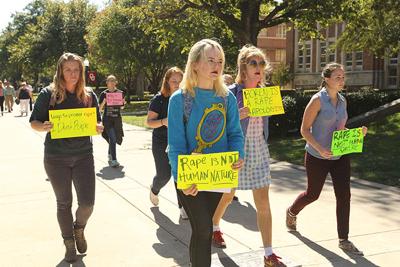
On Oct. 11, students gathered and marched to Evans Hall to protest OU President David Boren’s statements about sexual assault in a Daily article. Boren told The Daily the problem of campus sexual assault cannot be eradicated “any more than we can eradicate human nature.” The activists, led by sociology sophomore Kelsey Morris, presented a list of demands — including a sincere apology and reassurance that Boren believes women who claim to have been assaulted. Boren never apologized, standing firm in his belief that readers misconstrued his words.
On Oct. 14, students marched from campus to Main Street to protest State Question 777, which they claimed would harm the environment if it passed.
Nov. 9, there was a march in protest of president-elect Donald Trump. Students wore black and marched from Dale Hall to the Bizzell Memorial Library. All students who felt marginalized or threatened by Trump were encouraged to attend and wear black.
And on Nov. 16, a large counter-protest clashed with anti-Black Lives Matter demonstrators on campus.
There have also been multiple rallies in solidarity with the Standing Rock Sioux Tribe, who have been camping since April in protest of the Dakota Access Pipeline and in opposition to the Plains All American Pipeline constructed during the summer that runs partially through Norman.
Throughout the semester, student activists have also used the Twitter hashtag #yOUrbad to shed light on issues on campus, including campus climate, details about specific events and statements from administrators. The hashtag is used to show what experiences on campus are like for marginalized communities.
Each of these protests has been student-led, although in some cases, faculty also participated.
“(Student activists) were the seeds that we planted, and now they’re full bloom. They’re shedding light on things, and they’re shading other things that need not be so prominent, such as hatred,” said George Henderson, professor emeritus of human relations. “I could not speak more proudly of the students today.”
Henderson was one of those students himself, although he wasn't involved until after he received his bachelor’s degree from OU. Before joining OU’s faculty in 1967, he was active in the Civil Rights movement of the 1960s. When he began teaching at OU, he was only the third full-time African American professor. He was also the first African American property owner in the city of Norman.
“According to The Oklahoman and other papers — the Tulsa World — I was the first professor to say that I joined the faculty at a racist university, situated in a racist community, in a racist state, in a racist nation — but we will do better,” Henderson said.
No one heard the last part of that statement, Henderson said. The promise to do better was often lost in the idea that the nation was racist. His willingness to be “the first big-mouth activist” professor made him the face of change in Oklahoma, regardless of his personal feelings.
The culture of student activism has existed at OU for far longer than one semester, but rarely have there been so many individual demonstrations against specific policies or ideas. The fall 2016 semester brought an increased level of activism and a shift in how that activism is carried out.
In March 2015, protests against the racist Sigma Alpha Epsilon fraternity chant were spearheaded by a group of students of color called Unheard. During the fall 2015 semester, activism for Native American students fell under the banner of Indigenize OU.
This semester, however, the protests have been mostly organized by individuals.
Taylor Sanchez, a film and media studies sophomore, is one of those individuals. Before coming to OU, she organized activism in her hometown of Grand Rapids, Michigan. Although she has been in Norman less than a year, she co-organized one of the most notable protests of the semester — the die-in after the killing of Terence Crutcher.
Unlike Henderson, who believes an effective protest is defined by clear, long-term goals, Sanchez believes occupation is the most effective tactic. Her goal for the die-in was to take up space and cause disruption in order to force bystanders to pay attention.
“The goal with the die-in was not only disruption through holding the space hostage for four hours to force people to pay attention, but also blocking lines in the Union in order to make an economic impact,” Sanchez said.
Jabar Shumate, the OU vice president for the University Community, knew Terence Crutcher personally, and was present on the food court floor that day.
“It was a good experience to be a part of students mobilized for change and sending a message that ... things that are happening in and around us that relate to insensitivity or police brutality. We don't stand for that. We stand for inclusion and diversity,” Shumate said.
Sanchez is part of Revolutionary Baddies, a group of women of color who have a weekly radio show on KXOU that discusses social issues facing marginalized communities. The members of Revolutionary Baddies were also involved in creating the Twitter hashtag #yOUrbad.
“(Topics) range from talking about our own experiences to challenging mainstream narratives that overlook our issues. We also bring people in to get their insight,” said Angie Tran, a sociology senior who is also in Revolutionary Baddies.
Tran has worked to improve the visibility of issues facing the Asian-American community through her role as director of the Department of Inclusivity in the Student Government Association. She has also started a new student activism group called Uprooted to advocate for greater representation of Asian-Americans.
Henderson said activism will always be an important facet of change on college campuses.
"We have an opportunity to succeed or fail," he said. "That's what the civil rights movement was about. We might not succeed, but we have the opportunity to try."


