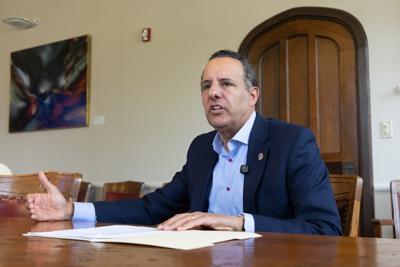


OU President Joseph Harroz Jr. sat down with OU Daily editors Monday afternoon to discuss housing changes at Traditions Square, growth hurdles and strategic plan updates.
Strategic plan
In 2020, OU launched “Lead On, University,” an eight-year strategic plan centered around five pillars for future growth at the university. OU announced a refresh of the strategic plan in 2025, incorporating both OU Health and OU-Tulsa into the planning efforts.
“Nothing’s perfect, but it’s going really well, …” Harroz said. “I’m really proud of what’s taking place.”
Harroz said a core tenet of the strategic plan is making education at OU more affordable and accessible, specifically citing growth in its first-generation student population. Of the total university enrollment, 28% is first-generation and 37% of in-state students are first-generation, according to OU Institutional Research and Reporting’s SoonerFacts reports.
“That’s my favorite statistic personally, because this idea of access to the American dream, to me, is huge,” Harroz said.
Harroz also spoke about the university’s increased investment in research. According to fiscal year expenditure reports, a total of $257,451,978 was spent in 2025 by hundreds of researchers across OU Norman’s campus. This was over $5 million more than 2024 and over $14 million more than 2022.
Harroz said OU Health, which launched an organizational redesign and merger in 2021, has expanded to serve the state’s needs. Oklahoma currently ranks 43rd in the nation for primary care provider availability, with rural and Indigenous communities facing severe healthcare shortages. OU Health is the state’s only comprehensive academic health system.
“OU Health has blossomed,” Harroz said. “And the state needs the help in a big way.”
Harroz said $80 million is going towards health research this year. He also said OU has increased the state’s capacity for patients by 50% the number of patients.
First-year, international student housing
Harroz said OU is currently experiencing its fastest growth on campus in the past 50 years. Since 2021, the university has welcomed a record-breaking first-year class each year. In fall 2025, the university marked its fifth consecutive record-breaking first-year class with 6,229 students, bringing the student body to 32,662 students.
The large increases in student population have generated concern that OU will not be able to meet housing demands.
The university currently has eight residence halls: Couch and Walker centers, David L. Boren Hall, Dunham and Headington colleges, Headington Hall, Cross Village and McCasland Hall, and two additional apartment complexes, Traditions Square — which has an East and West complex — and Kraettli Apartments. In the fall, OU will open the South Hall, a new residence hall on the former site of Adams Center.
The university announced in November that Traditions East will become strictly first-year housing, due to the large incoming first-year classes.
Harroz said the university plans to use both of the Traditions Square complexes to support students amid the lack of housing and parking as OU constructs new dorms for the increased enrollment. However, Harroz said using Traditions Square East and West is “transitional in nature.”
“My goal, and the general plan is that we wind up in a position where those two — we call them Traditions West and Traditions East — that those go back to traditional apartments for non-freshman, …” Harroz said. “That is the plan, but we have to see how growth goes and what the appetite is for expanding new housing through public-private partnerships.”
Traditions East, one of the closest apartment complexes to campus, has commonly been home to a large international student community, who require more accessible financial and transportation options when they arrive on campus. Scholarship packages for international students through the United World College program place students at any of the residence halls, with many upperclassman students choosing to stay at Traditions for its space, amenities and location.
Harroz said the university is working with international students to soften the impact of losing Traditions East to first-year housing.
“This does create a negative impact as it relates to the use of Traditions for some of them, and I’m not going to minimize it,” Harroz said. “The trade off here was: ‘How important is the first-year experience?’ and ‘Can we help international students as they go to the private marketplace for housing and not the university marketplace?’”
Harroz said the university is working internally and with the private market to identify options for alternative international student housing.
"I've asked David Surratt with Student Affairs and Housing as a whole to find vacancies that are available," Harroz said. "... It's imperfect but it's an effort to work with them on the housing that we have but also with those in the private sector that maybe want to house."
Harroz said using Traditions East as first-year housing will help relieve the pressure of parking concerns but will not provide a permanent solution.
“Is it perfect? No. We think we can do a lot with the shuttle service. We also know that it temporarily helps with parking, given these are freshman students that will be in Traditions West and (East),” Harroz said.
According to Harroz, the university will announce a new parking plan this summer to address the growth in recent years and anticipated future growth.
“Definitely hear the students’ concern and the faculty and staff — and not just one group of students, but on-campus students, commuter students and putting a lot of time into solutions for that,” Harroz said.
Harroz said the university is considering how it will expand into the rapid growth of recent years. According to Harroz, across all campuses, the student body is currently about 36,500 students and it will likely exceed 40,000 students in the next 18 months.
“Our obligation, and certainly our effort, is going into meeting each of those areas, from food services to quality of housing and the impact that first-year housing has,” Harroz said. “It’s not to say that they’re without growing pains, there are. Our goal is to make sure we understand them and meet them in a really constructive way.”
OU Bible-based essay controversy, appeal
In November, OU received state and national attention after a student contested a grade on an essay assignment, believing she received the grade because of her religious beliefs.
Oklahoma Gov. Kevin Stitt posted on the social platform X that the situation was “deeply concerning” and called on the OU Board of Regents to make sure other students weren’t “unfairly penalized for their beliefs.” Multiple state lawmakers in the spring also elevated pieces of legislation to regulate grading in higher education.
OU ultimately terminated OU graduate instructor Mel Curth’s instructional duties after an investigation which found Curth engaged in “arbitrary grading.” Curth has since filed an appeal with the Institutional Equity Office.
Harroz said while the university has concluded its official process, he understands the situation was impactful for students and continues to be. He said the main priority moving forward is to build a strong community.
“When these unfortunate realities of cultural divides come up, the job is not to avoid them, but to understand and learn from them,” Harroz said. “And so to us, it's always a tough question itself, and how you manage it. One of the lessons to our students is you're never going to please everybody, but the goal is that you go through a process and you act with a level of consistency and hopefully with a level of communication.”
State dynamics, funding
The Oklahoma State Budget Transparency Dashboard outlines allocations for the fiscal year 2027 budget, including higher education funding.
According to the dashboard, the Oklahoma Regents for Higher Education requested over $1.5 billion in state funding, and the Senate, House and governor have a proposed allocation of $1.1 billion. With the legislation still in session, a set budget has not yet been approved.
The budget comes two years after the state regents received $444 million less than it requested, leading to a substantial decrease in how much the regents would request in the following years.
Despite these changes, Harroz said the university’s relationship with the state Legislature is a positive one.
“The relationship with leadership has been really good, far exceeding what I thought it might be,” Harroz said. “They want to improve the state while they’re here, and they’ve come to understand the importance of research and making sure that higher education is promoted.”
The current agreement between the Oklahoma Senate, House and governor of $1.1 billion shows a relatively flat budget for the coming fiscal year.
Harroz said while a flat rate is not ideal, the state has invested in university projects, such as the new Life Sciences Laboratories Building and Stevenson Cancer Center, which he said has kept the university out of debt.
“Flat is not ideal, because we know that the costs aren’t flat. I mean, inflation is not theory. Inflation hits in a very real way, and it hits everything from our biggest expense, which is payroll, to cost of food, so let’s be clear, when there’s no increase in state legislature, it hurts.”
According to Harroz, the state gave OU $80 million to go toward the new Life Sciences Laboratories Building, $50 million for the Stevenson Cancer Center, among other projects, which Harroz said kept the university from going into debt.
Though he said the university still needs more funding from the state, Harroz said the one-time investments have been instrumental in OU’s development.
“Yes, it’s one time, but it avoids taking on debt that would last for 30 years,” Harroz said. “Yes, we need more to compete, and yes, the average amount we get per student is lower than our competitor states, and we’ll keep asking for those operating dollars, but the one-time things they’ve done have been incredibly helpful.”
Harroz said the state’s job is to provide opportunities for its citizens and access to higher education, healthcare and economic opportunity are the three simplest ways the government can support citizens. He said the university’s job is to prove it is deserving of financial investment.
He said compared to peer institutions and aspirational peer institutions in the Association of American Universities, there is room to grow, but he is grateful for efforts by members of the Legislature. In conversations with former legislators living in other states, Harroz said high performing public research universities are a significant driver of economic prosperity.
“Within the resources they have, they’re doing a good job — and hopefully we’re doing a good job — but, there really is more that can be done,” Harroz said. “Across the board, (legislators) will tell our leaders, the big secret to driving economic prosperity and better health in a state is to invest in high-performing public research universities.”
With this in mind, Harroz said his goal is to attract investments by being a high-performing institution.
“It’s our job to show that we can perform and to try and attract the investments that other states have made to lift the health and economic opportunity and prosperity of those states,” Harroz said.
Rock Creek Entertainment District progress
Harroz said the university will issue an announcement regarding its next steps for the Rock Creek Entertainment District next week on May 12.
“We have the first issuance of debt by Cleveland County, that first authorization of $50 million,” Harroz said. “We're now working on the selection of who’s going to develop it.”
The Rock Creek Entertainment District is a development project in Norman’s University North Park area.

The entertainment district will include a new arena, with OU athletics acting as an anchor tenant.
“Lloyd Noble has kind of run its course being a facility building in the ’70s,” Harroz said.
Lloyd Noble Center, OU’s current arena for men’s and women’s basketball and gymnastics, opened in 1975.
Harroz said the existence of a “live-work-play” area like the Rock Creek Entertainment District is crucial for retaining students after they graduate.
“This isn't inventing something new,” Harroz said. “This is a proven formula for how you take growth in student enrollment and then create the kind of place that people want to be and grow in their careers, grow their families, grow their relationships.”
Two tax increment financing, or TIF, districts will partially fund the development of the entertainment district. The TIF districts are expected to raise up to $600 million in 25 years, according to the city’s district project plan.

Since the entertainment district was approved by Norman City Council in 2024, Norman residents have expressed concern about its financing methods. In February, the Oklahoma Supreme Court rejected a petition from Oklahomans for Responsible Economic Development, which called for the entertainment district to be turned to a public vote.
Norman City Council has also considered different methods to turn the district to a public vote. In April, council failed to see an agenda item which would have authorized the city attorney to enter litigation to clarify if council has the authority to order a vote on TIF district ordinances.
Harroz said he understands residents’ concerns and it’s natural for people to be nervous about change.
“Change and progress, it always comes with a threshold level of anxiety. It's human nature, …” Harroz said. “There's no question there are some individuals that have anxiety over this. We've done our best to address that. I think those conversations have been really constructive.”
Harroz said he never wants to discount concern from people, but university leadership is now focused on moving forward with the project.
“Our job now is to make sure that these promises are fulfilled, …” Harroz said. “Once it's done, people can say, ‘You know what, this really is positive for the community.’”


