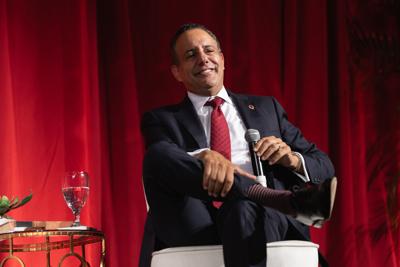
OU President Joseph Harroz Jr. sat down with OU Daily news editors Tuesday afternoon to discuss strategic plan updates, on-campus housing changes and university responses to federal directives.
Strategic plan
In 2020, OU launched “Lead On, University,” originally an eight-year strategic plan centered around five pillars to represent significant goals set by the university. The university announced a refresh of the strategic plan in spring 2024.
A primary goal of the strategic plan was for OU to become a member of the Association of American Universities, an invitation-only organization of America’s leading research universities credited for life changing education, research and innovation. Member universities earn the majority of federal funding for research.
“It’s going really well,” Harroz said. “All the things we hope to accomplish macro really are exciting. Just seeing the new McCasland Hall … we hoped five years ago, would we be in a position where reaching excellence as identified by AAU status (be) in our sights and something we could attain. We knew five years ago that was a stretch. Now we see that it is attainable.”
As college enrollment decreases across the nation, Harroz said OU’s enrollment has gone up 31.4%, another key aspect of the strategic plan. He said dealing with the unprecedented growth is a challenge, but it is a good challenge to face.
According to an August press release, OU welcomed the biggest first-year class in state history with 6,251 students, nearly 1,000 more than the previous class of 5,615 students.
“Our biggest challenge to deal with is growth is like the best problem you could have,” Harroz said. “Up 31.4% in our freshman classes in three years, and fastest growth overall since 1975, so 50 years, that’s awesome and I love it. … It’s fun that it’s a growth problem, not a contraction problem.”
Harroz also said the university has already gained $450 million in research funding and $1.6 billion in donations. At OU’s Health campus, Harroz said increased enrollment and additional funding are helping the university reach its goal of decreasing deaths from cancer by 10% and deaths from diabetes-related illnesses by 30%.
“All of those things are moving really positively as we look at the next five years. I love the challenges,” Harroz said. “I love some of the quantifications, like to move towards a billion dollars in total research. That’s a big thing that actually impacts lives.”
Harroz said as tensions rise federally, he hopes the strategic plan can allow students to learn at a university that celebrates different points of view and ideas and helps them build connections that will benefit society as a whole.
“As we identify how we're more alike than we are different, we can actually move forward together,” Harroz said. “The belief is that through these strategic plans, we can do things that matter to students and society.”
Federal, state directives
Last week, OU revoked a policy allowing some immigrant students lacking permanent legal status to pay in-state tuition, according to a GoFundMe set up in support of an affected student.
The removal of the university’s policy is in accordance with an Aug. 29 ruling on a state law, which deemed the in-state tuition waivers unconstitutional and in violation of the Supremacy Clause.
Harroz said OU was not as heavily impacted by the directive as other universities in the state.
“We're trying to be as helpful as we can without violating the law. That's our position but the good news is we do have some opportunities to try and help, …” Harroz said. “The reality was triggered by the legal interpretation that took place that we’re bound by.”
On Sept. 19, President Donald Trump signed an executive order requiring institutions to pay $100,000 for each immigrant worker sponsored by a H-1B visa. H-1B visas are granted to people who come to the U.S. to work in a specialty occupation.
Harroz said OU doesn’t have a clear answer on how the order will affect the university and employees currently under H-1B visas.
“We don't have a clear answer yet on when the impact is going to be on the H-1B's, but we're looking at it really closely,” Harroz said. “It just hasn't matured enough for us to understand that impact.”
Harroz said OU’s general counsel leads discussion about how the university addresses federal and state directives.
“It's led by the general counsel because much of it is legal interpretation. Student Affairs is a part of it and Operations on the academic side,” Harroz said. “It's a big group, and you have to have it because, I mean, we look at the number of executive orders and (interpretations) that have come out. It crosses too many areas, so we picked the general counsel and Armand Paliotta to lead that.”
Harroz said general counsel meets at least once a week to address each of the executive orders issued and make sure the university is in compliance.
“In the research space, there’s obviously a number of individuals that fit the H-1B criteria for that particular category of specialized individuals,” Harroz said. “We don’t have a hard, concrete answer but we’re looking at it and we discuss it at least every week.”
The Texas Tribune reported on Oct. 2 that the Trump administration asked the University of Texas to agree to a “set of operating principles” in exchange for access to federal funding. Harroz said the Trump administration has not offered this to OU, and he hasn’t looked into it.
Department reviews
On Thursday, the Black Wall Street Times reported the university was moving toward dismantling the Clara Luper Department of African and African American Studies.
In a statement to the Daily Friday, Senior Vice President and Provost André-Denis Wright confirmed the African and African American Studies department alongside the Judaic Studies Center were facing reviews.
“The University of Oklahoma is not closing the Clara Luper Department of African and African American Studies or the Schusterman Center’s Judaic and Israel Studies or their programs," Wright wrote.
Harroz told Daily editors the review of both departments was an annual review the Oklahoma State Regents for Higher Education conducts for all of the university’s roughly 300 degree programs.
“It’s 20% of those each year, there's some fraction that, around every five years, goes up for review,” Harroz said.
Harroz said the State Regents do not tell OU what to continue doing and not doing, but they do ask the university to look at certain criteria. Criteria include amount of graduates, credit hour production and others, according to Harroz.
Harroz said he understood the emotion behind the possible closure of the African and African American Studies department and the Judaic Studies Center, but he clarified that reviews had been completed and the departments will remain.
“This review is not going to trigger a closure of those two,” Harroz said.
Housing changes
In August, OU opened McCasland Hall, a new first-year housing residence hall with over 500 beds, a coffee shop, convenience store and lounge spaces.
McCasland Hall is one of two buildings that will compose the dormitories. Harroz said the second building is making great progress and is set to open in time to welcome the class of 2030.
After construction for the second building is done, Harroz said the university will start phase two of construction, which will consist of three new housing buildings.
“It’s a really exciting challenge because you need to be up a couple percent a year in our freshman class, which is obviously by far the line share students and housing,” Harroz said. “With this growth, I’m really happy we’re building these.”
OU Daily was informed via an anonymous tip that OU was considering turning Traditions East into first-year housing, requiring upperclassmen and international students to find housing off-campus.
Harroz said the university is coming up with a plan to keep up with student growth expected for the incoming academic year.
“All the academic literature tells us that student outcomes are better when you have freshmen in (on-campus) housing. … In the next couple of weeks, we should have this figured out, what is our plan if we have growth for next year, and we don’t have that nail down.” Harroz said. “What we do know, and what you may be hearing is right, which is we need to decide these things over the next several weeks so that we can be clear in the strategy for this … coming fall.”
Turning Point USA tour
Turning Point USA announced on Sept. 23 that it would visit OU’S Norman campus on Oct. 16 as part of its “The Turning Point Tour.” Speakers include English actor Russell Brand, Oklahoma Gov. Kevin Stitt and reality star Savannah Chrisley. The event will be held at the McCasland Field House.
The organization’s founder and conservative activist Charlie Kirk was fatally shot on Sept. 19 at an outdoor event at Utah Valley University as part of his “The American Comeback Tour.” Kirk was scheduled to visit OU in the fall.
Harroz said the university always considers campus safety, but Kirk’s death emphasized potential concerns.
“We always spend time thinking about safety on campus, but after the tragedy with Charlie Kirk, it just highlights the realities that you've got to be super scrupulous in how you handle safety,” Harroz said.
Harroz said he will not attend the event because it’s scheduled at the same time as the fall Presidential Speakers Series dinner. He also said the university does not endorse speech of any particular speaker or group.
“Our job in education is not to say we're for this speech or against this speech … but to provide the forum where students can have that experience … and to allow student groups to bring to campus those speakers that they choose to bring, and then to make sure that the students that choose to attend or don't choose to attend, that if they feel like their rights are being infringed, there's an outlet for them too,” Harroz said.
Harroz said the heart of a university is in providing space for open discourse and dialogue of multiple perspectives.
“We are a place where we want people to learn and to hear different points of view. That's part of being a student, so that you can not learn what to think, but how to think and how to process free speech, ...” Harroz said. “We don't want to just close things down and say that we're going to be safe only and not have an exchange of ideas. It's something we spend a lot of time on, and are spending a lot of time on.”


