
Correction: This story was updated at 1:54 p.m. on April 10 to reflect the proper spelling of Mahmoud Khalil.
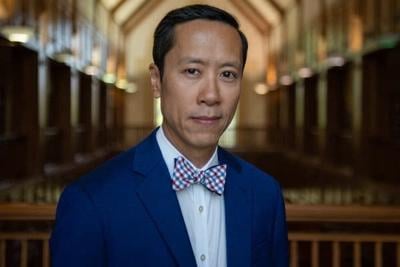
About 50 people attended a lecture Monday by OU law professor Joseph Thai titled “Campus Speech Rights and Wrongs,” a forum to educate people on First Amendment rights on college campuses.
The event was hosted by OU Law Students for Palestine and the OU chapter of the American Association of University Professors in the Bell Courtroom of the OU Law Center.
Thai has a history of working on civil rights and served on the legal team that successfully challenged Oklahoma’s same-sex marriage ban in Bishop v. Smith, a year before the Supreme Court upheld marriage equality nationwide.
At the beginning of his lecture, Thai said it’s important to define the reason for giving lectures like this one.
“It’s been my policy to frame these talks as education and not advocacy,” Thai said.
In an interview with the Daily after the lecture concluded, Thai said he wants to be inclusive in these talks.
“The First Amendment is inclusive. Free speech is protected on all sides, so I wanted to convey to the audience that this is for everyone,” Thai said. “Everyone should understand why free speech is important and why they should advocate for the right for people to speak, not only in favor of what they feel, but also against what they believe.”
During his lecture, Thai went over the law of free speech in outdoor areas, classes and events; hate speech; defunding universities that have major protests on campus and deportations.
First amendment rights on campus
Thai said not only is free speech protected by the First Amendment on traditional public forums like parks, streets and sidewalks on university campuses, but it’s also protected by House Bill 3543.
“The outdoor areas of campuses, of public institutions, of higher education in this state shall be deemed public forums for the campus community, and public institutions of higher education shall not create ‘free speech zones’ or other designated areas of campus outside of which expressive activities are prohibited,” the bill states.

Thai went over “time, place, manner restrictions,” which are content-neutral restrictions the government can place on free speech to ensure safety or public order.
Thai spoke about Columbia University's recent mask ban after the Trump Administration threatened to pull $400 million of federal funding from the university due to what it called “the school's failure to protect students from antisemitism.”
Thai wrote in an email to OU Daily in March that Trump’s statement about banning masks and “illegal protests” is vague on details but wrote that it’s “backwards” if Trump is asserting pro-Palestinian protests are generally illegal.
“There is a very high bar for political protest to rise to the level of incitements to violence or true threats that fall beyond the protection of the First Amendment. Most of the non-violent protests and encampments last year - as well as the counter protests - lie at the core of the First Amendment,” Thai wrote.
Thai said this should not be seen as a “time, place, manner restriction” since it is not content-neutral.
“The right to anonymity is an important part of free speech that should be protected,” Thai said.
Regarding free speech in classes and events, Thai said reasonable restrictions can be made such as a professor asking that students only speak if called upon.
Thai referred to House Bill 1775, which prohibits discussions about race or gender in the classroom, also known as the “anti-critical race theory” bill, and said it does not apply to college courses and is only applicable to K-12 curriculum.
Hate speech
Thai told the audience that hate speech is protected under the First Amendment right to free speech, except in the incident of fighting words, true threats or incitement.
Thai used the 2015 video of OU’s Sigma Alpha Epsilon chapter singing a racist chant as an example of how hate speech is still protected under freedom of speech.
“As offensive as we may find it, this speech is still protected under that First Amendment right,” Thai said. “Even under Title VI, that speech is still protected.”
Title VI of the Civil Rights Act prohibits discrimination based on race or national origin in programs receiving federal funding.
When speaking about the federal government’s recent use of pulling funding from universities, Thai said top constitutional scholars agree that the government cannot threaten cutting funding as a tool to control certain viewpoints.
Again referencing Columbia University, Thai said the Trump administration pulling funding until the university agreed to their terms was suppressing a certain side of the conversation and limiting free speech.
In regard to potential deportations, Thai explained that this issue is free speech versus immigration, foreign affairs and national security. He referenced Rumeysa Ozturk, a Tufts graduate student who was maintaining a valid F-1 student visa, who was apprehended by Department of Homeland Security agents in a viral video on March 25.
Thai also referenced Mahmoud Khalil, a Palestinian activist who played a prominent role in campus protests against the war in Gaza at Columbia University. Khalil was detained by Immigration and Customs Enforcement agents on March 8.
According to the OUPD handbook, in order to encourage crime reporting and cooperation in criminal investigations, all individuals must “feel secure” in contacting or being addressed by law enforcement regardless of their immigration status. The handbook also reads that individuals may not be treated in any way that would violate U.S. or Oklahoma constitutions.
Nearly 300 international students have reported their student visas have been terminated without clear justification, according to The New York Times. Students who have had their student visas revoked may face detention or deportation.
“Universities are advising their students to take care in what they say in their classes and even in those public spaces,” Thai said.
This story was edited by Ismael Lele and Ana Barboza. Natalie Armour and Sophie Hemker copy edited this story.


