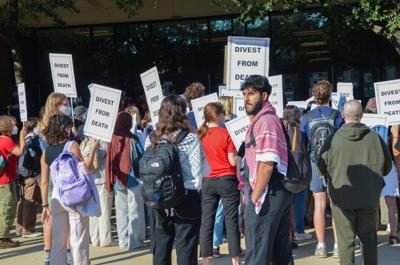


President Donald Trump announced all colleges, universities and schools would lose federal funding if they allow “illegal protests,” threatening “agitators” with imprisonment, deportation and permanent expulsion depending on the crime.
Trump did not specify what an “illegal protest” is, nor did he specify what would constitute an “agitator.”
OU law professor Joseph Thai wrote in an email to OU Daily that Trump’s statement is vague on details but wrote that it’s “backwards” if Trump is asserting pro-Palestinian protests are generally illegal.
“It is a core function of the First Amendment to protect political dissent from punishment by the government. The same freedom of speech that protects unpopular conservative speech on progressive campuses protects speech on all sides of the war in Gaza,” Thai wrote.
According to Thai, threatening to defund and prosecute raises other constitutional concerns. He wrote the First Amendment generally bars the government from using threats of defunding to coerce censorship or silencing private speech. He also wrote that Congress has the power of the purse, therefore, the president generally cannot withhold funding that Congress has legislated.
“There is a very high bar for political protest to rise to the level of incitements to violence or true threats that fall beyond the protection of the First Amendment. Most of the non-violent protests and encampments last year - as well as the counterprotests - lie at the core of the First Amendment,” Thai wrote.
According to Thai, there is potential for control of speech on campus to rise to the level of a violation of Title VI or Title IX of the Civil Rights Act.
“Those federal anti-discrimination laws prohibit federal grant recipients from engaging in or tolerating harassment on the basis of race or gender,” Thai wrote. “But it is again a very high bar for political protest to rise to the level of a federal violation, and most campus protests from last year did not.”
Alex Morey, Foundation for Individual Rights and Expression vice president of campus advocacy, wrote in a statement on the FIRE website that Trump’s message will cast an “impermissible chill” on students protesting the Israeli-Palestinian conflict.
“Colleges can and should respond to unlawful conduct, but the president does not have unilateral authority to revoke federal funds, even for colleges that allow ‘illegal’ protests,” Morey wrote.
In November, OU paid Greg Lukianoff, president and CEO of the Foundation for Individual Rights and Expression, $18,000 for his keynote address during Free Speech Week.
Morey wrote that students who choose to engage in misconduct must still receive due process.
“President Trump also lacks the authority to expel individual students, who are entitled to due process on public college campuses and, almost universally, on private campuses as well,” Morey wrote.
OU’s expressive activity guidelines
OU Marketing and Communications referred OU Daily to the university’s guidelines regarding expressive activity on campus in response to emails asking questions about if and how the university would comply with Trump’s statement.
OU Daily first emailed OU News on Tuesday at 12:53 p.m., asking three questions about OU’s enforcement of the proposed protest regulations and what would be classified as an illegal protest.
At 1:06 p.m., OU News inquired about OU Daily’s deadline, to which editors responded with a deadline of 5 p.m.
At 4:13 p.m., OU Daily sent a follow up email with seven more questions:
• Where are students on campus allowed to protest? Inside of buildings? Outside of buildings?
• What is the university policy regarding protests?
• Are masks banned, or to be banned, anywhere on campus?
• Will the university be making any sort of announcement informing its student population on how they should protest if they so choose?
• Does the university believe this is an infringement on the First Amendment?
• If the university chooses to comply, how will the university go about helping "imprison agitators" as Trump has outlined.
• If the university chooses to comply, how will the university go about "expelling" students as Trump as outlined?
At 5:44 p.m., OU News responded by directing the Daily to the university’s guidelines regarding expressive activity.
“The University of Oklahoma is dedicated to fostering the free exchange of ideas and opinions and committed to the principles of free speech and expression. Likewise, the University recognizes the historic significance of speech and assembly in society generally and on college campuses in particular,” the first sentences of the guideline read.
According to the guidelines, the outdoor areas of campus generally accessible to the public can be used for expressive activity on a first-come, first-served basis. OU does not limit demonstration activity taking place along public roads and sidewalks if it does not unreasonably restrict pedestrian traffic, damage landscaping, disrupt the normal operations of the university or otherwise violate law or university policy.
Advance reservations are not required for expressive activity in generally accessible outdoor areas of campus, however, reservations and prior approval are required if the property will be reserved for the exclusive use of a group or if the activity is a special event.
On the Norman campus, student groups and university departments may reserve several areas, such as the grassy area on the South Oval across from Dale Hall, through Campus Scheduling.
According to the guidelines, masks, bandanas or other material to cover a person's face are prohibited, but the restrictions do not include coverings for health or religious reasons or that are incidental to amusement, entertainment, holiday events, protection from weather or for prescribed medical purposes.
OU Daily has not observed university administrators enforce the above face-coverings mandate at any recent protests or demonstrations.
According to the guidelines, the university recognizes that individuals or groups may be opposed to certain expressive activities, and while disagreement is acceptable, use of violence or harassment is prohibited.
OU’s recent history with protest
OU Students for Justice in Palestine, formerly known as Student Coalition for Palestinian Liberation, has consistently demanded OU to divest from weapons manufacturers and specific corporate partners. Last Friday, SJP announced it will be marching on the South Oval during the OU Board of Regents meeting on Monday to demand divestment from partners associated with Israel.
During its May Day march in 2024, OU SJP pointed to 1986, when the Board of Regents divested from companies in apartheid South Africa.
SJP became a registered student organization in early February. In January, SJP held an art demonstration in Gallogly Hall as part of a larger day of action called for by the national organization. On Oct. 7, SJP and OU Hillel, an organization founded on campus that supports Jewish students, both held vigils for victims of the war in Gaza on the South Oval. SJP has held other protests over the past year on the South Oval, outside Dale Tower and inside Evans Hall, Bizzell Memorial Library and Oklahoma Memorial Union.
In a text message to OU Daily, Cruz Richardson, an international studies and Arabic junior and member of SJP, wrote that restricting students’ right to protest is a violation of the First Amendment.
“Protest have for years been the only ways for people to express frustration and demand change in system that fail them,” Richardson wrote.
Richardson wrote that this is a clear attempt to silence people who disagree with the status quo.
“We refuse to stand down or be silenced by any forces on or off campus and since the university has yet to make a stance on this we will continue on with our steadfast commitment to liberation for Palestinian people and encouraging divestment from weapon manufacturers by our (university),” Richardson wrote.
Richardson wrote he would be disappointed if OU supported the restriction of student protesting.
“I would be disappointed to see our university support the restriction of their students rights and to support this violent rhetoric against their own students,” Richardson wrote. “It would be a disgrace and a shameful legacy that will be remembered for forever.”
From 2015 to 2022, OU students mobilized to address various issues on campus and in Oklahoma.
During this time, OU Unheard and the Black Emergency Response Team were formed.
On March 10, 2015, OU Unheard, an alliance of Black students who advocate for minority rights on campus, organized a protest with students and administrators on the North Oval to protest a viral video of Sigma Alpha Epsilon fraternity members participating in a racist chant.
Members and others in attendance placed duct tape with the word “unheard” over their mouths. Protesters marched toward the Union, placing hundreds of Post-it notes on the door of the Student Affairs office.
In September 2016, the Revolutionary Baddies, a student organization led by women of color, to protest police violence and the Sept. 16 death of Terence Crutcher in Tulsa, organized a Black Lives Matter “Die-in.” The protest, which lasted about four hours, began on the South Oval, led by student leaders Ariana Hall, Taylor Sanchez and Carey Flack. Protesters made posters and marched to the Union, chanting “no justice, no peace, no racist police."
In August 2019, the “Save the American Organ Institute” rally saw protesters walk out of the OU School of Music convocation ceremony and sit on the steps of Evans Hall for three hours, providing a short list of demands.
On Feb. 26, 2020, members of OU’s Black Emergency Response Team gathered at Evans Hall for a three day sit-in and hunger strike after two professors in two weeks used a racial slur in class — once when a professor compared the word to the phrase “OK, Boomer” and again when the slur was used repeatedly while reading from a historical document.
This story was edited by Ana Barboza and Peggy Dodd. Gretchen Schultz, Sophie Hemker and Mary Ann Livingood copy edited this story.


