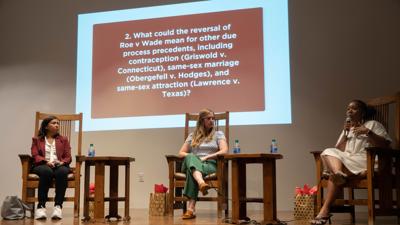

OU Human Relations hosted a panel on Tuesday night featuring experts who discussed the consequences of overturning Roe v. Wade and how Oklahomans can progress.
The panelists included Carla D. Pratt, a professor at the OU College of Law, Dr. Allie Regens, an OBGYN; and Tamya Cox-Touré, the executive director of the American Civil Liberties Union of Oklahoma.
Moderated by former Norman Mayor Breea Clark, the agenda included a 30-minute panel discussion on the importance of and context surrounding the Dobbs v. Jackson Women's Health Organization decision, followed by a brief question-and-answer session.
The panelists spoke about the background of the Dobbs v. Jackson ruling and what it means that states are now in charge of abortion decisions. The ruling overturned Roe v. Wade and holds that the Constitution does not confer a right to abortion.
All three panelists emphasized the need for Oklahomans to understand that the ruling was not the beginning of the attack on abortion access in the state, as Oklahoma Senate Bill 612, which was passed in May, made Oklahoma the first state to virtually ban abortion access.
Pratt said that the reason the Dobbs v. Jackson ruling happened is because the majority of the Supreme Court interprets the text of the Constitution literally, and abortion is not specifically mentioned within the text.
Regens shared her experience with patients in the aftermath of the overturning of Roe v. Wade.
“I have one-on-one interactions with patients who are seeking abortion care and how this affects them in their day-to-day lives,” Regens said. “There’s confusion on where they can go. Different standards from state to state make it extremely challenging for patients to know where is safe.”
A common concern following the Dobbs v. Jackson ruling has been the permanence of other due-process precedents, such as contraceptives in Griswold v. Connecticut, same-sex marriage in Obergefell v. Hodges and same-sex intimacy in Lawrence v. Texas. These concerns stems from a concurring opinion by Justice Clarence Thomas, who wrote the Supreme Court “should reconsider” its past rulings codifying these rights.
The panelists sympathized with this concern by agreeing there can be “no full trust” placed in the Supreme Court now it has overturned a historic precedent like Roe v. Wade.
When questioned how the Dobbs v. Jackson ruling has impacted their field and what the lasting effects of the ruling will be, the panelists noted the legal, medical and moral consequences.
“We reflect on the social burden this puts on people,” Regens said.
Cox-Touré specified how the ruling has affected Oklahomans and the reason many of them are confused on what pregnant people can and cannot do.
“House Bill 4327 says any person may sue another person if they think an illegal abortion was performed,” Cox-Touré said. “We have no determination, not even through state law, what aiding and abetting means. That is the problem with our state policies: doctors don’t know what they can do. However you feel about the abortion debate, there are real-life impacts to it.”


