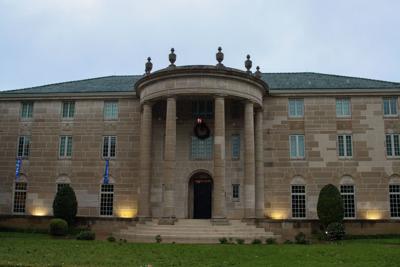

On March 27, rapper DaBaby stepped onto a stage on Beta Theta Pi's front lawn. His voice blared into the microphone as speakers erupted with a pounding bass.
Marketing first-year Abigail Huber stood near the concert barricade with her friend after arriving on the fraternity’s lawn hours in advance. But as the concert began, Huber quickly became worried for her safety.
“I’ve never experienced anything like it,” Huber said. “Genuinely, it was terrifying how packed it was.”
Huber said her shoulders were used by another student to rest his arms without her consent. Throughout the performance, the crowd yelled and pushed at each other.
“At one point, everybody started falling to the left, …” Huber said. “Everybody just started falling one way and my legs got crossed, and so I couldn’t stand. And then I lost my shoe, I lost my hat, my sunglasses fell off.”
Huber said she felt as though she had no control over her safety.
“I’m literally at the mercy of the crowd, and then my friend looks back at me at one point and she just doesn’t see me because I’m smooshed,” Huber said.
Across the street, professor and Norman resident Tamar Zinger heard her windows begin to vibrate. She placed her hands against the two tall panes of glass near the front of her house, trying to prevent the vibrations from shattering her windows.
“The bass was so strong that the glass was starting to vibrate,” Zinger said. “It was making this noise that I got so scared because glass can shatter. … I was holding it to break the vibrations.”
Zinger said that she resorted to bracing the glass with furniture.
“I couldn't just spend the whole evening by the glass, you have to put something. So I put those armchairs against the glass,” Zinger said, gesturing to her armchairs next to her windows.
Kaushal Palem, Alpha Tau Omega treasurer, wrote in a text message to OU Daily that joining the SEC has encouraged social competition between greek life within the conference.
“SEC definitely does it the best so to compete with the other schools these concerts help,” Palem wrote.
DaBaby’s performance was the second concert to be held this academic year, with rap artist Soulja Boy performing at Kappa Sigma in February. Pi Kappa Alpha will host electronic duo The Chainsmokers on May 2 in partnership with Phi Gamma Delta, Alpha Tau Omega and Beta Theta Pi.
Zinger, an OU architecture professor, has been living in Norman’s historic Ledbetter House for four years. She said living next to the fraternity house had not been a problem until this concert.
“Honestly, they’re really great, …” Zinger said. “They’re really great neighbors. There’s no problem whatsoever, ever.”
Huber said after the crowd fell down, she and her friend tried to leave but felt the crowd wouldn’t let them.
“We’re just trying to get out and people wouldn’t let you through, …” Huber said. “You just kind of yell and then you push them and then we finally got out.”
According to Huber, police arrived at the concert around the time DaBaby finished his performance, which she said lasted about 20 minutes. Huber said that she and her friend were shaken up when leaving the event.
“We’re soaked in drinks because everybody’s throwing them, …” Huber said. “We got out and we were shaking … just from being so scared.”
Huber said she and her friend paid around $60 each for their tickets but did not feel it was worth the money to go.
Huber said the security personnel at the concert did not make her feel safe.
“You could really tell that they were watching everybody, but it definitely didn’t make me feel safer just because there were so many of us,” Huber said.
Huber said that since that concert she has been more “vigilant” when going out.
Sarah Schettler, Norman Police Department public information officer, said there is frequent communication between the greek houses and NPD about events and noise variance permits.
“It is an ongoing partnership with any events that occur in the majority of the greek life housing just because that is within our jurisdiction at the Norman Police Department, …” Schettler said. “There are a number of special permissions or variance forms that they have to get approved. For events like this, typically they have to apply for a noise variance, and then if there’s going to be any road closures or any further needs from our agency from a public safety perspective, they do have to go through that application process.”
Noise variance permit applications must be filled out two weeks prior to the scheduled event, according to Schettler, and are $25 per location.
Schettler said the permits can still be revoked at any time if given reason.
“Those permits can be revoked at any time under the direction of a supervisor with the Norman Police Department, or another city employee, and that can be if there’s consumption or possession of alcohol for individuals under 21 years old, intoxicated people on the premises, use of narcotics (or) if there’s any disturbing of the peace,” Schettler said.
According to Schettler, Sunday through Thursday the noise variance can be no earlier than 7 a.m. and no later than 11 p.m. On Friday and Saturday, the noise cannot go past midnight.
Zinger said the fraternities do not alert the neighborhood when these concerts happen. Haley Dennis, a Norman resident who lives near the Beta Theta Pi house, also said neighbors are not alerted of these events before they happen.
“We knew about (the concert) beforehand, but it’s not because anyone warned us,” Dennis said.
Dennis, who lives next door to Zinger, said the noise is normally manageable and the night of the DaBaby concert, she was able to sleep fine.
“Noise doesn't really ever get that bad — you’d think it would. I can hear it, but to me it’s the cost of living next to a fraternity house, …” Dennis said. “I had no trouble going to sleep.”
Dennis said living next to the house has caused no problems.
“They’ve been good neighbors as far as fraternity houses go, and we’ve lived here for several years,” Dennis said. “It wasn’t anything egregious, at least from our experience.”
Zinger said there have been no other issues with living next to the fraternity house, but prior to moving in she expected noise to be a much bigger issue.
“Honestly, when I moved here, I thought there would be a lot of loud parties and stuff, …” Zinger said. “If that’s all it takes is two (concerts) a year, it’s OK.”
Schettler said in most cases, the greek houses are cooperative with the city.
“I think it’s important to understand that in most of these instances, the individuals that are planning these are working in coordination with the city and with our agency to make sure that they have public safety plans in place, and that they really understand what those conditions and guidelines are,” Schettler said.
Schettler said the people coordinating the event are told beforehand about the procedure for the violation of a noise variance permit.
“Ultimately, they’re kind of given this information and educated on this information in advance with the knowledge that if we continue to see, receive complaints and/or if there are any other issues unrelated to the event and we’re on the scene then there could be further action taken,” Schettler said.
According to an email to the Daily, Kylie Frisby, director of fraternity and sorority programs and services, wrote that the funding for concerts is managed by the chapters and that greek life fees are not managed by the university.
“The University does not manage or set the membership dues or fees with chapters. That’s all done internally through each specific fraternity or sorority,” Frisby wrote. “While some groups have increased their membership dues over the years to meet rising costs of products and other needs, I don’t believe that’s the case for all of our Greek organizations.”
Palem wrote that funding for these concerts since joining the SEC has not been introduced as a new fee.
“Our dues stay the same over the years,” Palem wrote. “We want to be fair and have our members have low dues while gaining the most out of them.”
Palem wrote that events hosted by greek life must be registered through the university.
“Without the university’s approval we cannot hold and be able to throw such a massive event so we always ask for their permission first,” Palem wrote.
Frisby wrote that registered student organizations, including greek houses, follow an application process prior to the event and must gain university approval.
“We review the event registration to help organizations with policy compliance and safety planning,” Frisby wrote. “When student groups host events, they also determine their own budgets for those events. They book, coordinate, and pay vendors as needed. Any fees, ticket prices, etc. would be set by the chapter directly.”
The Daily reached out to leadership of Beta Theta Pi, Kappa Sigma, Pi Kappa Alpha, Phi Gamma Delta and other greek organizations along with OU’s Interfraternity Council but did not receive a response by the time of publication.
Keaton Shaffer contributed to the reporting of this story.
This story was edited by Macey Thaxton and Audrey McClour. Larkin Bock and Mary Ann Livingood copy edited this story.


