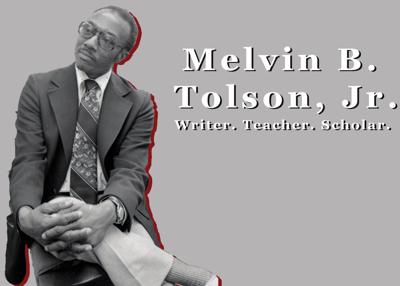
When Melvin B. Tolson Jr. came to the University of Oklahoma in 1959, his main goal was not to become an activist or a role model. He just wanted to go to school.
But he inevitably did both, and during the 1960s, when he became the first full-time black professor at OU, he broke barriers in higher education that would pave the way for other black scholars.
Described as soft-spoken and articulate, Tolson was a critical thinker, powerful writer and enthusiastic linguist. He built relationships between members of the black community on OU’s campus, creating a norm for black students to have connections with one another and view each other as members of a team, said George Henderson, professor emeritus of human resources and Norman’s first black homeowner.
“Walking across campus, if a black student walked past Melvin and didn't see and didn't speak, he'd go ... ‘Hey, come here. Good morning,'” Henderson said.
Tolson died in 2011, but he played a historic role at the University of Oklahoma, former OU President David Boren said in the spring 2008 edition of the Sooner Magazine.
“He has been an inspiring role model for an untold number of students working for academic excellence as the first African American faculty member to become a full professor,” Boren said. “OU is a much stronger university today because of the impact of Melvin Tolson Jr.”
Tolson was born in 1923 in Charlottesville, Virginia, and grew up in Marshall, Texas, with three siblings. Tolson’s family was intelligent, pushing each other and striving for excellence.
His father, a famous poet and professor, drilled the importance of getting a good education, encouraging Tolson and the rest of his family to earn doctorates because it would help them with job security later in life, Tolson said in an interview for an oral history project by Oklahoma State University.
“I grew up in an atmosphere in which students and teachers discussed major concerns and argued with each other all over campus,” Tolson said.
After Tolson earned a bachelor's degree in English and Philosophy in 1942 from Wiley College, a historically black college in Marshall, Texas, where his father taught, he attended Gammon Theological Seminary in 1946 in Atlanta, Georgia. In 1949, Tolson enrolled at Oklahoma State University, formerly known as Oklahoma A&M.
Public colleges in Oklahoma had been desegregated that same year after a Supreme Court decision on behalf of Ada Lois Sipuel Fisher, who petitioned to get into OU’s law school. Tolson said the students and staff at OSU were mostly friendly, one dean even saying that if Tolson had any problems, he would have allies. But there were still some problems.
“I remember one cold morning walking from the bus station to the campus and passing a group of four white fellows. I was bundled up,” Tolson said. “As I passed, one said to another, ‘Is that a Negro?’ The other said, ‘No, no. There aren’t any Negros here.’ That was 1949.”
When he graduated in 1950, Tolson was one of the first African Americans to earn a master’s degree at OSU. Tolson studied for a brief stint in Paris in 1956, Three years later, he arrived at OU to earn his Ph.D. in French and Spanish, according to his obituary in the Oklahoma Higher Education Heritage Society. While working on his dissertation, he was appointed to a special instructor in 1962 and an assistant professor in 1964, where he officially became the first full-time black professor at OU.
“When I came as a new assistant professor, (Tolson) had retired, but he stayed involved in the life of the department,” Pamela Genova, former chair of the OU department of Modern Languages, Literatures and Linguistics said in the 2008 Sooner Magazine article. “He loved to speak French with us, and he was always supportive … The students fall silent in awe of this man. He’s not only a fine scholar and a wonderful teacher, but also a person of high caliber.”
Like Father Like Son
Tolson’s father, Melvin B. Tolson Sr., was dedicated to his family, and Tolson saw him as a beacon of hard work and determination.
Tolson Sr. was a famous poet, as well as a coach to an award-winning African-American debate team at Wiley College. The team debated against and defeated multiple public white institutions, including Oklahoma City University and the University of Southern California. The story of the debate team was fictionalized in the movie “The Great Debaters,” which was produced by Oprah Winfrey and starred Denzel Washington as Tolson Sr.
At an early age, Tolson learned from both of his parents to not be afraid of difficult conversations surrounding high-stakes issues. If the children had a position, they were to defend it, just as their father taught his students on his debate team.
“I remember a sister-in-law when, the first time she came to visit the family after the marriage, had left the dinner table,” Tolson said in the spring 2008 Sooner Magazine. “I went to her room and asked her something the matter. She said she had never been in a place where the family argued like that.”
Tolson followed in his father’s footsteps by learning different languages in high school and college, including Latin, German and French. But while his father was learning different languages to improve his writing, Tolson took up the languages as part of his academic focus.
Tolson spoke proudly about his father’s legacy in interviews and writings. Tolson said that his father was a “fiery speaker” at high schools, churches and graduations, as well as an amazing person.
Henderson said Tolson spoke at international conferences, wrote articles for literary journals and contributed to historical reviews on race and culture, but the majority of his individual writings were never published.
Henderson said that he got the chance to read many of Tolson’s writings, and he said they were “beautiful.” But Tolson wasn’t sure enough of himself to have them published, thinking that the writings were not as good as his father’s, Henderson said.
Even still, Tolson reached heights as he broke barriers of racial discrimination in higher education and inspired students with his teachings in French literature classes.
“I was always just me,” Tolson said. “I was not him, and I knew that from early on.”
Legacy and Teachings
During the late 1960s, after Tolson had become a full-time professor, he played an active role in students’ lives by helping to form the the Afro-American Student Union, now called the the Black Student Association.
“I supposedly influence some students who have written me through the years … which surprised me, but other than that, it has been a normal life,” Tolson said in an interview with OSU.
This involvement helped push Tolson to gain respect from both the black community and students in his classes. And even those who never met Tolson personally still felt they benefited from his intrepid leadership, said David Surratt, OU’s vice president of student affairs.
“(Tolson) and others among the first black faculty that was part of the genesis of the Black Student Union are folks from whom OU has greatly benefited,” Surratt said.
Tolson found continued professional success at OU as the years went by, receiving a promotion in 1964 because of his quality of work as a scholar, an “outstanding” teacher, and winning the Regents Award for Superior Teaching in 1967, according to documents provided by the university.
“I can honestly say that Professor Tolson ranks among one of my favorite professors during my seven years at OU,” said Donald E. DeSpain, a 1973 OU graduate in a letter to Tolson. “For he taught us not only just about French, but also the responsibilities of life as it should be lived and appreciated.”
Henderson said Tolson focused on communities other than the black community, as well, saying he was also a hero to the hispanics on campus for also being fluent in Spanish, even though he wasn’t teaching them.
“You know, to me, I marveled at that. I'm having a brother to brother conversation, mostly black people,” Henderson said. “Melvin was pulling in the Latinos, and that was beautiful.”
It may not have been part of his main goal, but Tolson used his words to effect change, working behind the curtain to guide his colleagues and the community.
“There must be literally thousands of people like Melvin B. Tolson Jr. who were backstage while some of us were front stage taking the bows, and we couldn't have gotten there without our support system backstage,” Henderson said. “Well, Melvin was my backstage support.”
In 2002, OU dedicated the Henderson-Tolson Cultural Center in honor of Tolson and Henderson, which serves as a meeting and office space for the Black Student Association and its umbrella organizations.
At first, Tolson was hesitant to have his name attached to the center. Despite his contributions to the university, he believed that he was not deserving. Tolson was not worried about how he would be remembered. All along, he had just been trying to go to school.
Tolson never thought he made a direct impact on others. However, Henderson said that people like Tolson are the reason why others come to OU and decide to stay, as Henderson did. But to Tolson, he just believed he was living a normal life.
“But you see, this is the thing though — anybody, like myself, who had stayed the course, would have been special,” Tolson said. “It was just that I was looking for a place to go to school.”