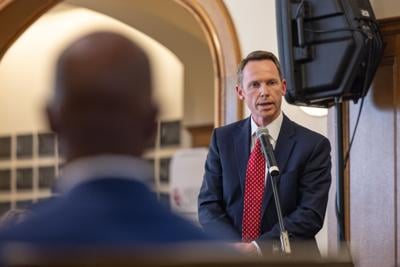

OU students and staff reacted to the implementation of a five-year plan to expand the College of Medicine, which aims to increase student admissions and implement changes to its curriculum.
Dr. Ian Dunn, executive dean of the College of Medicine, said there will be about a 40% increase of students in the next five years at campuses in both Oklahoma City and Tulsa. The plan will increase the number of students admitted to the doctor of medicine program from 163 to 232.
“There is a really critical need to improve the health of our state, and we are going to do everything we can to move the needle, part of which involves training more physicians to provide expertise and access,” Dunn said.
Dr. Andrew Liew, OU professor and associate dean of undergraduate medical education, said the OU-Tulsa School of Community Medicine is executing a new fast-tracked medical curriculum called “3+3.” This program allows students to spend only three years in medical school instead of four, followed by a three-year residency to become doctors.
According to Liew, this option is offered to students who show interest and have a preexisting idea of what specialty they would like to train in.
“The hope of increase in class size is that we can get more doctors to take care of the people in Oklahoma,” Liew said.
Currently, Oklahoma is ranked No. 47 in the country in health outcomes and Oklahoma’s physicians workforce is ranked No. 48 for the number of active physicians per capita within the state. Dunn said the expansion could help improve the overall health of Oklahoma.
Liew said lessening the levels of debt for students is important to OU officials. According to Liew, the accelerated track offers students a chance to decrease student debt by expediting the process of medical school.
Liew said eight years in school is not affordable for every Oklahoman, though it is an issue that OU’s medical community attempts to ease for its students.
The goal of the expansion is to give more Oklahomans access to medical care, especially in rural, tribal and underserved areas. Liew said OU is implementing a new hands-on curriculum by having students train in medical offices in underserved areas of Oklahoma.
While 32.6% of Oklahomans reside in nonmetropolitan areas, around half of Oklahoma land is said to belong to 39 federally recognized tribal communities.
Dr. James Herman, dean of OU-Tulsa School of Community Medicine, said OU medical programs are determined to give students positive experiences and encourage medical work in places where doctors are really needed.
“I really believe in the mission. All of this is near and dear to my heart,” Herman said.
The expansion, while currently progressing, is part of the constant growth process for OU’s medical programs, Herman said. As of this year, the OU College of Medicine has 992 faculty members. Herman and Dunn agreed they are always looking to make additions to OU’s staff in Oklahoma City and Tulsa.
Dunn said the plans surrounding the expansion have excited new generations of medical students, staff and faculty.
Sanika Navalkar, a biology sophomore and member of the Medical Humanities Scholars Program, said she is looking forward to the continual growth of OU’s medical community and the chance to work hands-on in the medical field.
“Any increase in the number of seats results in a positive response to the ever-growing demand of physicians, especially in Oklahoma,” Navalkar said.
According to Navalkar, the direct product of the expansion will be an increased number of physicians in Oklahoma. Navalkar said OU will be able to accommodate more extensive opportunities.
Arjun Penmatsa, a first-year OU medical student, said current and future generations of OU medical students are seeking special opportunities for field work. In 2023, the College of Medicine ranked No. 34 for the number of graduate schools practicing primary care.
Meena Ramadugu, medical anthropology sophomore and member of the Medical Humanities Scholars Program, said the issues of medical disparity in the rural and tribal areas of Oklahoma are just as important to OU medical students as the staff.
“It's really important that we understand the unique needs of each individual patient so as to fulfill their needs appropriately,” Ramadugu said.
Liew said OU’s medical school expansion over the next five years is proving to better prepare students to work in Oklahoma’s medical field. According to Liew, expanding the medical programs is about more than just a number, it is about expanding intentional medical care in Oklahoma.
“We need people taking care of the people of Oklahoma,” Liew said.
This story was edited by Anusha Fathepure, Ismael Lele and Ana Barboza. Kylie Caldwell, Mary Ann Livingood and Grace Rhodes copy edited this story.


