
Hands-on experience such as internships, research, study abroad and special admissions programs allows OU students to gain a unique leg up when it comes to career building and networking, faculty and students report.
OU colleges provide graduate and undergraduate students with opportunities to meet new people, visit unique locations and explore their professional fields — all to advance their careers.
From OU’s largest and smallest colleges, here is how faculty support students and how that has shaped students’ experiences.
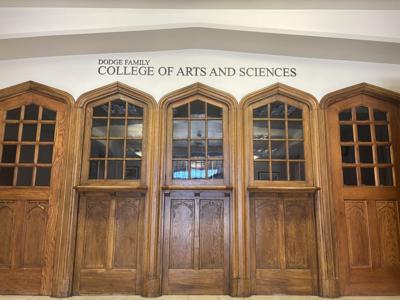
Dodge Family College of Arts and Sciences
The Dodge Family College of Arts and Sciences is OU’s first and largest college, with more than 8,000 undergraduate and 2,000 graduate students enrolled, according to its website.
Deonnie Moodie, associate professor and academic chair of religious studies, said the college’s size can have both positive and negative effects, considering a large portion of OU’s student population is situated in it.
“The challenge, and the promise, is that with a Dodge degree, you can do anything. You can do literally anything. That's wonderful,” Moodie said. “It also doesn't help students imagine what that looks like.”
Moodie also serves as the faculty fellow for co-curricular engagement, acting as a facilitator and coordinator for internships, research and study abroad opportunities within the College of Arts and Sciences.
Moodie said she is able to make career-building opportunities more accessible to students in the College of Arts and Sciences despite its large size.
“We have (around) 30 departments, we have over 60 majors, we have over 60 minors, we have tons of courses (and) over 600 faculty, so we are absolutely huge,” Moodie said. “What we have been doing as a college is individual departments offering a whole range of internships already, and then there's the new initiative that I'm a part of.”
According to Moodie, some College of Arts and Sciences degree programs, like social work and library information systems, have required internships in their curricula. However, Moodie said some programs do not require internships, which is something she is working to change.
“That's where my position was created,” Moodie said. “What we're doing is we are actually building new degree programs where internships will be an integral part of the degree.”
Moodie added that alumni support is critical to launching students into their first professional experiences, and she is working to create more direct pathways for students to gain career experience.
“One of the many things that we've been doing is connecting more directly with our alumni to see, ‘OK, … would you like to host an OU student as an intern?’ to create more direct connections with people who have our degrees, know how valuable they are and can create those pathways for our students,” Moodie said.
Sydney Tatom, a history and journalism junior, serves as an archival intern at the Oklahoma City National Memorial & Museum. In this role, Tatom said she helps organize historical datasets owned by the museum so future research can be conducted more easily and resources can be more accessible.
Tatom is also a third-year RUF/NEK Lil’ Sis and a Sooner Schooner driver. Tatom credited the communication in the College of Arts and Sciences with landing her internship.
“Somebody from Dodge emailed all of the junior and senior history majors and … gave us some contacts, and I think in that sense, the process was really accessible and really easy,” Tatom said.
Tatom said that from the email, juniors and seniors who were interested in the opportunity were paired with advisers who made the process easier. She said the process felt individualized despite being in the largest college at OU.
“We had advisers and people there helping us to figure out where we wanted to go, what work we wanted to do,” Tatom said.
Tatom said she wanted to work at the museum because of its significance in Oklahoma and U.S. history.
“I told the person who is in charge of helping me get the internship, right off the bat, ‘I really wanted to work at the (Oklahoma City) bombing memorial,’” Tatom said. “That was something that I thought was really important to Oklahoma history and was something that I wanted to have a small role in if I could.”
Tatom noted the reciprocal manner of the help she received from the College of Arts and Sciences and said she felt cared for by college leadership.
“My wants and needs were made a priority by the people in Dodge who were helping me get my internship,” Tatom said. “I felt really cared for by the process because what was important to me was reciprocated by them, and it felt like they thought it was just as important.”
Tatom said that despite the size of the college, she still felt supported in finding her internship.
“Even though it's the biggest college at OU, it's one that really cares about their students and cares about their individual paths and journeys to whatever the end goal is for them,” Tatom said. “Truly, I do think Dodge really cares for the opportunities that are available to its students, and I do think that they do their best to get students where they want to go.”
Honors College
The OU Honors College was first given college status by former OU President David Boren in 1997, according to the history section on the college’s website.
Paul Gilmore, dean of the Honors College, said he believes the Honors College’s smaller size is its strength.
“We have about 1,800 students in the Honors College right now, … (and the) honors-specific classes that they do take are usually about 15 to 20 students,” Gilmore said. “So for a student taking, say, Intro to Micro Economics, instead of being in a class of 300 or 400, they're in a class of 20.”
Gilmore added that smaller class sizes give Honors College students the unique opportunity to build a closer, more personal relationship with their instructors.
“They get that closer connection with the faculty member who’s teaching them, (and) they get to know the faculty member,” Gilmore said. “The faculty member knows them in a way that’s more difficult in (a) class of 400.”
Gilmore said one of the advantages of OU is its alumni network, which adds an additional layer of support for Honors College students.
“No matter what field you're in, … there's going to be some OU connection,” Gilmore said. “Our job is to make sure that those are readily available.”
Honors College students, particularly pre-law and pre-med students, can begin their post-graduate education early, according to the Honors College website.
Some Honors College students are granted automatic admission to the OU College of Law and the OU College of Medicine.
According to the website, a maximum of 25 candidates are selected each year to join the Honors College’s Pre-Law Scholars Program. Between five and eight incoming high school seniors who will join the Honors College are selected for the Medical Humanities Scholars Program.
Gilmore said that a pre-law scholar student’s final year of undergraduate studies counts as one year of law school, fast-tracking the student to complete law school in six years rather than seven.
Joseph Mathew, a vocal performance senior and Rhodes Scholar finalist, is a medical humanities scholar in the Honors College. He said that with interests in both music and medicine, the Honors College gave him the resources to pursue both and encouragement to explore medicine from different perspectives.
“That wasn't really something that was in the cards for me if I wasn't in this program,” Mathew said. "I probably wouldn't have chosen to do a music major, even though medical school doesn't have any requirements of what major you have to be.”
Mathew said the guarantee of acceptance into the OU College of Medicine added a layer of security to his time at college, which allowed him to explore other interests like music.
Mathew said he believes his unique blend of interests will help him stand out to employers in the future.
“Now I've found ways to bridge music and medicine in a way that’s very unique to my own passions,” Mathew said. “That'll help, especially with career development. It puts me in a unique situation because it’s such a niche combination of interests — it helps you stand out to medical schools in the future.”
Mathew said he plans to continue to pursue vocal performance while in medical school.
“In the future, when I am in medical school, I will continue to perform and continue to sing because I’ve discovered how much I love that side of myself,” Mathew said. “I don’t want to give it up.”
Mathew added that faculty and staff in the Honors College have been supportive of him pursuing medicine and music.
“Everyone is very supportive and wants to see me succeed,” Mathew said. “They push me in the direction of, ‘You can do both,’ and they don't try to be like, ‘No, you’ve got to pick one or the other.’ They're all very vision-forward.”
This story was edited by Ana Barboza, Thomas Pablo and Natalie Armour. Avery Avery copy edited this story.


