
It’s been two years since thousands of OU students left campus for spring break 2020, unaware that for many — including the graduating classes of 2020 and 2021 — it would be the last time they saw OU’s campus as it was before the COVID-19 pandemic.
While the chief medical adviser to the White House Dr. Anthony Fauci has declared the U.S. is clear of COVID’s pandemic phase, many of the changes wrought on the university and its people will linger.
The Daily surveyed people across the OU community on what the pandemic has taught them moving forward. Here are the lessons they shared:
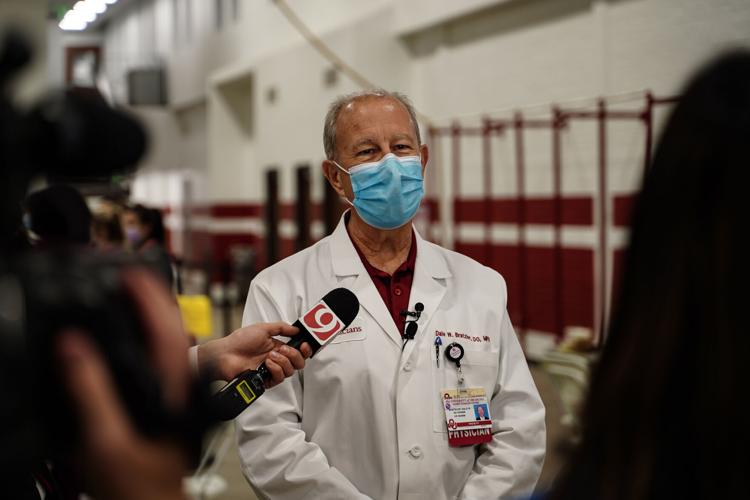
Dr. Dale Bratzler — OU Chief COVID Officer:

OU Chief COVID Officer Dr. Dale Bratzler speaks to members of the media before an OU COVID-19 vaccination clinic on March 26, 2021.
Bratzler said the COVID-19 pandemic prompted a renewed interest in the important role of public health. He said the U.S. was “ill-prepared” for the virus, and there were many lessons learned that will, hopefully, shape the role of public health in the future.
“The unprecedented surge in patients required all of the health systems in Oklahoma to work closely together to address the pandemic-induced health needs for so many,” Bratzler said. “The remarkable story of mRNA vaccine development — technology that had been researched for years, that was, in record speed, modified to produce highly successful vaccines to prevent the most severe complications of COVID-19 … will serve us well for years to come for a variety of diseases.”
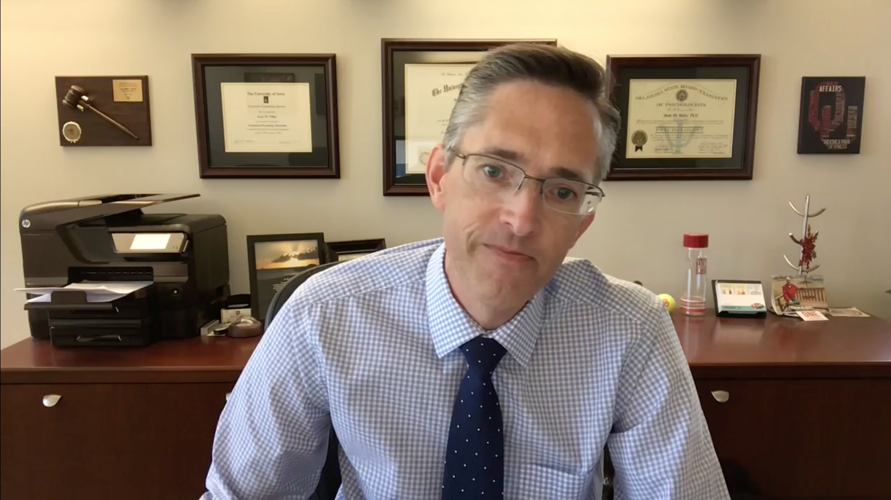
Scott Miller — University Counseling Center director:

University Counseling Center Director Scott Miller discusses the services provided by the center on June 12, 2020.
Miller said it was hard not seeing his colleagues at the UCC and students in person, but he was pleased with the staff’s ability to quickly transition, preventing them from having to cancel sessions or interrupt client care.
“I was so proud of the people I worked with that continued providing counseling through such a hard time,” Miller said. “I always knew we were taking the best care of our students, faculty and staff who were feeling overwhelmed and scared.”
Miller admitted it was hard, at times, to listen to all the negative stories created by COVID-19 while he navigated the pandemic. He said he learned that “we have so little control over external things,” but “we can adapt and accept what is.”
“We had to let our students know we were still with them through all of their challenges even when we were not in an office together,” Miller said. “We also had to find new ways to reach out to students who were isolated and withdrawn due to the pandemic. It was hard but we found a way to still be there for our students.”
Miller said he doesn’t think anyone will return to “normal” because the pandemic was a “traumatic” and “disruptive” experience. He said he thinks things will slowly feel more normal, and hopes to see the resilience learned from the pandemic experience.
“We just want our students, faculty and staff to know that we care about them and are here to support them with whatever it is that they are struggling with,” Miller said. “I hope this experience has taught us that we are in this together and that together we can get through this.”
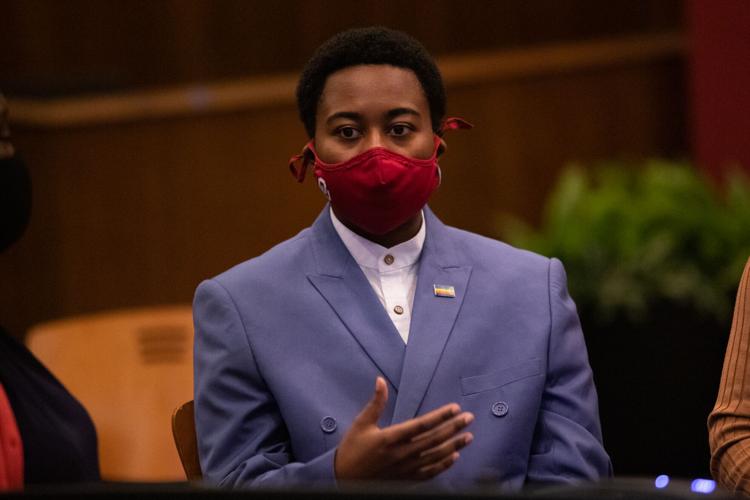
Jamelia Reed — Black Emergency Response Team co-founder and former co-director, and African American studies senior:

Senior African and African American studies major Jamelia Reed speaks at the Tulsa Race Massacre centennial symposium on April 8
Reed said that, as a leader of the Black Emergency Response Team and student advocate, she had to adapt to the pandemic, which made it harder to pull people out of their shells. Although Reed understood administration and faculty needed “grace” from students, she said students needed grace too.
“We have technology, but we really figured out and realized that, although we do have the technology, we can also get burnt out on technology,” Reed said. “Quickly, we had our cameras on (in class), but turned them right back off, or (stopped) attending period.”
Reed advised to “do what you love today, because tomorrow isn’t promised,” as she recounted the millions of lives lost to COVID-19. She said time is more valuable than people may think.
As Reed prepared to depart from OU, she provided a final statement to its leaders.
“The honor and pleasure is yours,” Reed said. “Understand, if you ever want my time and energy again, it will come at a cost, and it won't be free.”
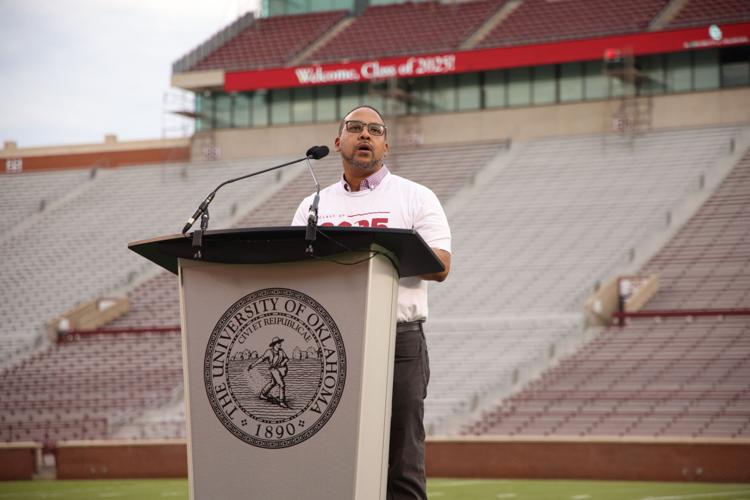
David Surratt — vice president of Student Affairs and dean of students:

OU Dean of Students and Vice President of Student Affairs David Surratt during the OU class of 2025 kick-off on Aug. 13.
Surratt said when he first came into the position in 2019, the OU community was trying to address campus climate issues, but these efforts were derailed by the pandemic. He said when he was a freshman at OU, he got involved in several public health-related student groups, and he tried to tap into that knowledge in the early days of COVID-19.
“I tried to trust, and what I think really good leaders should try to do is ask really important and powerful questions to gain an understanding of how to move forward,” Surratt said. “So that's kind of what I focused on was thinking about ‘What questions have I not asked? What are the sorts of information I need to get? And then how do I communicate and lead in a way that's both compassionate and clear?’”
Surratt said, throughout the pandemic, he spent time reflecting on the concept of tragic optimism, which was introduced by scientist, neurologist, psychologist and Holocaust survivor Viktor Frankl, who acknowledged the inevitability of pain, guilt and death.
“You have a choice to suffer and dive into these feelings of despair, or you have the choice of experiencing tragedy or suffering and focusing on ‘what is it that is to be learned from this experience?’ … I don't think I've met anyone that hasn't been touched by or impacted by COVID, either directly or indirectly, at this point,” Surratt said. “And so the question for us is ‘what meaning do we make of it and how do we move forward?’”
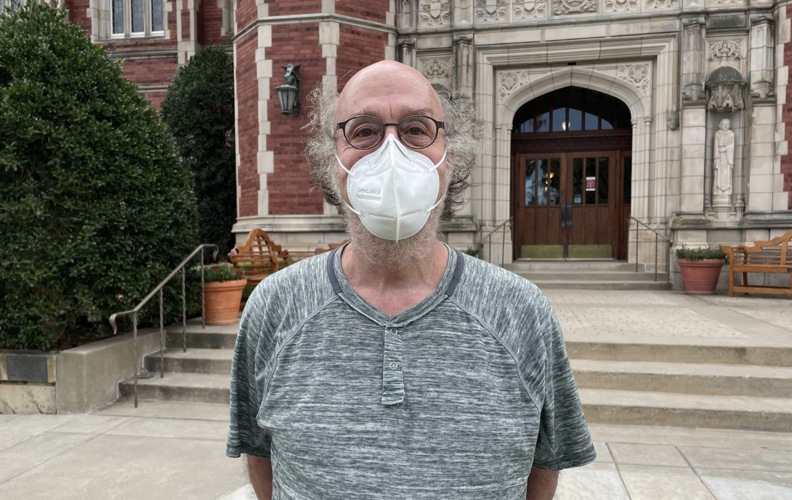
Michael Givel — President of the OU American Association of University Professors and political science professor:

OU political science professor and OU-AAUP president Michael Givel outside Evans Hall.
Givel said it’s been an honor and a challenge representing OU faculty throughout the pandemic.
“I hear stories about how staff members, in particular, have been resigning, and this is a trend that's been going on around the country since the pandemic,” Givel said. “Faculty members become more disassociated from the university due to being isolated, so representing all that can be an interesting challenge.”
The U.S. is “quite different” in its approach to protecting its citizens compared to other countries, Givel said.
“If you've kept your humanity and … you're doing the decent thing, whatever you're trying to do, that's all we can really ask,” Givel said. “Whether it's a little tiny thing or you're trying to change a law or something in between.”
Alex Gray — former Student Government Association vice president, and a public relations and women’s and gender studies senior:

Former SGA Vice President Alex Gray.
Gray said the COVID-19 pandemic made it difficult to prioritize different issues — like mental health, vaccines — and emphasized the importance of the OU community’s ability to rely on campus leadership.
She said her biggest takeaway from the pandemic was the ability to give and receive flexibility.
“(It's important to) give yourself grace and other people grace, because everyone is dealing with things, and the world is super unpredictable,” Gray said. “You just have to be able to adapt, and to be adaptable. You really just have to give yourself the space to do that and give other people the space to do that as well.”
While Gray plans to move to California to work for education nonprofit Teach for America after graduation, she said she’ll take the lessons she learned during her time in Norman with her.
“Something that I've definitely gotten out of it (is taking opportunities), because you never know what could happen, and you never know what the world can look like in a year,” Gray said. “I think that I really have grown into this mindset of, ‘I should take every opportunity that I have and do everything that I can to kind of experience life.’”
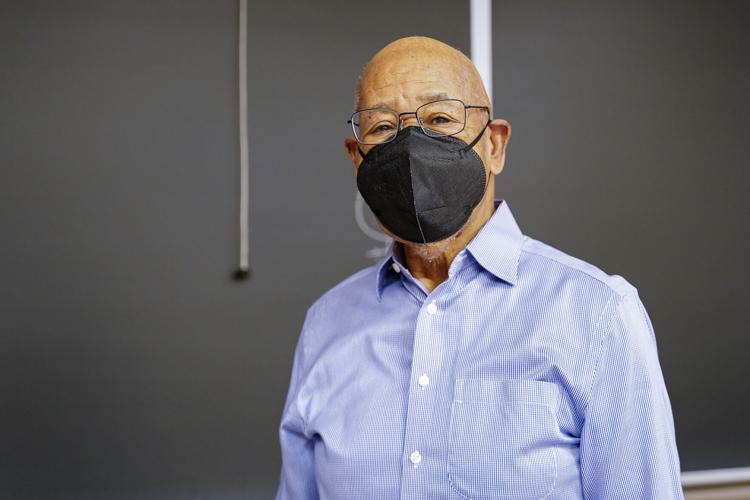
Dr. George Henderson — professor emeritus of human relations, education and sociology:

Dr. George Henderson, OU professor emeritus, poses for a photo on March 8.
Henderson wrote that his campus activities with students before COVID-19 revolved around teaching classes and having meetings with current, past and future students. He said after COVID-19 protocols were put in place, most of those activities went virtual.
“The meetings I held off-campus were rushed and felt emotionally cold to me,” Henderson wrote. “They were deficient in face-to-face and person-to-person interactions that are embedded in verbal and nonverbal cues.”
He said virtual gatherings meant misinformation, disinformation and wasted time affected his ability to help students actualize as humane persons and facilitate positive social interactions off campus.
He wrote that he hopes his “new normal” after the height of the pandemic will replicate most of his pre-COVID-19 behaviors, but if COVID-19 protocols are required again, he wants to have a better “plan B.”
“Truth be told, I was not creative enough to alleviate that situation,” Henderson said. “I should have tried harder to facilitate teams that were inclusive, emotionally safe and effective. Instead, I shifted my share of the unhelpful behavior onto the students. Shame on me.”
Crispin South — emeritus Student Government Association Undergraduate Student Congress chair:

Former OU Student Government Association Undergraduate Student Congress Chair Crispin South.
South said it was weird transitioning from conducting congress business in-person to virtual settings because maintaining community had become difficult.
When he was nominated to become an SGA chair back in December 2020, people in leadership positions — like graduating seniors Ways and Means Committee Chair Lauren Patton and Sustainability Committee Chair Jake Lange — kept their chairships from before his tenure through the end of it.
He said this is because the pandemic caused many people to leave or participate much less in congress, causing a gap between people willing to “take the reins” from previous leadership. When Lacey Lewis took over as chair, he said he had full confidence in the new executive team’s “resilience” because they knew what congress proceedings looked like both in and out of the pandemic.
South said as terrible, depressing and awful as the pandemic was, it completely changed his college experience for the better. He said he started the pandemic as a computer science major, a resident advisor and in Air Force OU. Now, he is none of these, but instead an international securities studies major.
“I’m just a guy at this point,” South said. “(The pandemic) offered me an opportunity to look at what I wanted to do and less of what I was expected to do or what I expected myself to do. I … was able to look at the things I actually liked doing and (used that to) plot out a better path for myself.”
Matt Marks — OU Food Pantry co-founder:
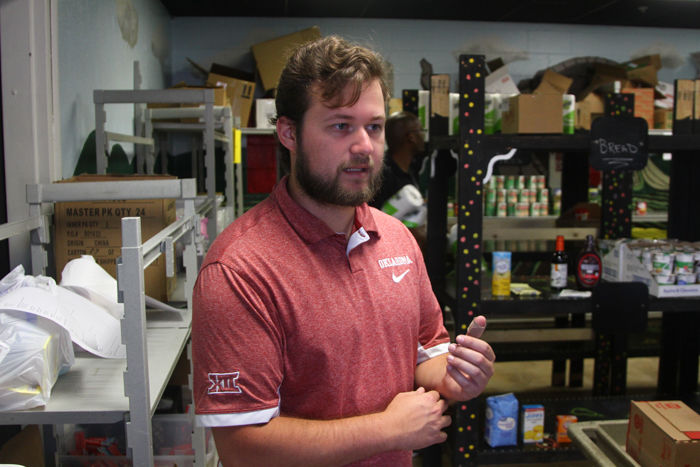
Matt Marks, graduate director at the OU Food Pantry, talks with a reporter Oct. 2.
Marks said the OU Food Pantry altered its operations during the pandemic by transitioning to online ordering. They utilized its storage area for volunteers to come in and bag groceries for their online orders.
“It’s worked out so efficiently. We try to get people in and out as quick as possible,” Marks said. “That's kind of a bright spot from having to change everything. At first, we were like, ‘Well, we really don't want to do it.’ We liked the store model — but I think we've all fallen in love with this model.”
The pandemic encouraged the pantry’s clients to voice their struggles to pantry volunteers. This revealed the help and impact having access to free groceries provides.
“I remember talking to an international student back in August who came over here and said, when they got over here, they didn't have a blanket or pillows, and they had to go buy all that and I'm like, ‘Well, that's not right,’” Marks said. “I mean, that's a very basic need that they should have. So, as we launched our clothing closet and (offered) some household goods, we're like ‘Let's try to get that stuff so we can hand out to our students and staff.’”
Marks said one of the biggest lessons he’s learned throughout the pandemic is that everyone needs help at some point. He said the tragedy and sadness brought by the pandemic create an opportunity to brighten someone’s day and take stress off people’s shoulders.
“I think that's the biggest lesson, is just hearing people's stories, learning how we can better serve them and talking to the community,” Marks said. “That's just opened my eyes over the last couple of years, just to see what more we can be doing.”
Keri Kornelson — OU Faculty Senate chair:

OU Faculty Senate Chair Keri Kornelson.
Kornelson wrote in an email to The Daily that she was fortunate because many of the logistics of running the Faculty Senate virtually had already been worked out by Amy Bradshaw and Joshua Nelson, the previous chairs.
She said the Faculty Senate Executive Committee worked long hours with her at the start of the fall 2021 semester to collaborate with OU leadership for plans regarding the two-week masking policy, COVID-19 testing and vaccines.
“We accomplished so much in a very short amount of time,” Kornelson wrote. “I was so impressed by the impact when dedicated and talented faculty come together.”
As the forefront of the pandemic winds down, Kornelson wrote that she thinks some things may change or go back to “normal.” She wrote that, as a faculty member, one personal silver lining of the pandemic was the technological skills and tools she and her colleagues developed. However, she still has a better sense of the “magic” that happens when people meet in person.
George Ahmadi — Student Government and Organization Services director:
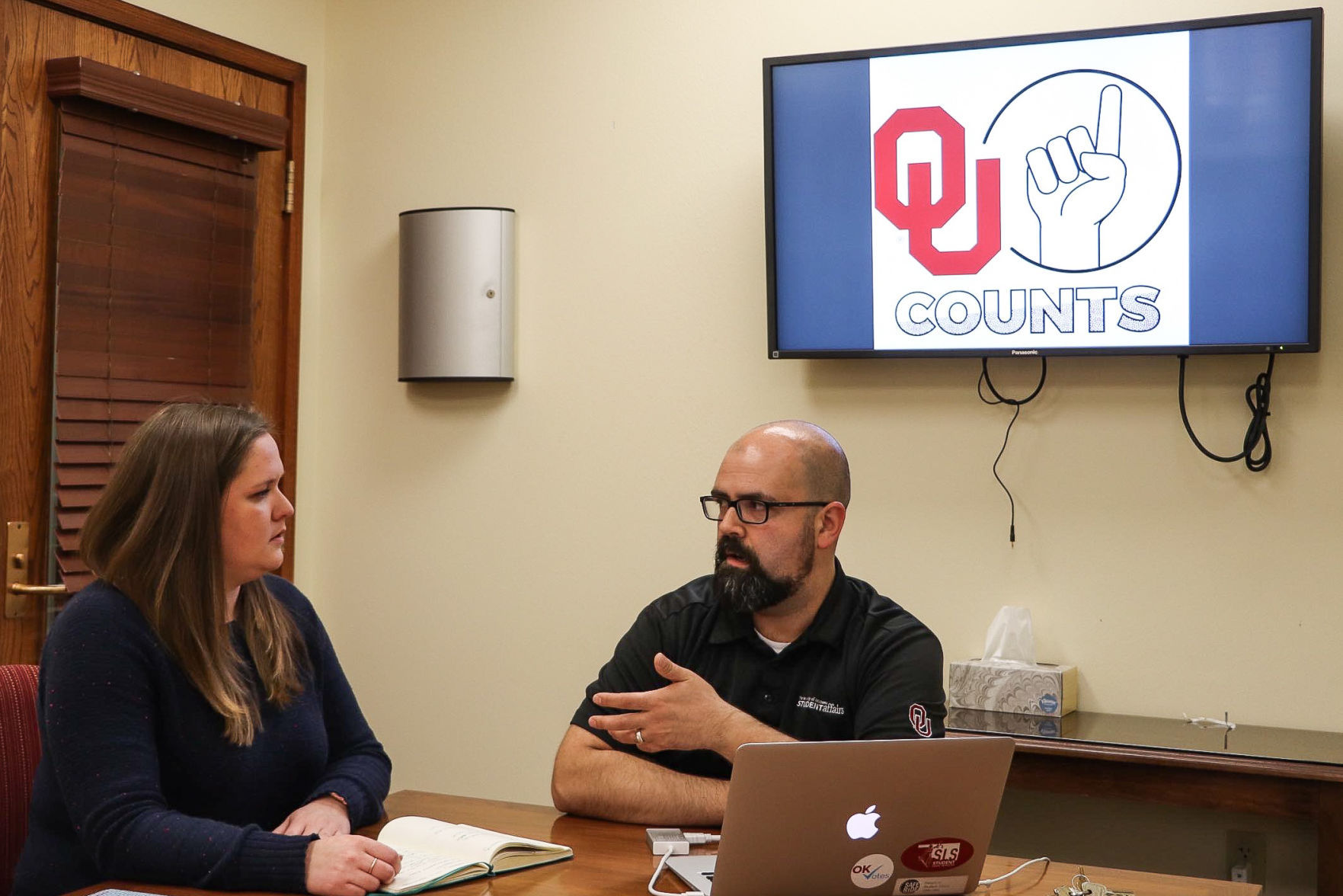
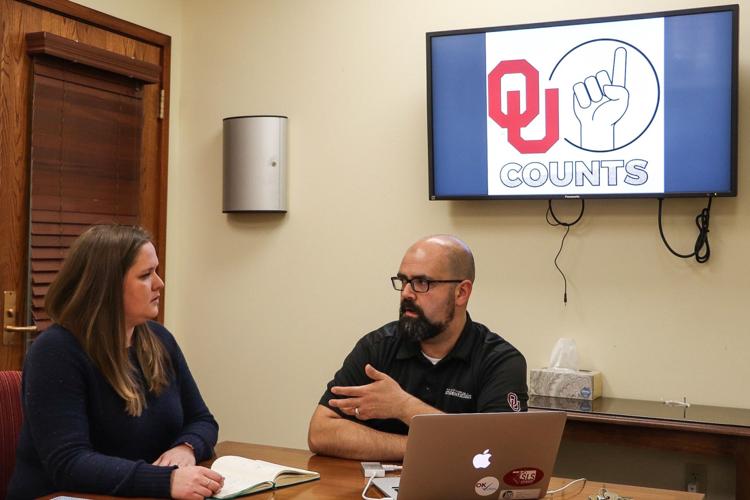
Lauren Schueler (left), director of N.E.W. Leadership and civic engagement at the Carl Albert Center, and George Ahmadi (right), SGA adviser, discuss plans for OU's Complete Count Committee, "OU Counts." on March 31, 2020.
Ahmadi said the biggest shift he experienced during the pandemic in his position was the university’s move from OrgSync to Engage. He also said a large part of the shifts he saw was the ceasing of in-person events for the campus’ over 500 registered student organizations.
He said Student Government Association staff tried to make COVID less impactful in students’ lives by providing a safe atmosphere and office space and leaving operations up to the student leaders.
“So much of what we do in campus life is dependent on being in person. I don’t think our operations were as affected as much as students’ lives that were impacted,” Ahmadi said. “April is a very active time on campus, especially with events. I felt like, at first, it was something that we were getting through, but over the summer was when we realized, ‘Oh, right, this is gonna go on. We’re not done.’”
Ahmadi said the difference between last year and this year, for him, is that last year was about following pandemic protocols and this year was really about “returning to campus.”
He said Bratzler and his team, and Surratt and the Emergency Operations Center have done an amazing job figuring out solutions so there wasn’t a large outbreak on campus, which allowed RSOs to return to in-person operations.
“I’m very happy to say it’s been a bustling April, but it has also been challenging because what we found is we really need a full year for all of us to really be able to assess what a standard year looks like,” Ahmadi said.
Coming out of the pandemic, Ahmadi said he is proud of Student Affairs for being there for students outside the classroom throughout the pandemic, and he looks forward to RSOs reintroducing in-person events to their schedules while also offering and expanding online events as well.
“What’s been interesting to me is students’ ability to be innovative about how they deliver their message and their information, which is a cool thing,” Ahmadi said. “Students are super adaptable in so many ways, and also super accommodating. … I hesitate to say that this is the new normal, but I think we are trying to strive for ‘Hey, what can we make for a meaningful experience?’”
Shane Hampton — OU Institute for Quality Communities director:

OU Institute for Quality Communities Director Shane Hampton.
Hampton said a big part of IQC’s operations is traveling to the places they are helping, which was halted during the pandemic. He said the workaround was to take two or three students at a time to the respective small town, and to utilize hybrid and online meetings and workshops to talk with community leaders.
One thing he said he could see being added to their standard practices is virtual meetings over Zoom and the usage of 360 photography to map the interior of a room and provide a 3D virtual reality experience for working remotely.
“Working with some faculty in construction science and interior design were able to (use the 360 photography),” Hampton said. “Students could walk through, literally walk through the building, and even measure things within the building.”
Hampton said a conversation he has seen open up as COVID-19 restrictions lessen is about how communities will operate after the pandemic, which relates to IQC’s role of looking at how healthy Oklahoma communities are and their ability to sustain people who live there socially and economically. He said he thinks the institute can engage with a lot of those questions in the coming years.
“There’s a whole other thread of trends with so many people changing jobs and looking for remote work with high cost of living in many metropolitan areas around the country,” Hampton said. “Coupled with the increased flexibility of companies with remote work, what opportunity does that present for nice, high quality of life towns in Oklahoma that have affordable housing and access to nature and natural amenities?”
John Emery — assistant professor of international security:
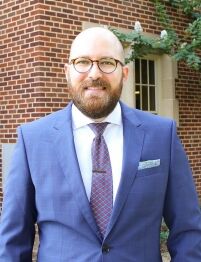
Assistant professor of international security John Emery.
Emery said having empathy and compassion for students by giving them options on how to best assess their learning during COVID-19 is something he’ll continue practicing as he teaches.
"I think the biggest value that has become more central to my life because of the pandemic is empathy,” Emery said. “Understanding that everyone is going through something unique and struggles in their own way. Some students need the space of class, for routine and normalcy, while for others it is completely draining.”
David Horton — Big Event chair:
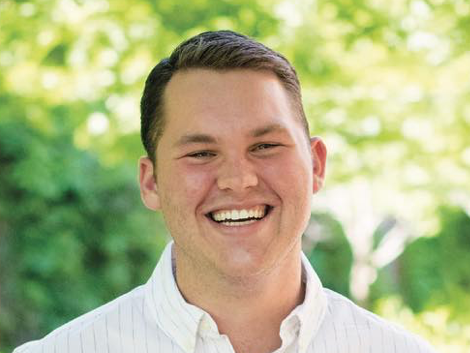
OU Big Event Chair David Horton.
Horton said he learned to be grateful for whatever situation he’s in as he reflected on moving back in with his parents when the pandemic first struck OU. He said he spent more time with his family.
“I think you don't really appreciate that a whole bunch when you're working all the time or trying to enjoy college, but just taking that opportunity to invest in those relationships is important,” Horton said. “The pandemic was a cool opportunity to see how I can learn from my family and really develop those relationships.”
Emily Rhinehart — Fraternity and Sorority Programs and Services coordinator and Panhellenic Association adviser:

Fraternity and Sorority Programs and Services Coordinator and Panhellenic Association Adviser Emily Rhinehart.
Rhinehart said as Greek Life returns to “normal” operations, she understands there is a learning curve to restoring these operations since they’ve grown accustomed to virtual Greek Life. She also added that overall involvement in Greek Life is down since returning to in-person operations.
The Fraternity and Sorority Programs and Services are trying to help students gradually get used to being more active with their organization, Rhinehart said.
“I felt the impact it had on students (was) not being able to build community in the same space. It truly put into perspective (the impact)proximity to others has on group dynamics when it was completely taken away … from losing loved ones to feeling lonely due to staying away from others 24-7,” Rhinehart said.
Francesca Losh — incoming Campus Activities Council chair:

Chemical biosciences senior Francesca Losh.
Losh said she and the organization have lots of plans and events in store as the university transitions back to “normal.” She said at the beginning of the pandemic, the CAC had to adapt quickly in order to still bring “excitement” and “life” to campus even virtually.
“The first few months were spent strategically planning how we can best provide the experience of ‘bringing college to life’ given the circumstances,” Losh said. “We converted many of our activities to virtual, finding a new appreciation for virtual events.”
Losh said the pandemic taught the CAC and herself how to adapt to new challenges and problems quickly, and she said these new skills have come in handy while returning to normal and hosting events across campus.
“We have definitely learned things from COVID-19 and are more ready to have a plan of action if new situations were to arise,” Losh said. “The pandemic provided a larger perspective for how we can continue to grow as an organization to bring college to life for students in the best way we can.”
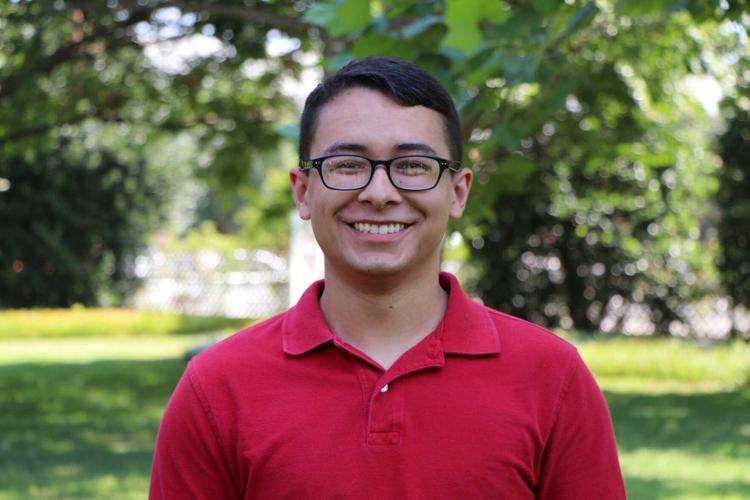
Zack Lissau — SGA president:

Marketing, pre-law junior Denzel Akuffo (left) and public relations, pre-law junior Zack Lissau (right) are one ticket for the presidential election.
Lissau wrote in an email to The Daily the theme of the pandemic was exemplified by the dedication he saw from OU faculty and staff. He wrote he applauds the staff who invested so much of their lives in the university and its mission.
“I was immediately touched by these acts of service from the staff at OU,” Lissau wrote. “Some tasks at OU that are completed by staff are unknown. This may include, but is not limited to, fixing the chairs in the library for hard-at-work, studying students during finals week, or tidying up the residence hall living rooms so that students can come back to a clean, organized space after a long day.”
Celebrating Staff Week at OU reminded Lissau of the “unwavering courage and bravery” the university’s service industry provides to the OU community and the world, he wrote.
“I write this to remind us all to remain patient with employees all over the country, but especially here at OU,” Lissau wrote. “Show your appreciation. Be kind because a smile goes a long way.”
Kaleb Slawson — OU Gaming Club president and information science and technology junior:

OU Gaming Club president and information science and technology junior Kaleb Slawson.
Slawson helped organize various events for OU Esports and OU Gaming Club, including a weekly “Super Smash Bros.” tournament, Sooner Smash Dojo and a back-to-school and end-of-the-year bash. The in-person events are both the most fun and challenging, Slawson said.
“It’s great to be able to have everyone come out like that, and that’s what I enjoy the most about (OU Gaming Club),” Slawson said. “But the difficulty of it comes from the planning of it. … That’s why it’s great to have so many members of (OU Esports) leadership.”
Slawson said he hopes OU Esports and OU Gaming Club will continue to grow and receive more competitive titles and scholarships.


