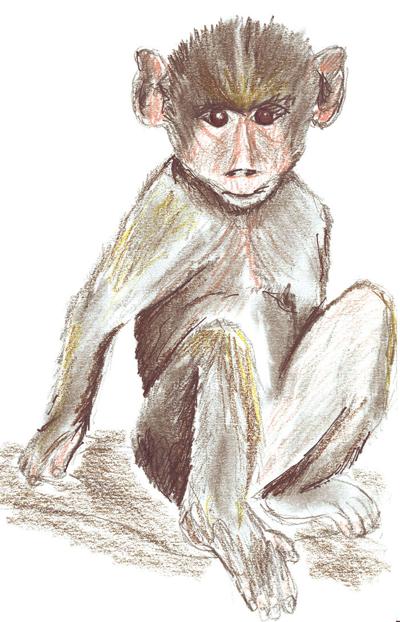
A complaint was filed on June 25 against OU for allegedly violating the Animal Welfare Act, regarding the deaths of 50 baboons under OU Health Science Center's care.
Stop Animal Exploitation Now, a national watchdog group, sent a letter to the United States Department of Agriculture on June 25 detailing OUHSC’s alleged infractions.
SAEN was alerted to the baboons' fate at OUHSC after the USDA investigated it earlier this year for alleged mistreatment of the baboons.
The USDA’s report cited the university for hosing down three young primates and putting them at risk for hypothermia. The report also said that the cages were inadequately cleaned.
Stacey Ellison, an SAEN research analyst, states in her letter that the OUHSC has violated section 2.33 of the Animal Welfare Act, Attending Veterinarian and Adequate Veterinary Care. The letter cites several pathology reports of dead infant baboons as evidence.
One infant was found dead on Jan. 16, 2014, after its birth 24 hours earlier. It was found partially cannibalized and it was unclear if the cannibalization was the cause of death or if the animal aspirated on its own amniotic fluid, according to the pathology report.
Additionally, two infant baboons were found dead within one day of each other on Feb. 5 and 6, 2014, both having suffered traumatic head wounds from unknown sources.
Another infant was found dead on Feb. 24, 2014, having been cannibalized by its mother. The pathology report notes that the animal was never observed alive and died on its date of birth.
Overall, 19 baboons suffered trauma-related deaths, often from severe skull fractures, and 17 of the victims were infants.
Ellison states that these deaths are in violation of the AWA because they reflected a pattern and there is no evidence that any measures were taken to prevent the pattern from continuing.
Ellison cites more violations of section 2.33, including improperly monitored animals.
On Aug. 12, 2014, a 10-day old infant was found to have been kidnapped by another baboon for two days and was emaciated and suffering due to being unable to feed from her mother.
On May 19, 2014, an infant baboon was found emaciated with its head stuck in the bars of its cage. Three more infants were found to be emaciated, and SAEN said it believes that this level of malnutrition would not have occurred if the animals were monitored daily, as required under the act.
Ellison said she would like to see the university comply with the AWA and improve the conditions for the baboons.
Ellison said she thinks that the baboons’ manners of death speak volumes about the conditions that they must live in.
“It’s hard to imagine a mother cannibalizing her own offspring,” Ellison said, “To be under that much stress and that much psychological pressure I think it says a lot about the conditions there.”
Ellison said the USDA has acknowledged the complaint and will launch a probe of OUHSC. It could be months before the department reaches any conclusions, however.
According to a statement from Dr. James Tomasek, vice president for research at the OU Health Sciences Center, the university is not aware of any investigation by the USDA, despite statements from SAEN.
“In fact, OU has never been charged by any state of federal agency with violating the Animal Welfare Act,” according to Tomasek.
Baboons are kept at the Fort Reno Science Park in the OU Health Sciences Center and are maintained in their “normal social environment in the wild” as approved by the National Institutes of Health, according to Tomasek.
According to the statement, in the natural environment, deaths in the colony often occur, especially infants as a result of accidents or adult aggression.
The university takes any and all deaths very seriously, Tomasek said.
OU’s Animal Care and Use Program has five full-time veterinarians who oversee animal health and welfare on a daily basis, according to Tomasek.


