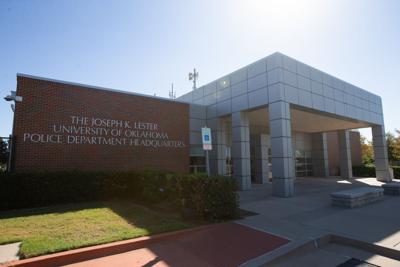

Oklahoma’s stalking statute was updated to allow law enforcement to serve warnings to offenders as stalking at OU continues to increase over the past five years.
Oklahoma Statute Title 21, Section 1173 details legal repercussions for those who engage in stalking, including a new provision for police officers to serve warnings to offenders. The section classifies the crime as a misdemeanor punishable by imprisonment of up to one year in county jail, a fine of no more than $1,000 or both.
Stalking, as defined under OU's Title IX policy, is when two or more acts, including but not limited to acts in which the stalker directly, indirectly or through third parties, by any action, method, device or means, follows, monitors, observes, surveils, threatens or communicates to or about a person or interferes with a person’s property.
Six cases of on-campus stalking were reported in 2021, the same as in 2020. Four cases were reported in 2019 compared to one in 2018 and zero in 2017.
According to the OU Police Department, stalking is most prevalent on campus during the fall and spring semesters when attendance is high.
“More college-age women report stalking concerns to OUPD than any other demographic. This mirrors national statistics, with women reporting being stalked more than twice as often as men, and with persons ages 20 to 24 reporting being stalked more often than any other age group,” Lieutenant Chase Brooks, OUPD public information officer, said.
According to Amber May, the assistant director for OU Advocates under the Gender + Equality Center, there is no way to attribute any number of stalking reports to just one factor, but common stalking behaviors include persistent phone calls, texts, social media messages, emails, showing up or waiting for someone at their work, outside their residence hall or outside the building they have class in.
OU reported one case of off-campus stalking in 2021 and zero in 2020, compared to zero in 2019, 2018 and 2017. One case of stalking on public property was reported in 2021 compared to three in 2020 and two in 2019.
“Even if you're on campus or off campus, it's best to be in pairs, or with friends. Make sure when you're walking, especially when it's night out or dark, to have multiple people that you're with, or at least let somebody know where you're at and where you're going,” Ali Jaffery, Norman Police Department lieutenant, said.
According to the Oklahoma Department of Human Services, victims of stalking can file a protective order in district court in the county where they or the abuser lives. Victims must fill out a form called "Petition for Order of Protection" or in an emergency situation, ask for an order immediately, and file a "Petition for an Emergency Order of Protection."
“The reality is that only stalkers can stop stalking from occurring. But, society can work together to minimize stalking by: Educating people to understand, recognize, and address stalking. Mobilizing men and boys as allies in prevention efforts because we know that girls and women are at greater risk of stalking,” May wrote.
The OU Institutional Equity Office provides supportive measures in response to reports of illicit behavior. Supportive measures are intended to be readily available and are designed to protect the parties or the university’s educational environment. Christine Taylor, OU’s Institutional Equity officer and Title IX coordinator, wrote. The Title IX coordinator organizes the implementation of supportive measures.
To report stalking, contact OU’s Sexual Misconduct Office at smo@ou.edu or 405-325-2215.
Additionally, OU Advocates offers a 24/7 service hotline for OU community members facing sexual violence, harassment, stalking or relationship violence at 405-615-0013.
This story was edited by Alexia Aston, Karoline Leonard and Jazz Wolfe. Mary Ann Livingood and Nikkie Aisha copy edited this story.


