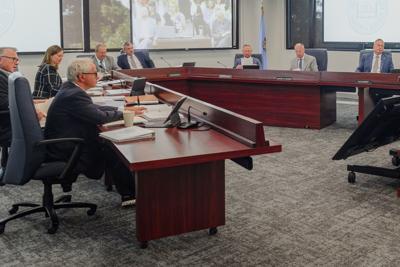
EDMOND — The Oklahoma State Regents for Higher Education on Thursday unanimously approved a request for an additional $426 million from the state Legislature for next budget year.
Regents said they will need hundreds of millions more on top of their over $1 billion current legislative allocation for deferred maintenance, workforce development programs and research projects.
The agency’s request includes $347 million in one-time requests, $21.5 million to pay for legislative initiatives and increasing the agency’s base operating budget by $57 million, an increase of 5.5%.
The $57 million increase to the base operating budget includes $13.5 million to meet “critical workforce” needs in education, health care and engineering. They also want $43.5 million for student success programs like scholarships, student support, campus safety and “performance-based formula allocations.”
“Our budget request reflects continued investment to meet growing workforce needs in STEM, education and health care,” said board Chair Courtney Warmington in a statement. “Increasing college degree completion in high-demand fields remains public higher education’s top priority.”
The $347 million in one-time requests would be for “institution-specific allocations.”
Over $56 million of this would pay for deferred maintenance across all institutions. To address all deferred maintenance at Oklahoma’s public colleges and universities would cost the state $1.9 billion, according to the budget request.
It also includes $68 million for both University of Oklahoma and Oklahoma State University for “research and capital projects,” $60 million for regional and four-year universities for workforce investments and $20 million for two-year colleges for the same purpose.
The final $21.5 million for “legislative initiatives” includes funding for programs passed or required by the Legislature like expanding concurrent enrollment opportunities for high school students and funding financial assistance programs.
Legislative priorities
The Regents on Thursday approved a series of their priorities for the upcoming legislative session.
One goal includes increasing the annual family income limit to qualify for the Oklahoma’s Promise scholarship program, said Jarrett Jobe, vice chancellor for governmental relations. The scholarship program offers qualified Oklahoma students, based on income and academic standards, an opportunity to earn a scholarship for college tuition.
Jobe said the agency also wants to clear up definitions in the law passed last session expanding Oklahoma’s Promise to the children of educators.
Oklahoma higher education leaders previously said lawmakers may not have allocated enough funding to meet the demand for this expansion.
The scholarship program is expected to cost the state $88.2 million for the upcoming fiscal year, officials said. This is an increase from previous years, largely due to a longer application window, more students meeting the requirements to qualify and the Legislature expanding the program to the children of Oklahoma educators.
Stabilizing property insurance rates is another major priority, Jobe said, because insurance is increasingly contributing to more expensive operational costs for all public higher education institutions.
“As you know, we’ve received in our budgets and relief for our system over the last few years to the $5 million to stabilize these rising costs,” he said. “(We) have met with the insurance commissioner last year and we’re trying to figure out some statewide policies to help not only higher education, but the state, to keep those down and mitigate rising costs.”
Other priorities include supporting campus research, supporting adult learners and enhancing campus security by addressing physical and cybersecurity threats.
Oklahoma Voice is an affiliate of States Newsroom, a nation 501(c)(3) nonprofit supported by grants and donations focused on delivering state government news. The Voice maintains full editorial independence. For more stories by Oklahoma Voice go to oklahomavoice.com.


