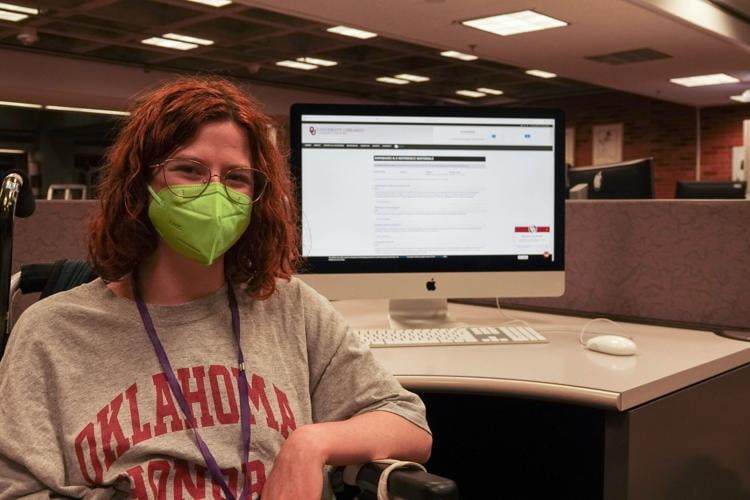

When Flora Ellis came to OU, she had two years of unrestricted interactions with OU Libraries databases. Now a communications sophomore, she felt better equipped to navigate her college courses than her peers, thanks to her background in higher education research gained through her advanced junior and senior AEGIS English class at Norman High.
Beth, a junior at Norman North High and an AEGIS student who requested her last name not be used, is being required to conduct mediated searches with library staff on a separate list of databases deemed appropriate for K-12 users.
To succeed in the course, Ellis said it was important students could access OU’s more academically rigorous databases over Norman Public Schools’ less comprehensive, age-specific offerings. But if Ellis were in Beth’s shoes, she said she would feel anxious and be less likely to use OU Libraries resources if she had to participate in a mediated search.
As OU seeks to become a top-tier public research university through the first pillar of its strategic plan, students like Beth are experiencing obstacles related to their research before they have an opportunity to consider going to OU.
This is an on-the-ground consequence of House Bill 3702, a bill codified into the Oklahoma Statutes Nov. 1 intended to filter out obscene material within academic library databases.
Sen. Darrell Weaver (R-Moore) and former Rep. Todd Russ (R-Cordell), the bill’s authors, wrote HB 3702 with the intention of protecting children from obscene and pornographic material in academic settings.
Rep. Andy Fugate (D-Del City) said it is a piece of model legislation, or prefabricated bills often written by special interests seeking to achieve a political goal, according to the Center for Public Integrity. Fugate said similar bills that have passed through the legislative session across the U.S. in the past few years are a result of well-intentioned people being led astray.
As OU and other institutions weather the bill’s impacts, current and former local high school students, OU librarians, professors and some Oklahoma legislators believe the bill is connected to state and national efforts to ban books and restrict material on gender- and race-based topics, further infringing on academic freedom, research and education.
From the House floor to libraries
Russ took to the House floor for the fourth reading of one of his final bills before his successful bid for state treasurer.
The law states that a school district, charter school, virtual charter school, state agency, public library or university can only offer digital or online library database resources to K-12 students if the vendor, person or entity providing the resources verifies that everything complies with safety policies regarding material defined as child pornography or obscene in section 1024.1 of Title 21 of the Oklahoma Statutes.
Although it’s the vendor’s burden to maintain these filters, employees of the institutions covered by the bill aren’t exempt from prosecution for “willful violations,” according to the bill’s text. Russ said on the floor May 12 that it is the primary responsibility of teachers and librarians to manage those systems.
When House Rep. Melissa Provenzano (D-Tulsa), a former high school teacher and education administrator, asked why this bill was required when protections already exist in K-12 and public library settings, Russ said several schools and libraries lacked proper filters. When Provenzano asked Russ to define areas of concern, he was unable to specify any.
In mid-November, about two weeks after Oklahoma institutions began to grapple with the enacted law’s impact, Russ declined to comment on HB 3702 despite multiple phone and email communications from OU Daily.
Fugate said Russ missed the mark with HB 3702 as children can use search engines beyond academic databases and settings to view inappropriate material. He said the bill’s effect differs from its intended purpose.
“What this bill did and does is, once again, unfairly target teachers and librarians with drastic penalties for things that, quite frankly, are, generally speaking, out of their control,” Fugate said. “And, at a time when we can't find teachers for our classrooms, the last thing we need to do is make it even scarier to participate in the education process.”
OU is one of many Oklahoma institutions managing the impacts of this legislation. According to an open records request, OU Libraries leadership worked under the guidance of its Digital Strategies and Innovation Team, OU general counsel and the provost’s office to implement safeguards for K-12 students interacting with its databases.
It took months to plan the library system’s response and for signed certifications from vendors to come in before the library could separate complying databases to a website for K-12 students.
On Oct. 26, an OU spokesperson wrote in an email to the Daily that the university intended to fully comply with HB 3702 and was in communication with its vendors regarding theircompliance. On Nov. 4, the spokesperson wrote that the university was working with vendors to ensure it can offer as many resources to K-12 students as possible, and an open records request was required for the complete list of complying vendors.
Many library staff learned of the bill’s application to their work on Oct. 28 through a weekly OU Libraries newsletter. OU’s general counsel requested certifications from all contracted database vendors and, as of Nov. 16, 71 of the 120 database vendors OU is contracted with signed on in compliance with HB 3702, according to a records request.
Fugate, who previously provided access to The Oklahoman newspaper and its century-plus archives through online library systems in colleges and high schools, said vendors will likely put a general policy in place, obtain liability insurance and point to their reasonable due diligence if infractions surface. Doing so would shift the blame to employees providing access to the resources.
The bill states if a provider fails to comply, the institution should withhold payments pending the verification of compliance. If the provider fails to verify its compliance in a timely manner, the institution should consider its noncompliance a breach of contract.
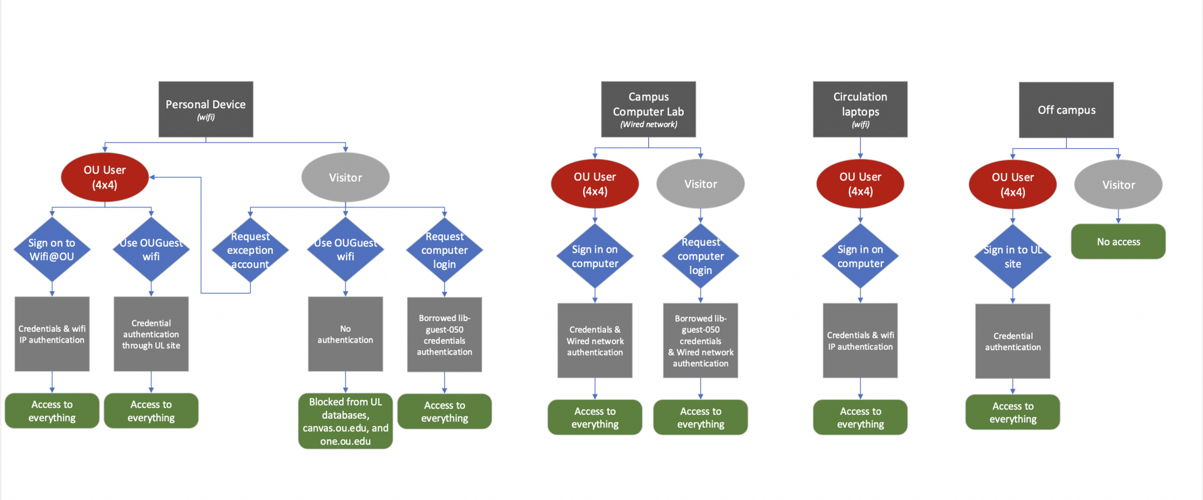
Visitors, excluding K-12 students, can access databases by requesting a guest credential or an exception account from OU IT to gain access for an extended period on a personal device, according to the Oct. 28 newsletter. Guests are directed to use the WIFI@OU for a more secure network than OUGuest.

A diagram created to assist in understanding user access to databases from various devices and locations with various credentials, according to an email obtained from an open records request.
A memo included in a Nov. 4 OU Libraries newsletter noted the system can’t grant K-12 students access to vendor-certified databases on computer lab workstations and classrooms without giving them access to all databases. It stated that K-12 students will be referred to two library staff members who will conduct a mediated search with students at the Research Help Desk.
Beth said she doesn’t want to have to jump through more hoops to get the information she needs to accomplish higher-level work within her classes.
The AEGIS English course Beth is enrolled in focuses on challenging literature and creative writing that ends with students taking both the Advanced Placement language and literature exams, according to Norman North High School’s online news magazine.
The class is currently working on a research paper on authority, and Beth said she wants to write about the distribution and framing of information related to power structures. But, as a high school junior, she said her research is being monitored the same way a kindergartner’s would.
“The point of this class is to do more things that are personal and independent so we can learn to do college-level work to prepare for college,” Beth said. “We're not going to have people looking after us all the time. … I would like to be able to think of how to do things for myself.”
When she was in high school, Ellis said she would often go to the library with her peers outside of class hours to research literary criticisms for her 25-page project. She reminisced on making a home in a corner of the library with her friends to research together.
As Ellis reflected on the hours she spent researching, she said she never came across material anyone could describe as obscene. She questioned why students would go to OU Libraries to find obscene material.
“You really have to search on those databases to find what you're looking for, and so, what are the odds that a high schooler just having to do an intense paper is just sitting there looking for specific inappropriate material on there? And if they are, it's not really the responsibility of the government to be upset with,” Ellis said. “I mean, most kids have phones. Now, we have access to the World Wide Web. You know what you could find on there? Much more obscene — if that's the word we're using — things than you're gonna find on an academic search database.”
Defining obscenity and the law’s impact
In Oklahoma, obtaining and possessing child pornography has long been criminalized in section 1024.2 of Title 21, with a conviction being a felony offense with imprisonment of up to 20 years and a fine not exceeding $25,000.
The definition of obscenity, according to Oklahoma Statutes, is based on the federal definition created in the 1973 landmark U.S. Supreme Court decision in Miller v. California. The phrase “contemporary community standards” is not a national standard but one based on local communities.
As this law applies both definitions to its requirements for filters and guidelines for prosecution, a clear understanding of those standards and their application to database materials is all the more important.
On May 12, Rep. Meloyde Blancett (D-Tulsa) asked Russ if he could define obscenity based on Oklahoma Statutes and provide the floor with a better understanding of his intent with the bill. He said his understanding of obscenity was irrelevant and that the bill’s guide is current statutory guidelines.
Blancett followed up, seeking an understanding of the statutes. She said she didn’t have the title in front of her and wanted to make an educated vote.
“Representative, again, I am not changing the definition of obscene,” Russ replied. “If there's some level (of) obscenity that you want to leave open to kids in K-12, then maybe you can help us with that.”
Mary Sue Backus, an OU professor of law emeritus who taught an education law course for about five years, wrote in an email to the Daily that the new law’s criminalization of the possession and distribution of child pornography is redundant. She also noted whether materials “lack serious literary, artistic, educational, political, scientific purpose or value” is arguable.
“I would argue that all the books OK has banned (i.e. I Know Why the Caged Bird Sings, Maya Angelou) have serious literary, education merit,” Backus wrote. “I suspect many OK legislators disagree on that.”
Joey Albin, an OU education and social sciences librarian, has emailed Russ and Weaver asking about the bill's intent. Because he has received no response, Albin said all he can do is put HB 3702 into context with other library-related legislation. His main concern is whether the bill targets material regarding 2SLGBTQ+ people by equating them with obscenity or pornography.
The past legislative session saw a slew of failed anti-2SLGBTQ+ bills, including Senate Bill 1142, which would have fined schools a minimum of $10,000 per day if someone flagged that a school has books that “make as their primary subject the study of sex, sexual preferences, sexual activity, sexual perversion, sex-based classifications, sexual identity, or gender identity or books that are of a sexual nature” and a school official or librarian refuses to remove it within 30 days.
Senate Bill 1470 would have fined teachers a $10,000 minimum if they taught something that went against a student’s religious beliefs, and Senate Bill 1654 would have banned 2SLGBTQ+ books and books that discuss “non-procreative sex.”
Albin specializes in education, social work, sociology and human relations departments. He makes decisions on materials and services related to them and assists students and faculty as they research.
When Albin heard about HB 3702, his first reaction wasn’t fear of the consequences he could face if he were perceived to have wilfully violated the law. Instead, Albin said he wanted to center the people he believes the bill is likely about and reaffirm his commitment to supporting them.
“If you are a part of that community in Oklahoma and you hear lawmakers talking about obscenities in libraries and facilities and classrooms, you know exactly what they're talking about,” Albin said. “I think that was my first reaction, was to bring that equation, to bring that suggestion into the education research process with databases and everything is to just further allow that kind of insinuation to take root in other aspects of our society.”
Michael Givel, a political science professor and president of the OU American Association of University Professors, said he is concerned about the phrasing “contemporary community standards.” These standards are likely different in Tulsa than what they might be in small-town Oklahoma, Givel said, creating confusion on what these standards are in the context of HB 3702.
He said the bill is contrary to academic freedom and research, as it presents a hardline view of morality in conflict with the real world.
“Are we going to, for instance, ban certain nude art out of Europe that came out of the Renaissance because of this? Certainly suggests it. It's obscene,” Givel said. “What about political speech? (Are we) going to arrest politicians we don't like and trump up the charges based on some sort of obscene thing, supposedly, they said in public? This has a vision of a dystopian society. That's where this is heading. Whether the federal courts are going to toss this out or not, I certainly hope so.”
Critics say the impact of bills like HB 3702, even if seemingly minimal on the exterior, is self-censorship in the classroom. Givel said colleagues have told him they are self-censoring materials regarding race, gender and sexual identity.
Givel said the realities of diverse communities are being downplayed as a sentiment that education should be comfortable emerges among some students. He said he doesn’t subscribe to that point of view.
“Education, sometimes, should make you uncomfortable, and by doing that, we should be talking in a very analytical, civil fashion about the issues,” Givel said. “I think that is how learning happens.”
Similar bills across state lines
HB 3702 is one of at least seven laws limiting access to educational databases that passed through 2021-22 legislative sessions across the nation. Four died at the end of the session, and two passed in Tennessee and Utah.

According to a report created by the EveryLibrary Institute, a nonprofit dedicated to ensuring continued public and political support for library funding, common themes of these bills include that database vendors must filter and block access to obscene materials, failure to prevent access to harmful materials will lead to a termination of the vendor contract, and individuals may file a civil action if violations occur.
Although the past legislative session saw increased targeting of library databases, the effort to limit access wasn’t new.
The report refers to two incidents in 2018 where over 650,000 elementary and high school students' access to EBSCO library databases was curtailed in the Utah Education Technology Network based on an unsubstantiated pornography complaint. The Colorado Library Consortium and EBSCO were sued for pornographic and obscene content that was “harmful to minors.” The Utah decision was ultimately overturned, and the Colorado lawsuit was dismissed.
But, as legislators continue to focus on libraries, librarians and library staff across the U.S. are managing a climate of unprecedented scrutiny and censorship.
Dwight Hunter, the president of the Tennessee Library Association, said the past year presented various challenges, like the Age-Appropriate Materials Act of 2022.
The act states that schools operated by a local education agency and public charter schools must maintain a list of materials in their library collection, adopt a policy for developing and reviewing materials in the library with procedures to develop, review and evaluate feedback regarding if the library collection is age-appropriate, and remove materials that don’t meet criteria.
Teachers were logging overtime to catalog every book in their classrooms, which Hunter said was pointless because librarians already catalog their books, and they had to create lists to allow parents to object to books. He said the state Legislature was shocked by the bill’s unintended consequences.
Hunter referred to bills like HB 3702 as “cookie cutter” legislation and said conservative groups are attaching themselves to these bills in “united anti-library fronts.”
“What we're finding out is that there's a lot of unintended consequences to (this legislation) because not one state is the same,” Hunter said. “There’s going to have to be some sort of pushback to tweak some of those.”
The future of research
Without full access to OU’s library databases as a high school junior and senior, Ellis said her transition into higher education wouldn’t have been as smooth. While her peers were just learning to use library resources, Ellis found herself sitting back as her professors refreshed her memory, and she could more effectively navigate OU’s offerings when research assignments came around.
Now, Ellis said she worries about current AEGIS students like Beth, who are restricted on what and how they search. She laments that the librarians she once talked to on high school field trips must now take caution in introducing students to the university’s databases.
Most of all, she fears for the future of research.
She said she thinks high-achieving high school students — among them, prospective OU students — might elect to avoid uncomfortable mediated searches by seeking out more accessible search engines like Google Scholar with papers that aren’t always peer-reviewed or free.
As vendors began to sign contracts complying with the law, Rick Nagel, OU regent and academic chair of research, said whether elegant or manual, it sounds like accommodations are being made, and he is glad vendors are seemingly on board.
Nagel said the university will always comply with the law, and he understands the spirit by which HB 3702 was enacted into law. But if there are any issues with the bill, Nagel said the university will go back to the Legislature to seek remedies.
“We don’t want to restrict access to academic materials at all.”
Fugate said as students enter OU’s library to research, they will be cognizant of the friction introduced by HB 3702. He believes instructors will see a “dumbing down of research” in classroom settings as they rely on nonacademic sources.
Ultimately, Fugate said the bill doesn’t solve the problem it was created to address.
“Does it solve a different problem?” Fugate asked. “And that is: provide another mechanism to attack teachers and to make it more difficult and uncomfortable for educators and librarians and kids in public institutions? Yeah, it does. … If the point is to make those things harder then yeah, it solves that problem.”


