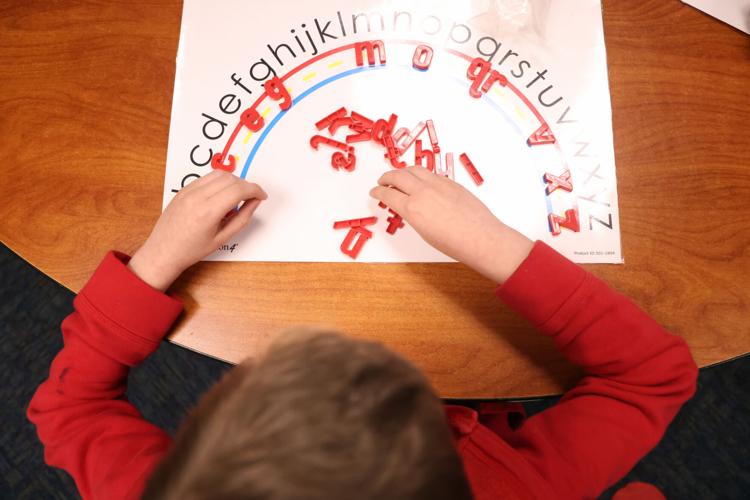
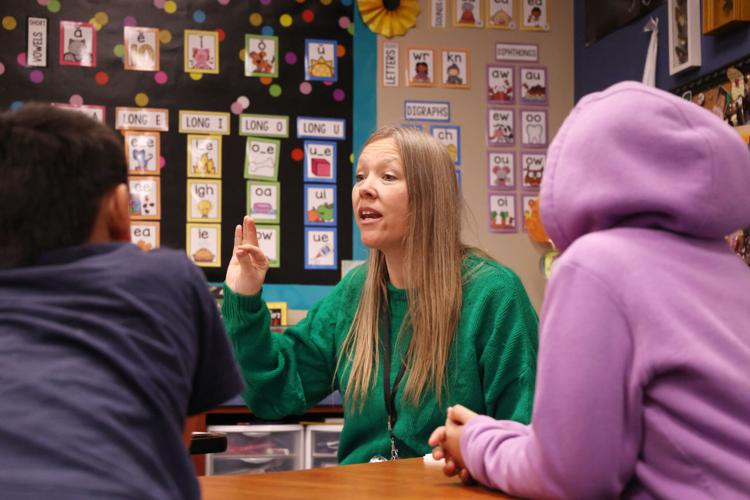
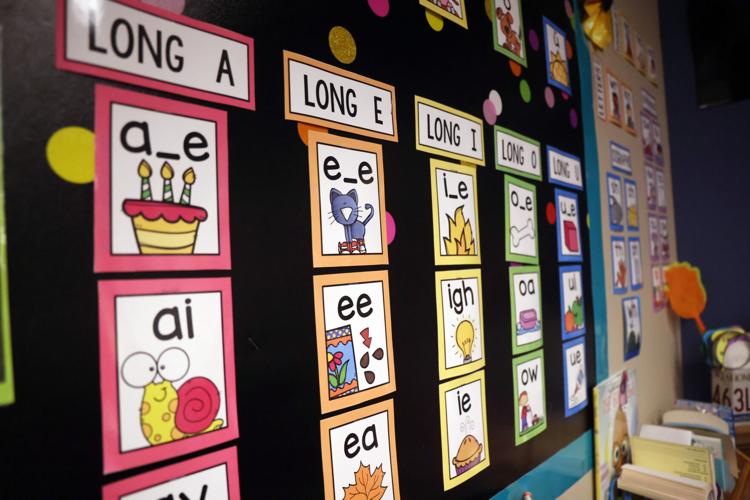
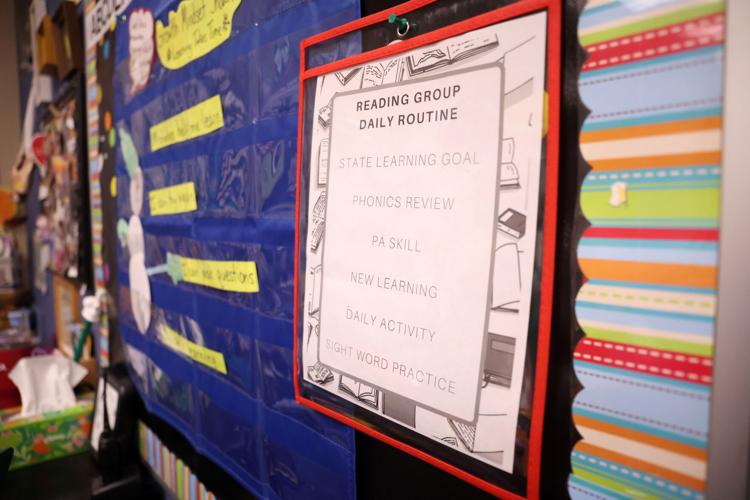


At Norman’s Reagan Elementary, literacy coach Jodie Cook sits with a reading group of four second graders. Cook helps them practice letter combinations like “th” and “er,” using plastic letters to spell out words and having the students read stories.
These students have been identified as in need of reading intervention, so they meet with Cook in an intervention group for half an hour daily. And they aren’t alone — last year’s Oklahoma state test results showed 73% of third graders scored basic or below basic in English language arts, meaning they do not meet grade-level standards.
Though coaches like Cook work across the state to fill gaps in student literacy outcomes, both educators and state legislators think more is needed to remedy low reading abilities. Oklahoma is on track to legalize third grade retention as multiple bills advance through the state legislature, even as conversations about execution continue.
Retention refers to when a student is “held back” and must repeat a grade, and third grade retention laws require students to meet grade-level standards to be promoted to fourth grade. As of 2023, 16 states and the District of Columbia had third grade retention laws.

Remediation specialist Jodie Cook speaks to students at Reagan Elementary on March 9, 2026.
What are Oklahoma’s current and potential literacy laws?
Oklahoma’s Strong Readers Act, formerly called the Reading Sufficiency Act, was passed in 1997 to improve reading outcomes by third grade. According to the Oklahoma State Department of Education’s website, the act ensures that literacy level is a prerequisite for promotion from one grade to the next while providing funding for literacy instruction.
The Strong Readers Act was amended for the 2013-14 school year to include retention for third graders with below-grade-level reading scores. However, in 2024, a senate bill removed mandatory third grade retention from the law, emphasizing training teachers in science-based reading instruction instead.
In 2023, the education department introduced a three-year pilot program of state-wide literacy coaches called Helping to Elevate Reading Outcomes for Every Student, or HEROES, which is up for renewal this year.
Multiple bills in the legislature now seek to change reading interventions, extend the HEROES program, and notably, reinstate third grade retention just a year after it was removed.
Oklahoma Secretary of Education and OU professor Daniel Hamlin said Oklahoma is among multiple states following Mississippi’s example. The “Mississippi Miracle” saw a state rise in its education ranking from 49th in 2013 to 16th in 2025 by focusing science-based efforts on younger elementary students, utilizing literacy coaches and third grade retention.
“That's what we're trying to do with our state legislation during this legislative session, is to get some resources in place for those early interventions,” Hamlin said.
How are students scoring?
According to 2024-25 state test results, only 27% of third grade students met reading standards, scoring proficient or advanced. Even fewer met standards in grades four through eight.
Since 2018, Oklahoma state testing scores show more than half of third graders do not meet English standards. Results showed slight improvement in 2024 because the state inflated its score measurement, but it has since reverted to its original scoring metrics to align with national assessment standards and accurately reflect student abilities.
Oklahoma ranks 46th out of the 50 U.S. states in fourth grade reading on the National Assessment of Educational Progress’ list. Nationally, 69% of fourth graders also had below proficient reading abilities, according to data from its 2024 test.
Deann Jones, OSDE project manager of the Strong Readers Act, said that since the COVID-19 pandemic, an increased number of students have needed reading intervention plans. But this year, she said numbers have returned to pre-pandemic levels as early screenings and targeted interventions help students catch up with their peers.
What are Norman schools doing?
Ann Rosales, NPS director of elementary teaching and learning, said the district’s literacy instruction is evidence-based, following science of reading principles that emphasize word recognition and language comprehension. Rosales said learning to read is a complicated process that involves development in many areas — it’s more than phonics and vocabulary words.
When a student tests in the bottom 40%, Rosales said their teacher creates an individual instruction plan to provide intervention specific to the skill or skills they lack. The student receives personalized instruction time in addition to the standard of at least 90 minutes of reading instruction per day, and teachers communicate the plan to families.
Norman literacy coach Leslie Liesenfeld said she and other coaches spend time in classrooms to support teachers and students. Emily Evetts, another Norman literacy coach, said coaches work with teachers to aid in professional development and data-based teaching methods.
“We spend a lot of our time … being that bridge between what research says is best practice and applying it in the classroom to help our kiddos,” Evetts said.

Reagan Elementary on March 9, 2026.
The language experience children have before entering school is a substantial driver of reading ability, Liesenfeld and Evetts said. Liesenfeld highlighted the importance of adults reading books with children, turning the pages and talking about the story. Evetts said this also creates strong oral language skills, which make students more successful readers.
According to Rosales, interventions in first grade and kindergarten are most effective. She said research shows that if a student is reading at their grade level by the end of first grade, they’re more likely to be a proficient reader moving forward.
Norman offers summer school for kindergarten through third grade students in the bottom 10% to target specific reading skills. Rosales said the district also provides families with learning resources so students don’t backslide over the summer. According to Rosales, ninety percent of summer school students showed growth in the past three years, which she said gives them a strong start to school in August.
The retention debate
Retention research is mixed, but third grade is a significant year for students to be held back because it is when state testing begins.
Rosales said there isn’t evidence for long-term positive gains after retention.
“As a society, we can get really focused on one of those parts, whether that's the part that's in the media or that's the part that really is being evaluated,” Rosales said. “But when we really focus in and look at the complexity of each of those pieces, recognizing that they all have to work together, it's not just one thing.”
Hamlin said old retention studies compared retained students to all other students, which made it appear like retention didn’t help at all. More recent research comparing retained students to similar students who weren’t retained shows positive short-term effects, and long-term studies are still ongoing.
According to Hamlin, third grade retention laws are only effective because other interventions precede and accompany retention, such as reading screenings in early grades, ongoing conversations with families, tutoring and summer school programs.
“Everyone says third grade is too late, and so we should retain earlier, …” Hamlin said. “That’s the point. Third grade retention is a last resort.”
Parents still have the option to retain their children earlier, but Hamlin said he doesn’t recommend a mandate for these grades because test scores are inconsistent. Reading test results aren’t stable until a student is in third grade, he said.
“This is not easy, no matter which way you cut it, and we have to make a decision that's ultimately in the best interest of the child,” Hamlin said. “I don't think we should push through a third grader who can't read just because they may lose their friend group, or there may be some other negative social consequences.”
Jones said retention is not the answer to students’ problems. The first step is providing strong core reading instruction, she said, and step two is identifying struggling students early to provide the right intervention.
“Retention itself is not intervention,” Jones said. “We're not looking at it as intervention. It's more of a fail-safe to give the students additional time for the interventions and supports that we have in place to work for them.”
Melissa Ahlgrim, OSDE program director of literacy policy and programs, said people often forget retention is still an option under the Strong Readers Act. Still, she said retention is not the program’s recommended first step because giving a struggling student another year of the same instruction that isn’t helping them won’t work.

Reagan Elementary on March 9, 2026.
“We do not read naturally, we have to be taught,” Ahlgrim said. “Our brains are not hardwired to process print. So if we're just saying, ‘Well, they just need another year to grow up or to mature. They're not…’ Those, we know, are all misconceptions. Those do not happen. It's like talking to a deaf person and saying it again louder. They're still not going to hear you.”
Though no long-term studies clearly support retention, Ahlgrim said it can help when students are making progress with interventions and simply need more time. Still, she said research shows that screening and intervention work best.
Challenges
Ahlgrim said retention is rendered ineffective when the repeated year looks the same as the first — and in Oklahoma, that’s often the case.
The legislature cannot easily create requirements for the retained year because school districts’ capabilities vary, Ahlgrim said. For example, it cannot create a law that a retained student must have a different teacher than their first year, because some districts only have one teacher per grade, she said.
Jones said if retention is reinstated, it will likely still be up to districts to shape that retained year, but the education department could put out guidelines for them.
Rosales said training teachers is crucial in reading improvement too, and though the education department provides plenty of resources, it doesn’t ensure all teachers are fully trained. She said there are currently more teachers with less than five years of experience than ever, and they need more support and professional training.
Rosales said Oklahoma teacher preparation programs and university curricula lack scientific training in how the brain learns to read. Teachers are responsible for a classroom of 20 students with varying reading levels and need continual professional development to sustain them, according to Rosales.
“It's that sustainability plan of making sure they have that support that they need and that growth that they need to have the highest impact on students,” Rosales said. “Because sometimes students’ needs change and they progress. Your need as an educator changes.”
Rosales said Norman’s literacy coaches offer helpful teacher support, but smaller districts don’t have as many. The HEROES program may help, but she said that the program takes effective, bright teachers out of classrooms where they’re needed in the midst of a teacher shortage.
Hamlin related the lack of training to teacher labor market struggles. He said this disproportionately impacts rural, low income schools, which are often where students with the greatest needs are.
“If you think a classroom teacher really matters — and I think there's no question that a classroom teacher really does — then what do you get?” Hamlin said. “You get students that are not really getting the kinds of educational experiences that they need. So tight teacher labor markets have been a real issue.”
Hamlin said a lack of instructional days contributes to lagging reading outcomes. The national average of instructional days is 180 per year, but Oklahoma’s average this year is 166 days, including seven professional development and parent-teacher conference days, which makes the true average 159 days. Hamlin said he supports HB 3151, which would add seven instructional days a year.
“Our kids get a lot less instruction, there’s just no doubt about that,” Hamlin said. “I think that affects lots of things, like literacy outcomes, math outcomes, student outcomes.”
Ahlgrim and Jones said they are optimistic about student growth, and Jones said administrators, legislators, teachers, the education department and parents are working together to help students become capable readers.
“Our teachers are doing some wonderful and great things in their schools,” Ahlgrim said. “It is not necessarily the bleak picture that is sometimes painted that we see. Do we have work left to do? Absolutely. But we do have some great things going on in our state.”
This story was edited by Natalie Armour. Larkin Bock and Tori Pham copy edited this story.


