
As Oklahoma’s nursing shortage is expected to worsen, the U.S. Department of Education is considering changes to professional degree definitions, which would limit the federal loans available to students pursuing graduate nursing degrees and physical therapy programs.
Last summer, Congress passed the fiscal year 2025 reconciliation bill, or the One Big Beautiful Bill. As a result of this legislation, Direct PLUS Loans for graduate or professional students will no longer be available to new borrowers starting July 1.
Graduate PLUS loans are federal student loans available to students attending graduate or professional school. The loans have allowed graduate students to borrow up to the total cost of their program, including fees and living expenses, after financial assistance is applied. When the program comes to an end in July, these loans will be subject to borrowing caps.
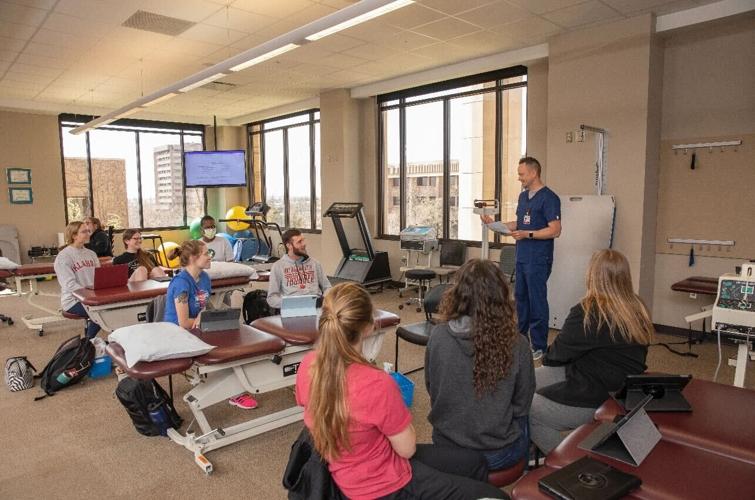
In November, a committee in the Department of Education proposed a definition for “professional” degrees that would sort programs by the amount of federal loans students would be allowed to borrow. The definition would include some medical and law degrees but exclude numerous other health professions. If the proposed definition is not changed, programs that would not be considered professional include nursing, physical therapy and physician assistants.
Under the new definition, graduate students in professional programs would be limited to $50,000 per year, with a $200,000 lifetime limit on federal loans. Graduate students in programs not designated as professional would be limited to $20,500 a year, with a $100,000 lifetime cap.
OU’s Doctor of Physical Therapy program cost an estimated $63,756 for first year in-state residents during the 2025-26 academic year, according to the office of financial student aid. This is $43,256 higher than the federal loans that would be available to students. For students who are not Oklahoma residents, the estimated first year cost is $86,231, which is $65,731 higher than the federal loans that would be available to students.
Similarly, the first year cost of OU’s Doctor of Nursing Practice program is $60,401 for residents and $80,651 for nonresidents, with respective funding gaps of $39,901 and $60,151.
Miles Williams, a health and exercise science senior, said he wanted to become a physical therapist after watching his older brother go through a traumatic injury.
“Seeing him be able to recover, the process of physical therapy and how his therapist inspired hope and gave him a new purpose in life … it really resonated with me,” Williams said.

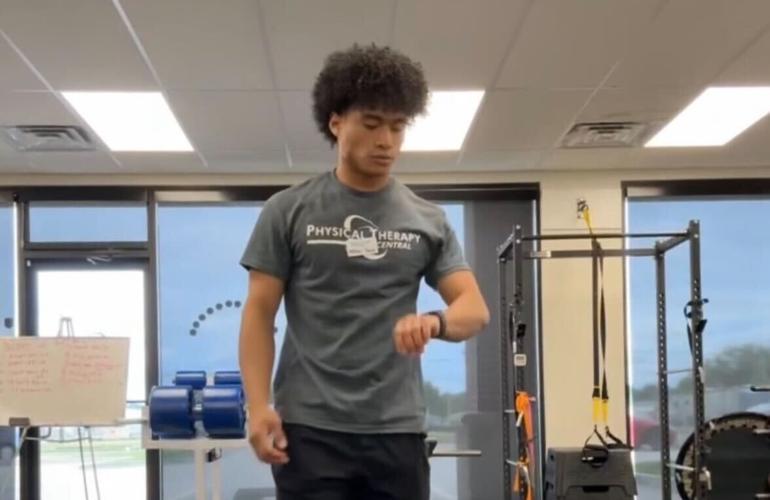
Miles Williams, an OU health and exercise science senior, aspires to become a physical therapist.
Graduate school is the next step for Williams and other undergraduates who want to become licensed physical therapists, but the changes in federal loan regulations would make it more difficult for certain health care students to access the required education.
According to MIT Federal Credit Union, students would need to rely more heavily on private student loans to fund schooling after using other sources of financial aid, such as scholarships or tuition waivers.
“The fact that now it’s even harder to get federal loans for some students trying to go into the physical therapy field is definitely unfortunate because it may lead toward a shortage in the future of clinicians or therapists,” Williams said.
According to the Oklahoma Hospital Association website, the past three years have greatly strained state hospitals.
“Of the nearly 300 individually identified allied health professions, critical shortages can be found among almost all of them in Oklahoma,” the site reads.
This mirrors a nationwide nursing shortage. Nightingale College reported that Oklahoma is projected to have the third-highest nurse shortage in 2026 with a 28% deficit.
“You would think with there being a shortage, it would make more people want to go toward (a health care) career because that means there’s a demand for it,” Williams said. “The debt-to-pay ratio makes some people wary of the career path.”
Melissa Craft, dean of OU’s Fran and Earl Ziegler College of Nursing, says the nursing shortage will likely get worse over the next several years.
“After COVID, what we saw is an uptick in the number of nurses leaving the profession due to burnout, …” Craft said. “Also, there’s an increasing demand. … The increasing age of our population that needs care and the increasing places where you see nurses, all of that comes together to increase the shortage.”
Laney Tuthill, a health and exercise science senior, said the federal loan caps and health professional shortages will affect students and universities in the coming years.
“In the next couple of years, it’s going to be scary for students to want to go into nursing because of the federal loan cap, …” Tuthill said. “In later years, I think (the schools) are going to see more of an impact because it’s not as affordable and people can’t get the loans that they need.”

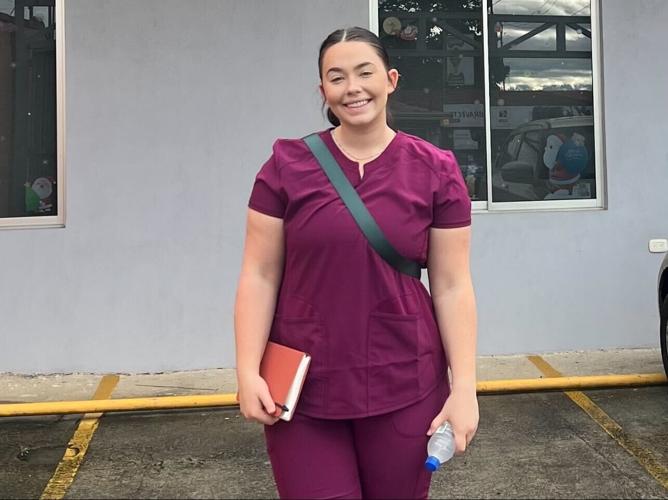
Laney Tuthill is an OU health and exercise science senior.
Tuthill said graduate school may eventually become affordable, but it won’t happen for a long time.
“With the shortage, as the years go on, the price of schooling is going to go down. If they’re not allowing federal loans, students aren’t going to go to that school,” Tuthill said. “They’re going to decrease their (tuition) to be affordable, but I don’t think that’s going to be until years later.”
Williams was accepted into New York University and is set to start the program this summer, but he said the federal loan caps have impacted his decision.
“Hopefully, I can figure out a way (to afford it). I’ve applied to multiple scholarships, and at the end of the day, it’s my dream to go to NYU and become a physical therapist,” Williams said. “Even if I have to figure out alternative ways to pay for my school, I’m gonna make it happen.”
The university has implemented initiatives to support the state health care workforce, including breaking ground on the new life sciences laboratories building in October.
“This building will be essential for meeting Oklahoma’s health care workforce needs by expanding the pipeline of students with the foundational training in biology and chemistry that is necessary to enter OU’s nursing, allied health, and medical training programs,” said Michael Markham, dean of the Dodge Family College of Arts and Sciences.
In September, the Board of Regents approved several updates to academic programs in the College of Nursing. This included the addition of a Certified Registered Nurse Anesthesia track within the Doctor of Nursing Practice program.
“That’s based on similar conversations (about need), looking at the literature and looking at projections,” Craft said. “What are we projected to need? ... What do we currently have?”
The federal loan caps will affect students pursuing graduate-level education. The Department of Education website states that 80% of the nursing workforce does not have graduate degrees. However, graduate degrees are required for many health care specialists, such as midwives, anesthesiologists and physical therapists, all of which are critically understaffed in Oklahoma.
Craft said the college works directly with graduate students to explore all avenues of financial aid available to them.
“We work very closely with Student Affairs and the bursar’s office in monitoring all of the support that’s available — the financial aid and the federal legislation that's occurring, …” Craft said. “The opportunity is if we could move into (the) professional (definition), there is additional funding that our students currently don’t have. … We’re just gonna sit and see what happens with that.”
Craft said she uses one of OU President Joseph Harroz Jr.’s quotes, which is also an objective in the “Lead On, University” strategic plan, as a motto for combatting the shortage.
“We will meet the health care needs of the state of Oklahoma with the urgency with which it demands, …” Craft said. “We have that opportunity, but not only is it an opportunity, it's a challenge.”
This story was edited by Macey Thaxton and Audrey McClour. Hannah Lambert and Mary Ann Livingood copy edited this story.


