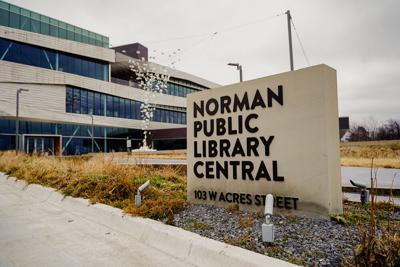

Norman Public Library Central closed about two years ago after water intrusion caused mold to grow throughout the building.
Now, the city is involved in two ongoing lawsuits regarding the management of the library.
The Norman Public Library Central, at 103 W. Acres St., temporarily closed in November 2023 for five months until its permanent closure was announced in April 2024.
In October 2024, the city filed a lawsuit in excess of $75,000 against the library contractors Flintco, MSR Design and ADG Blatt on counts of breach of contract and negligence regarding the construction of the library. Oklahoma civil procedure does not require that a party allege a specific amount as it would be determined in court.
On March 9, the city of Norman announced that the lawsuit was added to the Dec. 7 trial docket, but stated the city will continue mediation efforts to reach a faster resolution.
“The City of Norman stands with community members in wanting to see the Norman Public Library Central building reopen as quickly as possible, while recognizing that legal matters can often take time,” the website reads.
Since the library’s closure, Pioneer Library System and the city have looked for ways to move materials that were left inside the library. Last year, Pioneer Library System sued the city for breach of contract and negligence regarding the mold case.
Discovery reports, remediation plan
Inspection reports from January 2025 revealed that mold was still present in the building, with some areas worsening. However, March 2025 reports showed that mold conditions had improved in some areas but remained present in others.
A recent report by Cavins Group states that a comprehensive mold assessment was performed at the library on April 1. Five samples were collected and submitted for analysis.
The report states that existing containment measures were functioning as intended and water diversion systems appeared to be working, with no signs of active leakage or structural compromise at the time of inspection. While low concentrations of Alternaria, Basidiospores and Epicoccum spores were detected in the interior samples, levels were significantly lower than those identified in the exterior control sample.
Alternaria and Basidiospores are pathogens that are found in drywall, plywood and paint. Epicoccum is an organic matter pathogen that can cause allergic reactions.
Air quality testing was conducted through the facility’s common areas, with spore-trap samples collected from the children’s area and the common areas on the first, second and third floors. According to the report, these areas meet condition one criteria, indicating a normal indoor fungal ecology.
Normal fungal ecology, as defined in the report, is the presence of mold spores or fragments in a non-problem building, meaning the mold inside a building is similar to what is naturally found outside in the surrounding environment. The goal of a mold remediation plan is to achieve condition one or background, also known as pre-loss conditions, according to the report.
The report recommends the city engage a professional mold remediation company with an Institute of Inspection, Cleaning and Restoration Certification to address the identified areas of mold growth.
Tiffany Vrska, chief communications officer for the city of Norman, wrote in an email to the Daily March 14 that the city has spent roughly $1.362 million on facility remediation services such as testing, hazardous waste fees, special consulting, fencing and related activities.
Vrska wrote the city is working on a damage model as part of the lawsuit to determine the full cost of repair. She wrote the city is engaged in the lawsuit to reach a full remediation plan.
“Remediation at this time centers around preventing any further deterioration of the library,” Vrska wrote. “This means continuing basic maintenance and upholding safety measures for the site, while continuing testing to ensure the environment remains stable.”
Pioneer Library System response, lawsuit
Pioneer Library System serves residents of Cleveland, McClain and Pottawatomie counties, including three locations in Norman.
In August, Pioneer Library System filed a $150,000 lawsuit against the city and Norman Municipal Authority for breach of contract and negligence.
The lawsuit reads that following the completion of the library, Pioneer Library System and the city entered into an agreement that required the city to provide utilities and maintenance, and to build or provide a suitable space for Pioneer Library System in the event the library, or any other city-owned properties, became unfit.
Pioneer Library System and city officials have searched for ways to move 167,000 items sitting unused inside the library since its closure in 2023.
Lisa Wells, executive director of the Pioneer Library System, told the Daily in February 2025 that the books remaining in the library cannot be in Pioneer’s circulation system, but a storage facility would allow books to be in Pioneer’s digital catalog and available for courier service. Wells said the organization hired an independent contractor to help relocate the collection.
Wells wrote in an email to the Daily March 17 that Pioneer Library System was able to safely remove some programming materials, equipment and personal staff belongings from the building that were deemed safe at the time.
“We were unable to successfully negotiate alternative space to relocate the materials, and the majority of the physical collection remains inside the facility,” Wells wrote.
Vrska wrote that the city has remained open to working with Pioneer Library System on storage spaces but discussion has not been revisited.
While the city and Pioneer Library System continue to explore remediation plans for the library, a reopening date is still undetermined.
Background
In November 2023, the city hired Cavins Group to investigate water leak issues in the building’s roof. The group discovered traces of mold on each level of the facility, which was identified as Stachybotrys, commonly referred to as black mold, and Fusarium.
Jason Olsen, city of Norman Parks and Recreation Department director, said at a November 2023 press conference that the library had been experiencing water intrusion issues since it opened in 2019.
Report documents obtained by KFOR in September 2024 showed that mold was found in the building over a year before the library’s opening. Reports from early September 2024 also showed that Paecilomyces, a pathogen that can cause severe human infections, was found in the building.
Vrska wrote in an email to OU Daily shortly after the documents were released that the city was not aware of the situation because the building was still an active construction site.
“The City of Norman did not have possession of the building in 2018 yet because it was an active construction site with the contractor being responsible for the construction site,” Vrska wrote. “All issues cited in field reports during construction were communicated to the City to have been taken care of by contractors.”
This story was edited by Natalie Armour and Audrey McClour. Vanessa Essien and Tori Pham copy edited this story.


