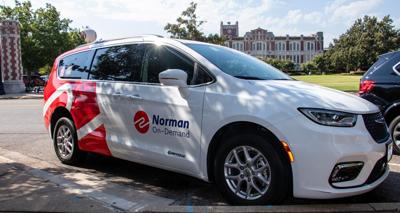

Norman On-Demand, a new microtransit service, joined the city’s array of transportation services, which OU students say is beneficial as the university transitions to the Southeastern Conference.
The rideshare program, introduced to Normanites and OU students in August, is compliant with the Americans with Disabilities Act and operates during evenings, late night hours and all day on Sundays to complement the schedules of preexisting public transit services. The first six rides are free before it costs $2 for one rider and $1 for each additional rider.
Norman On-Demand operates from 7 p.m. to 1 a.m. Monday through Wednesday, 7 p.m. to 3 a.m. Thursday through Saturday and 10 a.m. to 6 p.m. on Sunday.
Ward 7 Councilmember Stephen Tyler Holman, chair of the Community Planning and Transportation Committee, said the service “fills in the gaps” where and when the Embark buses don’t travel.
“In our current bus transit system, those routes are fixed and go on the same route every day. How do we help people that live nearby, but they don't live close enough to get to a bus stop?” Holman said.
With Norman On-Demand being a pilot program, changes may be made to the service area or hours of operation, Holman said. The service is currently experimenting with Sunday, evening and late night services after hearing requests from residents.
Norman On-Demand stops operating at 1 a.m. Monday through Wednesday, 3 a.m. Thursday through Saturday and 6 p.m. on Sunday. Embark’s hours end at 10 p.m. on weekdays and 7 p.m. on Saturday.
“The intent is that they're more complimentary of each other and have different functions,” Holman said. “For example, the bus system can obviously carry a lot more passengers per hour than the on-demand system can.”
Afrah Thasneem, landscape architecture graduate assistant, said there is a need for a new service because Embark does not have enough routes in Norman.
“From my home to my college, I have to take two buses,” Thasneem said. “So it would be easier if they could get similar routes and if I could take the same bus. One single transportation would be much easier for me because I don't want to have to jump between two buses.”
Although there are programs like SafeRide in use over the weekend, Norman On-Demand operates seven days a week and is accessible to students as well as Normanites.
Chris Firch, OU Student Government Association President, said Norman On-Demand’s partnership with OU’s SafeRide, which is free for students, was exciting as it focused on catering to students.
“So many different students are going to utilize this program,” Firch said. “A lot of students don’t have cars, so being able to go grocery shopping has to be a lot more accessible to do. Instead of having to pay up to $10 for an Uber, they can just use a microtransit system.”
He said this program stands out because it’s a public transit system, specifically microtransit, that can take you straight to your destination in a car that fits four or five people.
As OU prepares to move to the SEC, Holman said Norman may expect more growth and therefore a greater need for transportation services.
“We're already experiencing population growth that is a higher total number and a higher growth rate than more than half the cities in the SEC already from a population standpoint,” Holman said. “Norman's growth has been more than Columbia, Missouri and College Station since they went to the SEC. Norman compares pretty well to SEC schools.”
Holman said Norman could potentially see more traffic as an SEC school because of their dedicated fan bases.
John David Jones, Auburn University’s Student Government Association president, said Auburn’s transportation service’s hours of operation are affected by SEC football games.
“Shuttles run as early as two hours post-game based on traffic conditions,” Jones said. “It gives you a phone number to speak with a dispatcher to request to be picked up, and then you can also use the Auburn Safety app’s chat request feature.”
Auburn has a partnership with the Lyft Late Night Smart Ride program, designed to ensure all students have access to safe travel from campus to their residence, Jones said. Students will be provided for up to a $10 discount per ride.
Auburn also has a night security shuttle operating between 6 p.m. and 7 a.m., Jones said. The night shuttle is catered toward students as the service only provides on-campus travel and destinations.
Firch said the idea of Norman’s rideshare program is about providing safety for students and affordable transportation.
“One of the great, great assets of Norman On-Demand is making sure it's successful for every student, regardless of disabilities, what they look like or where they come from,” Firch said.
Holman said the primary difference between Norman On-Demand and other rideshare programs in Norman is that it offers ADA accessible vehicles on-demand. None of the operating private companies in Norman offer that service, he said.
“The main motivation for even pursuing the on-demand program was feedback we'd heard for a while since we took over the transit system,” Holman said. “Members of our ADA community regularly expressed their frustration with not being able to freely travel about the city as needed, on demand, like everybody else can.”
Thasneem said she has had positive experiences with transportation in Norman accommodating those with disabilities.
“The drivers are really good at taking their time and making way for them,” Thasneem said about Embark. “They cater to all individuals.”
While there is a paratransit service offering to take Normanites anywhere in the city limits, it is required to schedule at least 24 hours in advance. Holman said members of the ADA community have told him they feel that is not equal treatment.
“They feel pretty strongly that they should have the ability to travel on demand to where they need to go, and (city council) agreed,” Holman said.
As Norman accommodates the ADA community, the university grows closer toward preparing for SEC game days. The city is in good shape with its transportation services, Holman said.
“Since the 2010 census, Norman has grown by well over 20,000 people. We measure up pretty good, more so than I think people would give us credit for,” Holman said.
Holman said Norman benefits from being close to Oklahoma City since a lot of the SEC schools are not next to big cities.
“Norman is not an island out on its own,” Holman said. “We're in a somewhat unique situation in that we're very close to a much larger city that's rapidly growing. In Norman, you've got options to stay in Moore or in Oklahoma City. A lot of fans who come to Norman for OU games live in the metro area and they're able to drive back home when it's over.”
This story was edited by Alexia Aston, Taylor Jones and Peggy Dodd. Sophie Hemker and Nikkie Aisha copy edited this story.


