
As OU has continued to see record-breaking class sizes, the city of Norman has kept pace with the expansion, but officials have worries about the sustainability of physical and financial infrastructure.
Population projection
AIM Norman, or Area and Infrastructure Master Plan, is Norman’s comprehensive, 25-year strategic blueprint to guide the city's growth. AIM Norman projects the city will house around 180,000 residents by 2045.
The master plan covers multiple aspects of the city, including land use, drinking water, housing, stormwater, parks, transportation and wastewater. The plans were approved by Norman City Council in June.
Scott Sturtz, Norman public works director, said the city factors OU students into the master plan.
“Each one of those accounted for population growth, and including … some population growth in student population,” Sturtz said. “So we've already planned for that, and all of our previous plans accounted for some of that also.”
According to the comprehensive land use plan on the city’s website, the student portion of Norman’s population grew at a lower rate than non-students during the 2010s. Even as OU entered the Southeastern Conference in 2024, the document notes non-student growth will likely outpace students.
Chris Mattingly, Norman utilities director, said a student population increase of 10,000 could marginally increase the growth rate, but student population does not alter much about how the city designs and implements services.
“It's weird. (OU)'s a big organization, but … our town is so big, it doesn't really affect it a lot from our perspective,” Mattingly said.
According to OU Institutional Research and Reporting, OU’s student population has grown each year on its Norman campus since 2020. That fall, 27,282 students were enrolled across undergraduate, graduate and professional programs. Last fall, 32,662 total students were enrolled.
In April 2020, Norman’s total population was 128,026, according to the U.S. Census Bureau. In 2024 — the year of the most recent census report — the population was estimated at 131,010.
Shared resources
Mattingly said the university is responsible for maintaining water and sewer lines and the stormwater system on its Norman campus, which ties into the city’s systems.
Roads on campus are also maintained by OU, according to Sturtz, including Timberdell Road, Felgar Street and Asp Avenue.
According to Sturtz, a similar responsibility applies to private developers who are often responsible for maintaining, and in some cases creating, infrastructure in underdeveloped parts of the city.
“We all coordinate with the university, and we talk to them quite a bit. We kind of know what their plans are, and we try to assist and make changes necessary,” Sturtz said. “But also, as development comes in to help support that additional growth.”
Roadwork projects
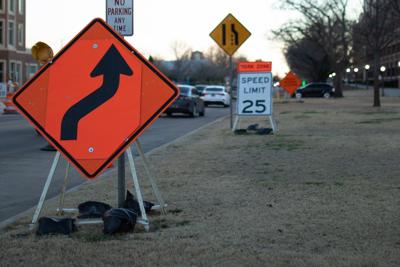
The city is working on multiple roadwork projects, including the Jenkins Avenue reconstruction project, expected to be completed this fall, and Lindsey Street renovations from Pickard to Jenkins avenues.
The roadwork plans stem from a transportation bond program approved by residents in 2019, covering 19 projects. The Lindsey Street projects are divided into two phases that cost around $14 million in total through bond and federal funds.
Mayor Stephen Tyler Holman said the Lindsey Street reconstruction will include left-turn lanes and drainage improvements. He said the city hopes the project complements the university and looks good for individuals driving through campus.
“It will fix the flooding problem at Lindsey and Elm (Avenue), and Lindsey and College (Avenue) once and for all. … We'll be enhancing Lindsey Street as it goes right through the campus,” Holman said. “We'll be redoing all that, making it look a whole lot nicer than it currently does. That project is at no cost to the university at all.”
But roadwork needs aren't always planned.
Last May, the city began an emergency repair of the storm sewer beneath West Boyd Street that lasted into football season.
Sturtz said the sewer was constructed a century ago using clay pipe, which was phased out in the mid-1900s.
“It was placed in small sections, and they weren't even put together correctly back when they were installed, and they had separated, and it caused a void under the road and the road sank 6 inches,” Sturtz said. “It was really an emergency repair that we had to go in and do.”
Sturtz said some lines throughout the city use corrugated pipes from the 1980s and 1990s that have since eroded. He said this contributes to one of the biggest problems the city faces: aging infrastructure.
“We've got infrastructure now that’s starting to get to be in that 20-, 25-, 30-year-old range and the materials are just, quite honestly, starting to fail,” Sturtz said. “So, how do we go back and repair and replace these areas that need that?”
Fixing the aging infrastructure issue proves difficult due to the city’s size, according to Tiffany Vrska, Norman chief communications officer.
Norman is one of Oklahoma's largest cities, covering 189.5 square miles.
“Our staff has a lot to keep up with in terms of infrastructure, and I feel like sometimes people don't realize how massive it really is,” Vrska said.
Financial challenges
Sturtz said the city’s stormwater infrastructure is especially dated, and Vrska said the city lacks a stormwater utility fee, unlike some other municipalities. Norman requires a public vote to increase water rates, and Vrska said a voter-approved stormwater fee would help with maintenance, though it has failed twice in the past decade.
In 2016, 71% of 16,000 residents voted against the utility fee. In 2019, voters rejected the fee again, with 60% of 13,626 residents voting against.
Sturtz and Mattingly said the city tries to be proactive in how it handles infrastructure needs. Mattingly said this approach saves money for the city and businesses.
“We'll spend extra money to do a quick repair, so you waste money,” Mattingly said. “It's an inefficient way to do things. … An ounce of prevention’s worth a pound of cure.”
Finances are also a concern, Holman said.
“Norman can definitely accommodate the growth of the university and just the general growth of the city of Norman, but we're really trying to change how we go about that so that we can become more fiscally sustainable,” Holman said. “The demand for services and staffing at the city and all those things is outpacing the new tax revenue that all that growth has generated.”
The city’s 2025 fiscal year end budget projected the city is spending funds faster than it’s gaining them. In September, the city reported earning just over a million dollars less than expected during the 2025 fiscal year.
Holman also said infrastructure must consider housing needs in a way that does not displace residents and accommodates a growing population.
“If we're not keeping up with demand, the rent and cost of housing in Norman could get to the point where more and more people cannot afford to live, … and that includes a lot of students,” Holman said.
Putting costs back on developers to maintain infrastructure could also slow developers from creating new housing, according to Jane Hudson, Norman’s planning and community development director.
“We're putting that cost on the developer to bring those utilities to those sites. And so that's when it gets expensive, and that's what has slowed down a lot of it too,” Hudson said.
One aspect of Norman’s growth is the Rock Creek Entertainment District, a $1 billion project that will include an arena featuring some OU sports as anchor tenents. Two tax increment financing, or TIF, districts will divert 100% of sales tax and ad valorem tax to fund up to $600 million in project costs for up to 25 years. The remaining portion of the project will be privately funded.
Holman called the project a sizable gamble.
“It's just a really high-risk gamble, and maybe it pays off down the road, but if anything goes wrong, it could be a real problem for the city's budget, …” Holman said. “Instead of hedging all of our bets on one massive development, having 100 small developments is generally more preferable when you're talking about the health of a city.”
Holman also said he is concerned the city could lose a part of its identity as it develops — its college town feel.
Holman cited Austin as an example of his concern, saying that it isn’t a college town despite housing the University of Texas at Austin. He said as Norman becomes bigger, it becomes harder to maintain a sense of community and resident input becomes less influential.
“(In) Norman, a small group of people can have a major impact on public policy and the direction of the city,” Holman said. “(It’s) just small enough where a small group of people can enact change and big enough that that change can actually, really mean something.”
This story was edited by Anusha Fathepure and Macey Thaxton. Hannah Lambert, Chelsea Low and Tori Pham copy edited this story.


