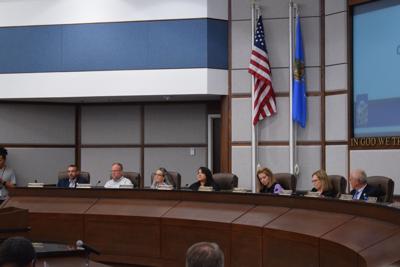

Norman City Council discussed a proposed contract with the Cleveland County Economic Development Coalition and adopted seven AIM Norman comprehensive plans at its Tuesday meetings.
AIM Norman comprehensive plan
AIM Norman is a 25-year area and infrastructure master plan composed of seven areas: a land use plan, housing strategy plan, comprehensive transportation plan update, stormwater master plan update, water hydraulic modeling update, wastewater master plan and sanitation master plan.
According to AIM Norman’s website, the comprehensive plan was designed to identify new opportunities to enhance the quality of life in Norman.
According to various staff reports, Norman released a Request for Proposal in September 2022. The citywide proposal was to develop an all-encompassing vision for the community.
According to AIM Norman co-chair Inger Giuffrida, this is the first time that any city in the United States has attempted to concurrently create a master plan that includes the seven sections covered in the proposed plan.
On May 8, the planning commission held a meeting to hear comments on the proposed plans.
According to a staff report, Norman selected the RDG Planning and Design team, to develop the master plans or master plan updates.
Comprehensive land use plan: According to a staff report, city staff recommended four changes to the draft plans for the comprehensive land use plan, including adding AIM Norman does not endorse or influence the development and alignment of proposed turnpikes planned in east and north Norman by the Oklahoma Turnpike Authority.
According to Amy Haase, urban planner for RDG Planning and Design, AIM Norman took several components into consideration when drafting the plan, including the use of one area for multiple uses, the extent to which land use is utilized and how that development affects its neighbors, and the number of housing units permitted per net area of land.
“Several of the AIM Norman Development Principles support a flexible land use approach that encourages mixing of uses and focuses on the intensity of uses rather than the use itself,” Haase said.
Ward 7 Councilmember and Mayor-elect Stephen Tyler Holman said zoning and code policies set in the 1950s were created to mandate suburban, low density sprawl.
“If there’s no way to get to it except by driving to it, then everybody had to drive to this one location, which is why you see so much traffic congestion in places like 24th (Avenue) and Robinson (Street) area,” Holman said. “We’ve really forced our city to grow outwardly in a low density suburban kind of way.”
Holman said he hopes that over the next 20 years, the city will make better use of existing space and land so that Norman doesn’t continue sprawling out further.
“For example, Midway Deli. Most everybody loves Midway Deli,” Holman said. “(They) love the idea of having a grocery store/restaurant that’s right in the middle of a neighborhood.”
Ward 6 Councilmember Michael Nash gave a presentation over his proposed amendments to the overall comprehensive plan before any plans were voted on.
Nash said it bothered him that the response to concerns is often that the plans are living documents and intended to be amended over time.
“I’m getting pretty tired of hearing that,” Nash said. “We don’t want to approve something that’s wrong, promising that we could fix it later because that’s not going to happen. What our job is to do when we’re presented with items on our agenda, it’s to approve that item, not what it could be at some arbitrary point in the future.”
Nash proposed adding a technical disclaimer on population growth modeling. The amendment states that the population projections incorporated into the 20-year comprehensive plan are based on an exponential growth model that lacks statistical justification given the historical population trends of Norman.
“This is one of those few cases where I’d say there may be disagreements with some things but the growth model was wrong,” Nash said.
Nash also presented a number of language amendments to the land use plan.
“Not a single one of these amendments are intended to change the functions of the comprehensive plan,” Nash said.
Ward 2 Councilmember Matthew Peacock said although he didn’t disagree with Nash’s proposed amendments, the city legal team has not had the chance to review them.
“That’s where my consternation comes from,” Peacock said. “We just got this in our inbox today. I’m not opposed to any of the stuff that’s in here, I just don’t have a good comfort level with it yet because I have not had the chance or the time to digest it.”
Nash said he had previously proposed that these items be seen over two meetings. Assistant city attorney Jane Hudson confirmed that council is able to vote on the amendments that change the language of the plan at a later date.
Ward 1 Councilmember Austin Ball said the one thing that led him to support Nash’s amendments was the word “compromise.”
“Everyone in this room worked hard to compromise on this,” Ball said. “Councilmember Nash’s amendment is just further compromising. It’s a good idea and a majority of (the audience) thinks it’s a good idea.”
Ward 4 Councilmember Helen Grant said they were going to vote no to Nash’s amendments because they value the time that the legal department takes to look at language.
The proposed amendments failed in a 7-2 vote. Nash and Ball voted in favor.
Council approved the comprehensive land use plan in a 8-1 vote. Nash voted against the resolution.
Housing strategy plan: According to a staff report, the AIM Norman housing plan analyzes the housing market and outlines a strategic plan for addressing housing needs.
“A safe, comfortable, and attainable home for all is critical to Norman’s future success,” the staff report states. “Rising home prices contribute to housing challenges. The recognition of poverty and unhoused populations in Norman is growing, while limited student housing options strain existing neighborhoods.”
According to the staff report, Norman is planning to meet the need for about 23,226 new homes to accommodate a projected population of 185,759 by 2045.
The housing committee developed five goals:
Modernizing development regulations to achieve consistency, efficiency and outcomes;
Adding a variety of housing types across more densities and design approaches;
Increasing attainable, accessible and quality housing for all people;
Enhancing and promoting infill opportunities in existing neighborhoods;
And having clear, understandable and reasonable housing incentives and program procedures.
Grant said they liked that the housing plan was a flexible document and would likely be the first to be updated because other work will build onto the current plan.
Haase said she thought prioritizing housing plan updates was ideal.
“In communities where we’ve seen where they’ve taken their plan and started to implement, they’re easily coming back in five or ten years and saying ‘we accomplished things and we need to do an update,’” Haase said.
Nash also proposed amendments to the housing plan, including changing some descriptions for clarity and adding a note to check disclaimers in the forward.
Nash’s proposed amendments to the land use plan failed 7-2. Nash and Ball voted in favor.
The land use plan resolution passed in an 8-1 vote. Nash voted against the resolution.
Water utility master plan: According to a staff report, the water utility master plan expands on the 2060 Strategic Water Supply Plan and the 2018 Distribution System Modeling Update, evaluating necessary water supply and distribution improvements to meet current and future demands.
According to the staff report, key highlights from the water utility master plan include:
Evaluation of water supply alternatives to meet future demands.
Evaluation of the existing water distribution network under current average and peak demands to determine required system improvements.
Evaluation of the proposed land use to determine required system improvements to meet future estimated demands.
Preparation of a capital improvement program based on demand increases and triggers to efficiently time improvements when required for development.
Cole Niblett, Oklahoma water team leader at Garver Hydraulics and Hydrology, said the water master plan is focused on bolstering water supply resources and delivering safe drinking water to residents.
Niblett said water demands are projected to increase proportionally with population to about 23 million gallons per day by 2045. The projected service population is expected to be about 170,000 and the water supply plan projection accounts for about 140,000.
According to Niblett’s presentation, Lake Thunderbird currently provides about 69% of Norman water system demands, 24% is groundwater and 7% is through an Oklahoma City connection. Niblett proposed that by 2045 the supply would be 32% from Lake Thunderbird, 32% from groundwater, 16% from the Oklahoma City connection and 20% either reused, from the Oklahoma City connection or wells.
Council unanimously approved the plan.
Wastewater utility plan: According to a staff report, the wastewater utility master plan expands on past master plans and engineering studies to determine which improvements are needed to meet wastewater collection and treatment demands.
The staff report states that key highlights from the wastewater utility master plan include evaluating the existing wastewater distribution network, evaluating the proposed land use under the AIM Norman plan to determine what improvements are needed, evaluating various wastewater treatment alternatives and preparing a capital improvement program to construct required improvements.
Niblett said wastewater flows are also projected to increase proportionally with the service population to about 17 million gallons per day.
Council unanimously approved the plan.
Stormwater master plan update: According to a staff report, Norman’s original stormwater master plan was adopted by council in 2009. It addressed concerns with flooding, erosion, water quality protections and outlined and ranked priority projects across the city.
The staff report states that many of the projects outlined in the 2009 plan have been completed, including addressing problems like “Lake McGee,” the intersection at Lindsey Street and McGee Drive that was prone to flooding and fixed in 2018, and implementing a water quality protection zone ordinance and fertilizer ordinance, the first of its kind in Oklahoma.
According to the staff report, the existing Hydrologic Engineering Center's River Analysis System and hydraulic models for watersheds throughout Norman will be updated in 2025 using data from studies performed since the 2009 plan.
The report states that in addition to technical updates, input from the Stormwater sub-committee and public input were used to update the goals of the plan.
Alan Dennis, regional team leader at Garver Hydraulics and Hydrology, said key recommendations include requiring runoff quality treatment in new developments, preventing reduction of water quality protection zone widths, installing additional water quality monitoring stations and creating an incentive program for projects exceeding stormwater management requirements.
Council unanimously approved the plan.
Transportation plan: According to a staff report, the updated transportation plan includes roadways, traffic, parking and transit, aviation, bridges and active transportation. The staff report states that the work in these areas expanded on projects done in the 2014 comprehensive transportation plan.
The plan for aviation is consistent with the Max Westheimer Airport Master Plan that was approved by the Federal Aviation Administration in 2024.
The plan for transit was taken directly from the Go Norman Transit Plan that was adopted in 2021. The plan for parking was taken directly from the 2018 Strategic Parking Plan which was a joint venture between Cleveland County and the city of Norman. The plan for bridges was taken from the 2023 Bridge Maintenance Bond Program.
The comprehensive transportation plan update includes a renewed emphasis on non-motorized forms of transportation or active transportation including pedestrians, bicycles, scooters, wheelchairs and other “vulnerable road users.”
According to the report, staff recommended adding a statement to reflect that AIM Norman does not endorse or influence the development of turnpikes in Norman by OTA, similar to the comprehensive land use plan.
Brett Cabbiness, senior project manager at Garver, highlighted some of the plan’s projects, including changing Franklin Road and east 48th Avenue to an urban road, changing east Alameda Street from east 36th Avenue to 120th Avenue to a special corridor for multi-modal upgrades and traffic safety improvements, and implementing a new roundabout at the intersection of Franklin Road and north Porter Avenue.
Cabbiness said roadway improvements could include adding shoulders for safety, sidewalks or sidepaths, additional protected turn lanes, median dividers and travel lanes.
Holman asked if a plan will be outlined to confirm which streets will be widened or turned into an urban road.
Cabbiness said he wanted to make sure that the streets had a consistent number of lanes.
“Berry Road transitions in and out of three lanes, two lanes and four lanes,” Cabbiness said. “We want to make sure that it has a consistent typical section going forward because, as more traffic growth happens in our area, we want to make sure that that’s still an urban minor.”
Cabbiness said there are ongoing plans to turn Main Street into a two-way street. He also said some discussion has occurred about adding an underpass on Lindsey Street.
“The underpass at Lindsey Street is actually a project that the Oklahoma Department of Transportation and the regional transit authority is looking at for train safety but also vehicular safety,” Cabbiness said.
Council approved the plan 8-1. Nash voted against the plan.
Parks, recreation and cultural master plan: Last year, the AIM Norman parks subcommittee discussed five plan objectives including to maintain, update and improve the Norman park system; support and elevate the organizations that contribute to arts and culture in Norman; update and modernize policies; opportunities for connection; and growth and protect natural resources, according to a staff report.
Haase said the most common feedback received from the community was requests to create a comprehensive trail network master plan.
Council unanimously approved the plan.
Public comments
Ward 7 resident Charles Custer said he was an AIM Norman steering committee member and some of his comments were included in the plan.
“Obviously it didn’t have everything that I wanted, it didn’t have everything that everyone wanted,” Custer said. “I really do feel like this plan is a good foundational place for the city moving forward.”
Ward 5 resident Trey Kirby said he doesn’t know how Norman will be able to expand when there isn’t enough water to cover the city as it is now.
“We just ignore everything and keep growing because that’s the main goal right? No matter if we have the roads, the transportation. No matter if we have the sewer or the water -– it (doesn’t) matter as long as we grow,” Kirby said. “We don’t care about what we’re doing to our future generations, like our kids and grandkids, as long as we grow.”
Amy Cerato, Ward 5 resident and Oklahomans for Responsible Economic Development co-founder, said the turnpike plans need to be removed from the AIM land use planning map.
“Let’s be clear, this comprehensive plan must not become a backdoor yes to the OTA,” Cerato said. “Including it in this plan gives it undeserved legitimacy. Once turnpikes dictate zoning, we’ve lost all credibility in our conservation goals.”
Ward 5 resident Heather Messer said she’s disappointed that the AIM Norman committee was not trying to preserve any of Norman’s charm.
“Don’t try to make Norman another Fort Worth, another Dallas, another Austin, another San Antonio,” Messer said. “Keep the charm here.”
Messer said council should not vote on the plan and leave it to the next council, which will be inducted next week.
“I’m a staunch Republican,” Messer said. “And I have now voted for a guy with a man bun because I’m not happy with what’s going on.”
Cleveland County Economic Development Coalition contract
Council held a discussion regarding a proposed contract with the Cleveland County Economic Development Coalition, formerly known as the Norman Economic Development Coalition.
In February, the coalition announced its official transition to the Cleveland County Economic Development Coalition, which will include Lexington, Moore, Noble, Slaughterville, south Oklahoma City and property that doesn’t fall into a municipality.
According to a press release sent to OU Daily in February, the transition was originally proposed at the Norman coalition’s 2023 annual meeting. David Nimmo, former president and CEO of Chickasaw Nation Industries and outgoing chair of the Cleveland County coalition, wrote that this has been six or seven years in the making after former OU President James Gallogly challenged the Norman coalition and the Norman Chamber of Commerce “to be bold.”
The Norman coalition was part of Team Norman, which has been the driving force behind the promotion of the University North Park entertainment district.
In October, a contractor for the Norman coalition told OU Daily he offered to pay OU students to attend the public hearings for the entertainment district.
The $1.1 billion entertainment district would include retail and housing developments along with an arena, where OU basketball and women’s gymnastics would serve as the anchor tenants.
Since its approval in September, the district has faced several legal challenges.
According to City Attorney Rick Knighton, Norman originally established its contract with the Norman Economic Development Coalition in July 1996. As a refresh of the original contract, the updated contract states that the Cleveland County Economic Development Coalition cannot use city funding to engage in political activities.
“The CCEDC will not utilize any funding to engage in political activities with the purpose of supporting or opposing a candidate or political party,” the contract states.
If approved by council, the city would agree to invest the sum of $1 per capita, $130,046 as of the most recent Census Bureau projection in 2023.
Peacock said Norman has been funding the Norman Economic Development Coalition for about 30 years, and now other cities will be joining the coalition.
“This is going to sound terrible. We’re letting new people come sit at the table without the buy in,” Peacock said. “(We’ve) put a lot of chips on the table, we’ve risked a lot of chips over the years. I think there should be some deference given to that.”
Grant agreed with Peacock and asked if the “political activities” mentioned in the presentation are limited to questions on the ballot or if it includes a council decision.
Ward 3 Councilmember Bree Montoya said she held the same reservations as Grant and Peacock. Montoya said she was concerned about how the Norman Economic Development Coalition has not provided financial information or audits in the past.
“I know how expensive audits can be, so I can understand not providing an audit, but at the very least I would expect compiled financial statements,” Montoya said.
This story was edited by Ana Barboza and Natalie Armour.


