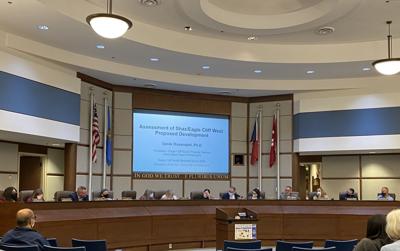

The Norman City Council conducted a public hearing regarding ward boundaries, finalized a date for a special election regarding a 25-year contract with the Oklahoma Gas and Electric Company and voted against the purchase of a new affordable housing complex at its meeting Tuesday.
Located at 1210 W. Robinson St., the 50-unit property was transitioned from a skilled nursing facility to a long-term, acute care hospital operated by the Norman Regional Health System in 2005 according to a staff memo listed in the city council agenda packet.
Earlier this spring, the city submitted a bid for $2.45 million on the property, which was later accepted by the seller, HCR ManorCare, Inc. At last month’s city council retreat, City Manager Darrel Pyle announced the sale during his updates to council, noting that the property was purchased with American Rescue Plan Act funds.
The memo said JHBR Architects in Oklahoma City were instructed to provide a preliminary design proposal including renovations that are estimated to cost $3-5 million. Following these renovations, the property will include a combination of studio and one-bedroom apartments — four being compliant with the Americans with Disabilities Act — with rent capped in accordance with Section 8 under the Housing Act of 1937.
Kathryn Walker, city attorney, said during a presentation to council that the purchase and renovation costs combined come to a total of $6.4 million in ARPA funds. Walker also clarified the city would not be handling any rent or evictions, agreeing with Ward 1 Councilmember Brandi Studley’s comparison to a typically-run apartment complex.
Studley went on to clarify that these units would be income-based housing, not to be confused with a homeless shelter.
The public was given an opportunity to speak, where 22 people voiced their opinions, including former Ward 4 Councilmember Lee Hall, who offered her support for the project.
“We have been given an extraordinary opportunity to address this need among all the others to take a stab at trying to provide a housing option that does not currently exist in Norman,” Hall said.
Maggie Logue, a Ward 5 resident, asked if the renovations had plans for kitchenettes instead of utilizing the centralized kitchen, as she formerly worked in the building when it was a nursing home. Pyle said that kitchenettes were planned and the timeline for the building is 16 months.
Hannah Smith, development director and co-founder of Care-A-Vans, also spoke in support of the measure, saying that if the council were able to provide these housing options, then fewer would face homelessness as the only option left, recalling a post from a struggling mother they saw on Facebook.
“It is hard out here and incredibly scary,” Smith said. “If we can provide just a little bit of compassion in this community then I won’t have to worry about seeing a medical disabled mother and her son in a tent.”
Dan Munson, a Ward 6 resident, suggested the council postpone the vote due to the absence of Ward 6 Councilmember Elizabeth Foreman and Ward 8 Councilmember Matthew Peacock, whose ward the property currently resides in.
Several speakers were worried about how much taxpayer money would eventually be used toward the project and what rules and limitations would be placed on residents at the complex.
Following public comment, Studley reiterated that utilities would be paid by renters, adding the building would only support temporary affordable housing and asked Pyle if taxpayer dollars would even be needed to support the project further.
Pyle said the city, through conversations with the Norman Housing Authority and staff that runs the community development block grant program, “anticipates” that revenue generated from operations to be able to keep up the property and support the program.
Studley said she found it “shocking” that the matter was later pulled from the agenda, as the council has consistently been talking about affordable housing, specifically this project, for over a year.
“I know because I see them and I feed them every single night. … I promise you there's several people in our community who are one paycheck away, one paycheck away, from being out on the streets,” Studley said. “To have a facility like this that will help us bridge that gap to get into housing, and we have a small opportunity here and a small drop in the bucket of ARPA funds to finance this, why not do it?”
Ward 7 Councilmember Stephan Holman discussed several emails he had received from his constituents, reading one from a single mother searching for Section 8 housing with just a month left on her lease.
“I’m having the hardest time finding a place, it’s almost like Norman discriminates against Section 8 or people with (housing) vouchers,” Holman read from the resident’s email. “I’m on my extension, which you only get one of, and if I can’t find a place, I have to start all over. … I only have to the end of the month or I lose the progress I’ve made.”
Holman said he support this measure, but agreed that there were questions to be answered regarding the facility’s operation. While he is prepared to vote for the measure, Holman said he would also agree with a motion to postpone, given questions from residents and the absence of Foreman and Peacock.
Ward 2 Councilmember Lauren Schueler apologized for many residents being “in some ways misled” about what exactly the facility was for, adding that affordable housing is a proven need for the city. Schueler added that she would support postponement if other councilmembers felt that were needed. If the current ward boundary proposal slated to be voted on passes, this property would be placed in Ward 2.
Both items, one to approve the property purchase and one to allocate funds for renovations, were originally placed on the consent docket but were taken off in a unanimous vote. In the end, the motion to approve the purchase of the facility failed in a vote of 4-3, with Ward 3 Councilmember Kelly Lynn, Ward 5 Councilmember Rarchar Tortorello and Mayor Larry Heikkila voting against the motion.
According to City Clerk Brenda Hall, though a majority of council voted to approve this land purchase, the city charter states that for any action to be approved, it must receive 5 votes.
Schueler asked if the council could still appropriate these specific funds for affordable housing in order to return to this conversation at a later date. This motion also failed in a vote of 4-3, with the same members voting against the measure.
OU Professor Steve Ellis said during more time for public comment regarding Schueler’s motion that he was “surprised” members of the council voted no for the measure, as it wasn’t what he observed most speakers wanted.
Several residents agreed with Ellis, including Care-A-Vans member Stephen Lett, who asked Lynn, Tortorello and Heikkila to later address why they voted no. The three never answered this question.
In a unanimous vote, the council forwarded the date of Jan. 10, 2023, to the Cleveland County Election Board as the date for a special election to renew OG&E’s franchise agreement with the city, granting them authority to provide electricity in Norman’s city limits.
According to Walker’s presentation on the agreement, a franchise is “right or privilege” to do an act that cannot be done by private individuals. The presentation also said the Oklahoma Constitution requires voter approval on use of streets, alleys and other public grounds for utility operations. Commonly, there is a franchise fee charged to the utility for the cost of access, which is typically passed to the customer.
The new agreement, should it pass voters, would allow OG&E to continue services through January 2048. If Normanites vote no on the agreement, Walker said the city would then move to a month-to-month franchise fee with the electric company.
After being appointed in April, a second Reapportionment Ad Hoc Commission forwarded its ward boundary redrawing proposal to council in early June, following the original commission being disbanded by council. A required public hearing was originally scheduled for last week, but was canceled due to miscommunication regarding agenda posting and slated for this meeting.
Walker clarified that members of the reapportionment committee were not given information about ward political affiliation, voting history in precincts or any council member addresses. Only two members of the public spoke during the hearing, one being OU Professor Cynthia Rogers.
Rogers spoke toward her appreciation that council sent reappointment “back to drawing board” following the concerns from residents during the original proposal. Last year, the first reappointment commission faced claims of political gerrymandering from Tortorello and Ward 5 residents.
No action was taken on ward boundaries at this meeting, as the agenda item was specifically for a public hearing. The first official reading of this proposal will take place Aug. 23, with the second and final reading taking place Sept. 13.
At the end of the meeting, during time reserved for miscellaneous comments, members of Pike Off OTA spoke on their concerns with the Oklahoma Turnpike Authority’s ACCESS Oklahoma Plan. Dave Moore, a Norman resident affected by the proposed turnpike, asked for the council to take action against the turnpike proposal.
Moore also spoke about how OTA’s proposed turnpike affects the “integrity” of the Norman 2025 Land Use and Transportation Plan, a long-rang plan for future development in the city. This plan was passed in 2004 and does not account for any turnpike construction in Norman.
“You don’t have to do anything to appease and accommodate the OTA’s insane toll road plans. Take a real stand and say no,” Moore said.
Amy Cerato, a member of Pike Off OTA’s board of directors, asked why the city isn’t “pushing back harder” against the OTA’s proposal, urging a lawsuit from the City of Norman against the OTA and describing the ecological, environmental and geological damage the turnpike could bring.
“These turnpikes are all about money and a supposed economic development by destroying the environment, displacing the humans who live here,” Cerato said. “The Norman 2025 Land Use and Transportation Plan specifically recognizes that it is important for the city to control the quality and location of growth. … Honor the plan. Get vocal.”


