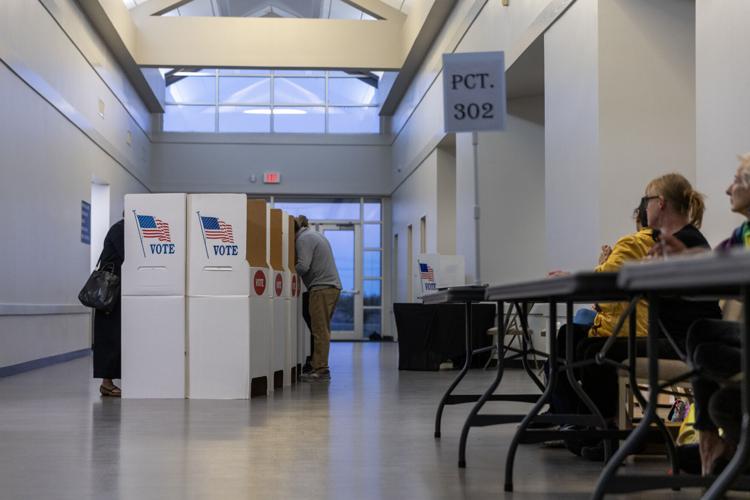



Across the city on Tuesday, Norman voters weighed in on their choice for mayor and representation in odd number wards.
At polling locations across the city, OU Daily talked to voters in every ward to hear their vision for the future of Norman and voting in local elections.
Ward 1: Cross Pointe Church
Bill Morgan, 82, believes voting in local elections is more important than voting in larger ones.
“That’s the people’s voice and it starts at the bottom and it goes up,” Morgan said. “That’s the way I look at it. It’s very important.”
Madison Resendiz, a 22-year-old law firm receptionist, sais she has passion for politics. With a degree in political science from OU, Resendiz considers the right to vote to be crucial. She believes every vote matters and has the potential to make a difference.
Resendiz said she appreciated that one candidate was willing to talk about the issue of stormwater drainage.
“Since I’ve lived here for the past couple of years, whenever it rains really bad it floods the streets. I feel like that’s a problem,” Resendiz said. “I like that one (candidate) wanted to address that.”
Ward 2: River Church

Voter entering River Church during Election Day on Nov. 5.
James Dunlap, 73, is a retired auto worker for General Motors and a long-time Norman resident. Although he likes the small-town feel that Norman has, he believes the city needs to be open to growth in the community.
Dunlap said voting in local elections is one of the only ways for someone to have a voice in the community.
“That’s my prerogative to vote,” Dunlap said. “If you don’t vote, you can’t bitch, you don’t have a voice to say anything.”
Steve Burleson, 66, said he thinks Norman is stuck in the year 2000 and unless residents are open to evolving, things will remain the same. He said Norman needs to focus on making the city more efficient and caring for its population.
“We should grow and quit nitpicking things and either get them approved or move on,” Burleson said. “Such as the arena, such as the turnpike — I don’t know what the big deal was — they’re going to come anyway.”
Kim Marks, chief investigator at the Oklahoma Indigent Defense System, said she is aware of the present divisiveness in all levels of government. She said Ward 7 Councilmember Stephen Tyler Holman, who is running for mayor, seems committed to pulling different factions together.
Marks said one of the biggest issues for her is homelessness in Norman. She hopes that if the right people are elected, these issues will be addressed.
“I work in downtown Norman, I see a lot of that day to day and it’s very concerning to me,” Marks said. “People don’t have homes and it’s getting very cold out and they’re hungry. So as a community, I think we need to look at those.”
Ward 3: Christ Church
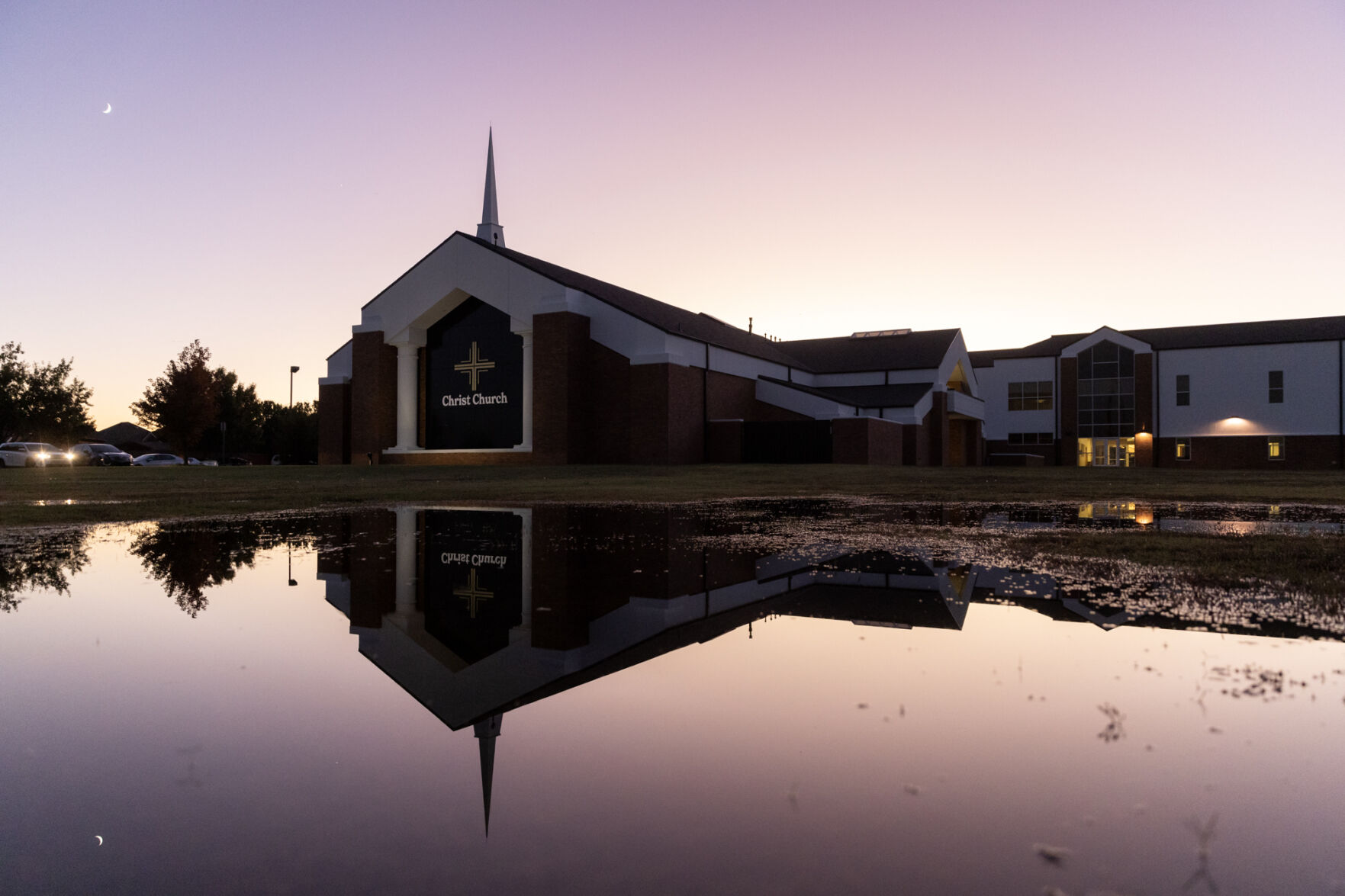
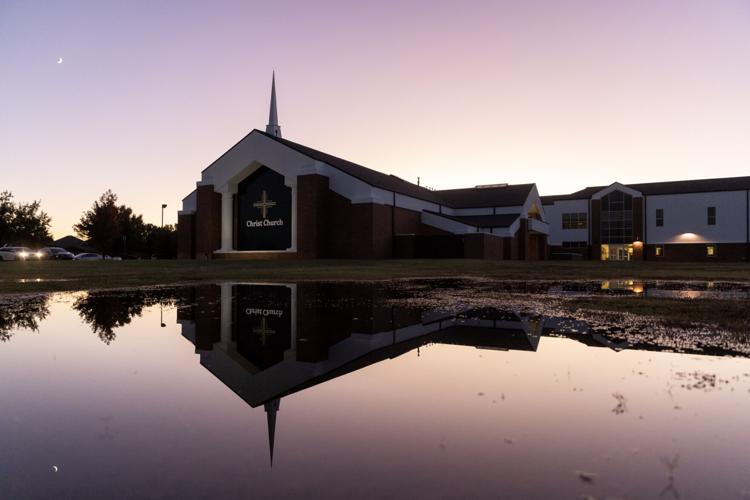
Christ Church during Election Day on Nov. 5.
Matt Sneed runs a marketing firm for Core Foodservice. Sneed said Norman is changing a lot, but growing in a positive direction under current leadership.
Sneed said he thinks of his great-grandmother when he votes, who didn’t get a chance to vote when she was younger. It’s crucial that succeeding generations continue to embrace voting, he said.
“She instilled in me that there was a God given privilege to vote, and so I try to exercise it every time I have the opportunity,” Sneed said.
Michael Oberst, who is retired, and his wife Debbie Oberst, who works part time at the hospital said the city is growing quickly, but it still feels like a small town and a good place to raise a family.
Michael Oberst said he supports the entertainment district because it will bring growth to Norman, but he’s not sure the city should fund an OU arena. Debbie Oberst said it’s important that city spending prioritizes necessities, like roads and infrastructure, not frivolous things.
The couple said local elections matter because they closely impact residents. Michael Oberst said he’s motivated to vote because he disliked former mayor Breea Clark, who served from 2019 to 2022. Clark’s stance on defunding the police and adding social programs instead was “too liberal for Norman,” Michael Oberst said.
During her tenure, Clark voted for a decrease to a proposed increase to the Norman Police Department’s budget in 2022.
“These are the people that matter to you more than the federal government, because … that’s where you live,” Debbie Oberst said.
Vic Clousc, a retired school administrator, said all levels of government are full of dissension, which is slowing down the legislative process. For example, Clousc said that although the Rock Creek entertainment district should go to a public vote, the process has taken far too long.
“I'm old, (the district is) not going to benefit me, but it's going to benefit the kids and the people,” Clousc said. “It's going to bring in a lot of money.”
Voting causes change, Clousc said, and it’s important people exercise their right to impact their city. According to Clousc, poll workers told him he was the 260th voter at Christ Church at around 1 p.m., which he said is a low number.
Ward 4: Goodrich Memorial United Methodist Church
Mike Tower, 71-year-old retired architect and former city council member, believes the most important issues in Norman are affordable housing, homelessness and the University North Park entertainment district TIF, but he said it all comes down to affordable housing.
Tower spent six years on city council from 1996-2002 representing Ward 4, previously Ward 6 during Tower’s time on the council.
“If people can’t work and live here, Norman’s not going to grow,” Tower said. “I would like to see it where we’re a kind, caring city and thriving with business. Both go together, but it seems like at this point people are making it a very partisan issue, which it isn’t. We need to work together.”
Andrea Donaldson, a 42-year-old Ward 4 voter who has lived in Norman for nearly 20 years, believes the biggest issue in Norman is homelessness and affordable housing. She said she’s voting because locally elected leaders directly affect her as a Norman resident.
“We really need to figure out how to make housing attainable for everybody, no matter what their background is,” Donaldson said. “The cost of living is getting outrageous, even for people getting their first apartment or college kids just trying to live away from home, or just married buying your first home, it’s getting unattainable for people.”
Donaldson said she doesn’t mind Norman's growth but wants to maintain the quaint feeling she’s grown to know and love.
“I want Norman to be prosperous and I want Norman to grow, but I don’t want us to outgrow ourselves to where we lose that small town feeling,” Donaldson said.
Galen Oliver, a 74-year-old Ward 4 voter, said the proposed entertainment district is not necessary for the future of Norman and he’s voting to express his opinion on the issue.
Oliver said Norman should focus on the middle and lower class, particularly issues surrounding homelessness and hunger.
“(The entertainment district) is on the opposite side of town from OU and OU should be for the students more than the people that live in Norman,” Oliver said. “I think Norman needs to concentrate on more middle class and the poor as opposed to the wealthy.”
Ward 5: Lakeside Church of God
Pamela Post, a 64-year-old retired voter, said she believes the biggest issue in Norman is the proposed Rock Creek Entertainment District TIF.
“I believe that financing is a major concern for most of the citizens of Norman. I also believe that the election of the mayor is a priority today,” Post said.
Post was among the proponents of the petition to turn the district’s financing to a public vote. In October, when the petitioners submitted the signatures to city hall, she said she was concerned the district would take public funding away from city services.
“They sit here and talk about how this is for economic development …,” Post said in October. “Yet they will not be able to provide services for the city because they are diverting up to $600 million of our city sales tax from the general revenue fund into the pockets of developers.”
Post said she hopes Norman continues to maintain its idyllic feel in the future.
“In 20 years, I’m hoping that it is a prosperous town (that) still has a small town feeling that everyone is comfortable in and is respected,” Post said.
Dominie Dew, a 50-year-old Norman Public Schools teacher, said the most important issue in Norman for her is the ACCESS Oklahoma turnpike expansion in Norman since her property could potentially be lost as a result.
“I'm particularly concerned about the potential for my property to be taken from me with the Turnpike,” Dew said.
Dew said politics begins at a local level and local elections determine how communities progress.
“I believe strongly in creating an educated citizenship and this is how we participate in our democracy. This is how we determine the direction we're going,” Dew said. “We should all be involved and care about what's happening in our community and have a voice for it.”
Dew also said she hopes Norman retains its unique charm while expanding for new opportunities.
“I hope that there's still that connection felt among residents, I think that that's a pretty good thing that Norman has going,” Dew said. “I also hope that we're looking to the future, and providing opportunities for kids so they want to stay here and be productive citizens here in our own community.”
Jeanne Wheeler, a 56-year-old real estate agent, said the biggest issue facing Norman is the lack of thoughtful discourse and “reasonable compromise,” which she believes could negatively impact Norman’s future.
“In all reality, the trajectory that we’re on, not being able to have reasonable debate … we could be very well in the same place we are today, which is nothing,” Wheeler said.
Wheeler said local elections allow residents’ voices to be heard.
“If you don’t vote … you get what the others choose for you,” Wheeler said.
Ward 6: Wildwood Community Church

Wildwood Community Church on Election Day on Nov. 5.
Will Irwin, a 37-year-old musician, said he is not very familiar with current city politics, but he’s concerned with homelessness in the city.
“Because we're more compassionate towards the homeless, (other cities) push their homeless off on us, and I just know that’s something that everybody's concerned with,” Irwin said.
Irwin said he came out to vote to support Holman, who he said was a friend.
“Voting is the most authority that you have as a citizen. I've lived in Norman about seven years and I like it. I care about it, and I just want to have a say in how things are run,” Irwin said.
Tim Corrigan, a 37-year-old pharmacist, said that although they are discussed “tangentially,” human rights are his biggest concern for Norman.
“It’s important to take care of people that aren’t going to be the highest socio-economic status,” Corrigan said. “I feel like human beings have worth outside of what their economic output is but apparently that’s an unusual view.”
Corrigan said local elections are important because they are more directly representative of individual votes.
“Your individual vote has a bigger weight than on state and federal levels,” Corrigan said. “Political movements that are long-lasting generally are grassroots and started at a local level.”
Jonathan Stapleton, a 44-year-old and co-owner of 405 Brewing Co. said the most important issue for him is attracting local businesses to Norman.
“The biggest issue in general, from my perspective being a small business owner, is attracting more small businesses and people to come to the areas where the small businesses are located,” Stapleton said. “Downtown Norman is a great example of a good collection of locally owned businesses that provide a lot of services instead of going to big national retail.”
Stapleton said he has lived in Norman his whole life and seen it progress, adding he does not believe it will halt.
“I’ve seen that it's changed significantly since when I was a child. There definitely are more people, more cars, more traffic, more houses, and I wouldn't expect that to stop, really,” Stapleton said.
Ward 7: Cobblestone Creek Clubhouse
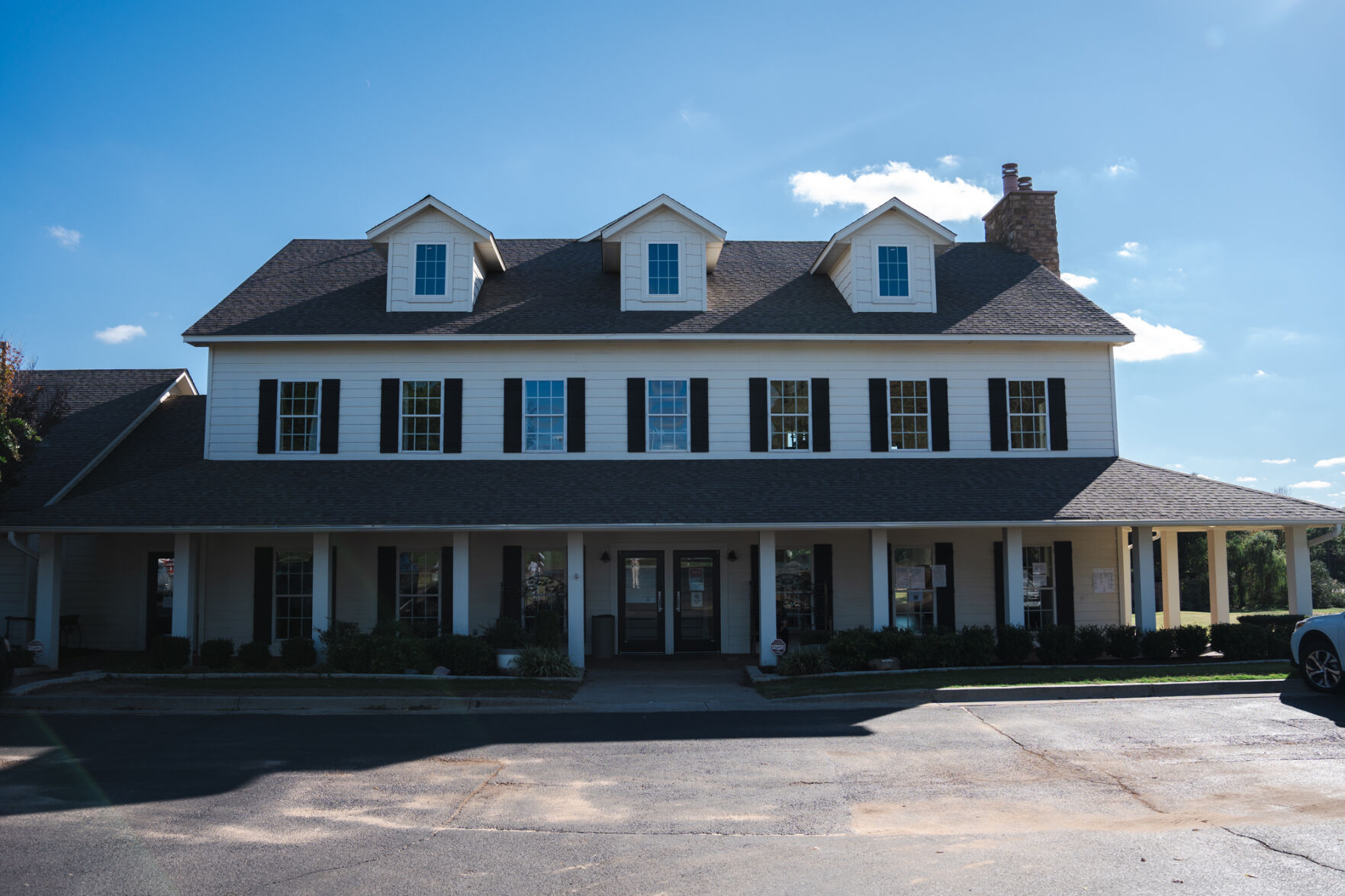
Cobblestone Creek Club House during Election Day on Nov. 5.
Dan, who did not want to use his last name, an 83-year-old retired Normanite, said he is voting for Holman for mayor because he believes current Mayor Larry Hekkila is a shill for developers.
“We need to walk the line between being business friendly and also taking care of the people of Norman, keeping it a vibrant university town, particularly in the light of the national political landscape these days,” Dan said.
On Sept. 18, Heikkila voted in favor of a financing plan that approved $600 million for the University North Park Rock Creek entertainment district. Since the vote, Heikkila has been a vocal supporter of the entertainment district, being one of the main presenters at a press conference promoting local businesses in favor of the development.
Tobi Morris, a 47-year-old who works in the restaurant industry, said it’s important to vote in local elections so residents can have a say in shaping their city.
“It's important for everybody to be aware of what's happening in their community. If you don't like the way that something is run get out and vote,” Morris said. “Make your voice heard.”
Tom Adolfs, a 63-year-old retired engineer, said he has a hopeful outlook for the city in 20 years.
“I see Norman pretty much the way it is today. A community where people all get along. They're very kind … I don't think we need to be anybody else. I think we need to be Norman,” Adolfs said.
Ward 8: Life Spring Church
Charles Franke, 63, is a millwright for Southwestern Wire and has lived in Norman his entire life. Franke said Norman’s lack of spending transparency, particularly with the Rock Creek entertainment district, motivated him to vote.
Franke said he loves being in Norman but is concerned about the rising cost of living as the city grows with OU’s move to the Southeastern Conference.
“I'd just like (Norman) to keep this small community feel that it's had for so long,” Franke said. “You kind of lose that in the big cities, I think that's what's kept me here all these all these years. (It’s) a place to call home.”
Caitlin Capps, social studies teacher at Norman North High School, said municipal elections directly impact residents’ lives. Divisiveness is Norman’s greatest challenge, Capps said, and the city must come together to solve its social and financial issues.
“When we get too entrenched in party politics, we miss caring for our neighbors and caring for our community and so I think working together to overcome, to look at all of the great and variety (of) things Norman’s dealing with,” Capps said.
Capps said she hopes Norman will grow well and include new voices in its community in the future.
Mike Wimberly, OU geography professor, said voting is his civic responsibility. Wimberly said he wants to see Norman prioritize local schools and affordable housing.
“I would hope to see (Norman) keep growing and be a place where people want to move and where people want to stay,” Wimberly said.
This story was edited by Anusha Fathepure, Ana Barboza, Ismael Lele and Peggy Dodd.


