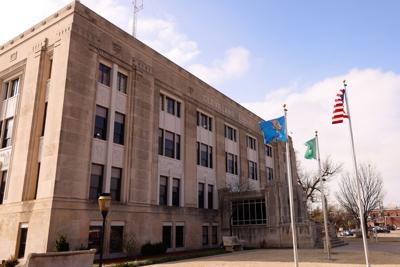

A Cleveland County judge found a defendant guilty of murder in the first degree with a fixed punishment of life in prison for the 2017 shooting of 20-year-old OU student Nathaniel Ewing.
The attempted robbery and shooting of Ewing took place on the night of April 23, 2017, and James Smith, 17 at the time of the shooting, was charged with the murder of Ewing in concert with Tyrek Turner, Cody Turbeville and Armani Morgan. Turbeville and Morgan both took plea deals to receive 10 years in prison and 10 years on probation, while Turner is still awaiting his own trial.
Smith pled no contest to the murder charge in 2018 and was sentenced to life in prison without parole. However, he withdrew his plea in light of a court decision that states only juveniles who are incapable of being rehabilitated can be sentenced to life without parole, according to court documents.
Smith's trial was set as a jury trial, but the jury was dismissed Tuesday when Smith asked that District Judge Thad Balkman make the final verdict. After deliberating for three hours, Balkman, in his verdict statement, said deciding this case may have been his heaviest burden yet as a judge.
“That’s because this decision revolves around life,” Balkman said. “Mr. Ewing lost his life. Mr. Smith, by law, if you’re found guilty, the sentence for this crime is life. And that’s why I listened attentively over the last four days, I took time to review my notes and go back over the evidence and reflect and deliberate on my decision.”
The assistant district attorney Jennifer Austin said this case was unique because of the amount of witnesses whose stories line up and the large amount of evidence collected that corroborates their testimonies.
Khloe Roper testified Tuesday that Smith reached out to her about buying marijuana, and she gave Smith’s Snapchat username to her brother Ian Roper. Ian Roper said he and Smith worked out a deal for Smith to buy marijuana from him and said he planned to get the marijuana from Ewing, who was his drug dealer.
Austin presented as evidence Facebook messages between Smith and a witness, whose lawyer asked he remain anonymous in the press out of fear of retaliation, that showed they were planning to rob Roper and Ewing.
The witness testified that he and Smith were driven to the meet up at Willowbrook Apartments by Cody Turbeville, who testified he was unaware of the plan to rob Ewing and Roper. When they arrived, the witness said Smith asked him for the gun and he gave it to him.
As Smith and the witness approached the car, he said Roper was standing outside the open passenger door and asked them for the money, and that he and Ewing would go get the marijuana. The witness said Smith started reaching for the gun, and Roper began “tussling” with Smith so he broke up their fight and put Roper in a headlock, moving towards the back of the car.
Smith leaned into the car and pointed the gun inside, the witness testified, and then shots were fired. The latent print examiner Candace Brown, as a witness from the Oklahoma State Bureau of Investigation, testified that the fingerprints on the outside of Ewing’s car matched Smith’s.
“Everything happened so fast,” Roper said on the witness stand. “I was in a headlock … I heard the gunshots. I looked up to see (Smith) with the gun.”
Marc Harrison, staff pathologist at the chief medical examiner’s office, performed the autopsy on Ewing’s body and testified that a bullet entered Ewing’s body on the right side of his torso and exited on his left side. A bullet also hit Ewing in the finger, Harrison said.
Harrison said the culmination of injuries to his organs made it almost impossible for Ewing to have survived.
“These are very serious injuries, a person would need rapid, definitive medical care to survive,” Harrison said.
Roper testified he ran away, not knowing Ewing was injured. The police were called by Khloe Roper, who was in her apartment at the complex when she heard the gunshots.
Turbeville, who said he couldn’t see what happened from where he parked, said he heard the shots before Smith and the other witness ran back to the car. Smith was yelling, “He was reaching for something, he was reaching for something,” Turbeville said.
Turbeville then drove them away and said Smith’s mother picked him up from his house about half an hour later. The district attorney showed Facebook messages from earlier that day between Turbeville and Smith where Smith suggested “hitting a lick,” which Turbeville testified meant robbing someone, and Turbeville responded he wasn’t okay with that.
Turbeville, who gets out on probation in a week, was asked, “You got out of this relatively well, right?” by Smith's defense attorney Troy Cowin, to which Turbeville responded that was not the case.
“My life still got ruined, a lot of other people's lives still got ruined,” Turbeville said. “I got out of it okay, not well. If I got out well I wouldn’t be sitting in this room talking to you right now.”
Throughout the trial, defense attorney Cowin tried to show the judge that Smith was less culpable for the shooting because of his young age.
Norman Police Department Detective Brett Willer, who interviewed Smith along with NPD Detective John Barbour after the shooting and heard his confession, testified Thursday after the court watched Willer and Barbour’s interview with Smith. During the cross-examination, Cowin asked Willer about placing his hand on Smith’s knee at one point during the interview.
“You think that’s legal?” Cowin asked.
Willer responded it was, and it was something he had learned as an interview technique. Cowin was also critical of Willer and the other detective telling Smith to “man up” and tell them the truth.
“You think a 17-year-old is a man?” Cowin asked.
“They can be,” Willer said.
In his closing arguments, Cowin claimed that Willer and Barbour coerced the confession out of Smith and that they took advantage of his age.
“Really look at whether the statements (Smith) made are voluntary or not,” Cowin said. “It’s a bad case, it’s no good for anybody. There’s a chain of eight people, and it comes down to the end of the chain where we have James Smith. Khloe could’ve broken that chain. Ian could’ve broken that chain. ... This is not on James Smith.”
Austin disagreed.
“It was (Smith’s) decision to pull that trigger,” Austin said. “All the other people involved did not not decide to put that bullet through Nathaniel Ewing’s body. … Yes there were other people, but today we’re here for James Smith. ... He should be found guilty and sentenced to life because that is what he deserves for what he did to Nathaniel Ewing.”
Judge Balkman said while Cowin did not want Smith’s interview to be used as evidence, it was and was part of his considerations.
“I’m not thrilled by some of the interview tactics that were used by the detectives, and I hope they aspire to improve how such interviews are conducted in the future,” Balkman said. “However, Mr. Smith's confession to the murder … was made voluntarily.”
Smith’s formal sentencing will take place at 9 a.m. Nov. 16.


