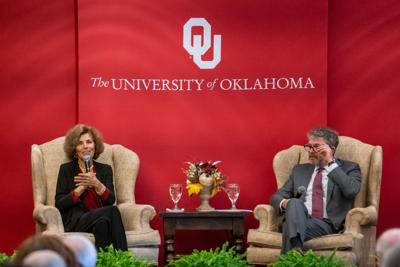

Nadine Strossen, the former president of the American Civil Liberties Union, spoke about the importance of free speech and open conversations on campus Monday as part of OU’s Free Speech Week.
Strossen, with Jeremy Bailey, director of the Institute for the American Constitutional Heritage and Sanders Chair in Law and Liberty at OU as a moderator, discussed how freedom of speech applies to academic censorship, the responsibilities of public institutions and the importance of open conversations over controversial topics.
In recent years, state government officials, like Oklahoma State Superintendent of Public Instruction Ryan Walters and Florida Governor Ron DeSantis, have made efforts to limit teaching topics like critical race theory and 2SLGBTQ+-related issues.
Strossen said it is important to defer to the professional expertise of education professionals as well as allowing local school boards to prioritize what they deem necessary. However, it’s important that all educators avoid limiting information as much as possible, especially in a college setting, she added.
“Freedom of speech includes not only the freedom to convey information and ideas on the part of the speaker, but also the right to receive information ideas on the part of the audience members,” Strossen said in an interview with OU Daily.
University faculty also have a responsibility when it comes to encouraging and facilitating free speech, Strossen said. The government speech doctrine specifies that public officials do not give up their rights to free speech when they take on their roles.
Academic institutions need to use caution, though, when issuing statements about things not directly related to the running of the university, Strossen said. Universities and university officials across the U.S. have put out many statements since the Israel-Hamas war took center stage in geopolitics, many of which have received a wide range of condemnations.
OU has not put out a statement regarding the conflict.
“No statement is ever going to satisfy everybody,” Strossen said in an interview.
Strossen recommended academic institutions uplift the opinions of community members as opposed to issuing official statements. She said it would provide people with the opportunity to discuss issues openly as a group.
Strossen also said speech, even hate speech, shouldn’t be restricted beyond statements inciting immediate violence. Instead, people should either ignore the hate speech or amplify voices focused on uplifting and supporting the communities being targeted.
Strossen said, more importantly, education should be the goal. Strossen, the daughter of a Holocaust survivor, said it's important to give Holocaust deniers a chance to learn instead of punishing or silencing them.
“Putting the Holocaust denier in jail is not going to eliminate Holocaust denialism,” Strossen said during her speech.
An audience member asked Strossen about her thoughts on the response two OU students faced in a 2019 incident in which they posted a video wearing blackface, which ultimately led them to withdraw from the university. Strossen said she wasn’t familiar with that particular incident, but that it would have been beneficial to educate the students on why what they did was offensive.
“I think if you immediately assume the worst and ostracize them and punish them, it's much less likely that they're going to change their views,” Strossen said.
Strossen said the most important thing, especially in an academic environment, is for people to have open debate and conversation about all topics, especially the most controversial ones.
“Every faculty member, every single student… should vigorously express their views,” Strossen said in an interview. “Hopefully there will be a range of views and vigorous debate — civil, hopefully, but vigorous debate — on the issues.”
This story was edited by Alexia Aston and Peggy Dodd.


