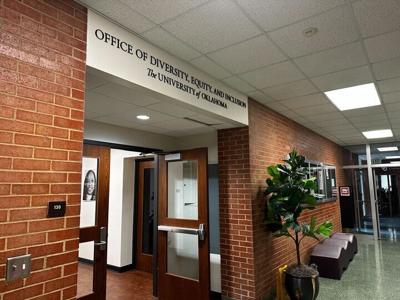

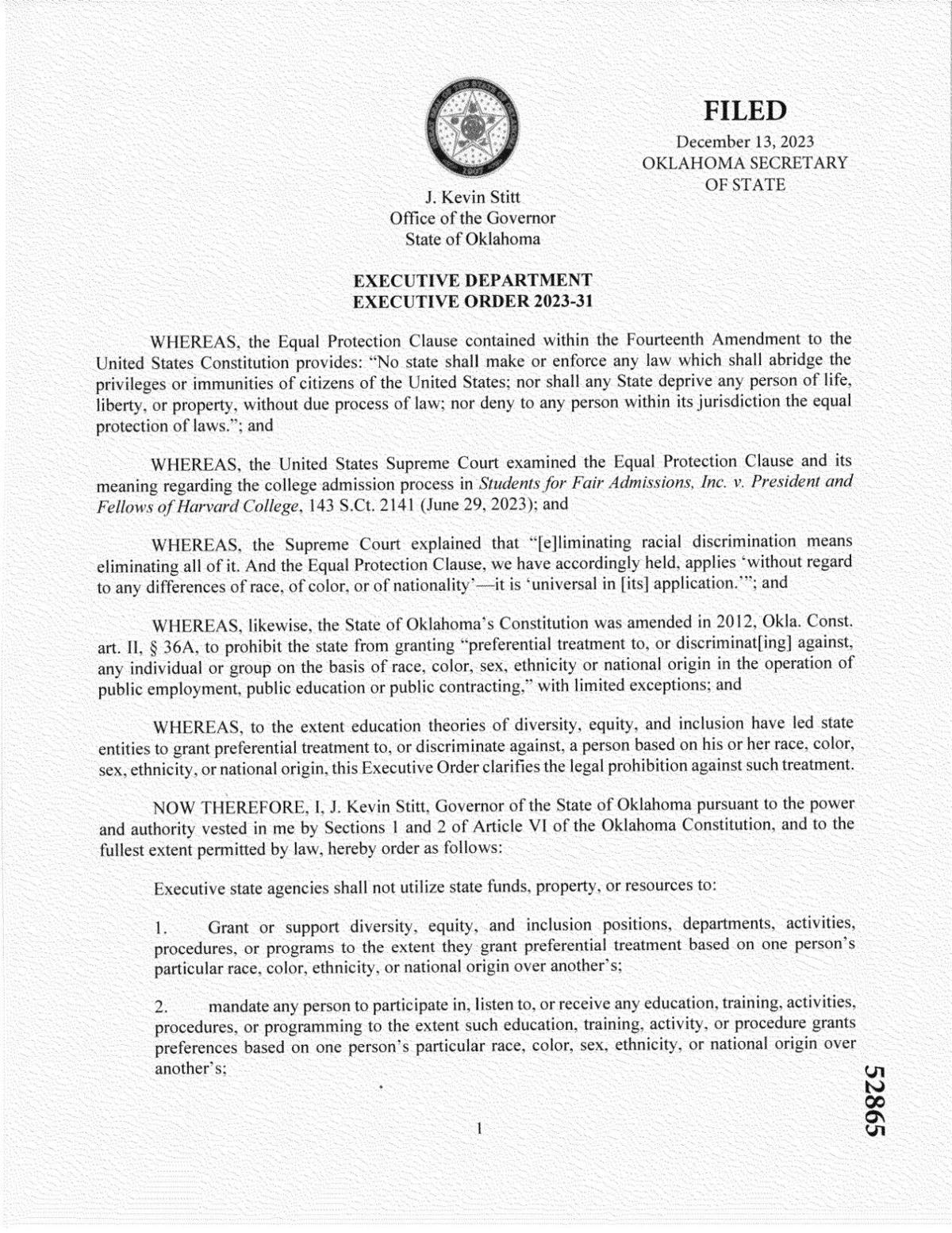
The deadline for public Oklahoma Universities to comply with Gov. Kevin Stitt’s executive order for a formal review of diversity, equity and inclusion in Oklahoma higher education passed Friday, resulting in several changes at OU to comply with the order.
On Tuesday, the American Association of University Professors at OU criticized the University’s actions in a press release taken in compliance with the order and called for OU administration to restore diversity, equity and inclusion efforts after numerous DEI programs were changed.
The AAUP at OU is a network of professors, researchers, graduate students and related professionals at the university who strive to include and represent all workers at OU, including faculty, staff and student workers.
In the press release, OU-AAUP claimed OU made “detrimental, intentional, and excessive efforts” in changing the Gender and Equality Center and the Office of Diversity, Equity and Inclusion, closing the National Education for Women's Leadership program, implementing new protocol for faculty syllabi, abolishing a course called “Leadership in LGBTQ Studies" and not implementing DEI training for Greek organizations after racist incidents.
The university started making changes following the December executive order, first by renaming the DEI Office to the Division of Access and Opportunity.
According to an Oklahoma Voice article, the decision to restructure the DEI Office was made months before Stitt’s executive order. In the press release, AAUP argued that targeting programs promoting diversity, equity and inclusion appears to be based on unexplained interpretations of Stitt’s order.
In April, the Gender and Equality Center, which focused on supporting students on campus through education, interpersonal violence prevention, advocacy for victims of gender-based violence and support and programming for 2SLGBTQ+ inclusion, was replaced with an Office of Advocacy and Education.
The Office of Advocacy and Education focuses on sexual assault and sexual violence prevention and response as well as health-related education programs and outreach. It also houses OU Advocates and oversees the OU Food Pantry.
A week later, the National Education for Women’s Leadership program, which trained over 650 women in political and public service leadership for over 20 years, was also closed due to the executive order.
OU-AAUP secretary Amit Baishya said the call for institutions to review their DEI programs is the most important part of the executive order.
In the release, the OU-AAUP wrote that OU’s actions send a message that it will take minimal steps to counter the executive order.
“OU’s efforts also directly override academic freedoms by diminishing faculty control over OU classes,” the release read. “These decisions turn back the clock on progress and put the University of Oklahoma on the wrong side of history.”
In December, the American Civil Liberties Union of Oklahoma, a nonprofit organization devoted to the defense and promotion of individual rights, stated that OU misinterpreted the provisions of the order and skipped the review process to eliminate all DEI programs instead.
Baishya said that some of the AAUP’s main concerns were the issues of academic freedom and faculty governance, which he said were targeted by the DEI changes.
A spokesperson for OU-AAUP wrote in an email to OU Daily that the organization has received reports from OU faculty members that syllabi have been checked for “possible legal trouble down the line.
“We are arguing that such legislations have to be seen as a continuum,” the AAUP spokesperson wrote. “There have been a number of reports to us on those lines. This, for us, is a breach of academic freedom.”
OU Daily obtained an email mentioning that the existing diversity statement in all syllabi needs to be replaced in compliance with the executive order.
“I think these are disturbing precedents where decisions are being made from above and sometimes we hardly have any say in this,” Baishya said. “It depends upon the vision of the university itself — do we think of it as a top-down institution, which is run basically by administrators who are not really given the reasons behind it, or do we think of it as an inclusive space for learning for faculty and students alike?”
OU did not comment on changes being made to faculty syllabi in their statement sent to OU Daily. In the statement, regarding the OU-AAUP press release, an OU spokesperson wrote:
“Since the issuance of the Governor’s Executive Order in December, the University has acknowledged its obligation to comply. In the more than five months since, university leaders have met and worked collaboratively with multiple stakeholder groups, including faculty, staff and students, to consult with them on progress related to compliance and to ensure that any changes made are within the scope of the executive order and in accordance with our foundational values of access and opportunity.”
The OU Office of the President website offers guidance to assist universities governed by the University of Oklahoma Board of Regents with implementing the executive order’s requirements. The guidance includes a list of the university’s obligations under the executive order as well as exceptions and further explanation for the obligations and exceptions.
Academic course freedom is an exception to the executive order, along with scholarly research and creative work; activities by registered student organizations; guest speakers or performances on short-term engagements; data collection; and access programs for military, veterans, Pell Grant recipients, first-generation college students, students from low-income families, students with unique abilities or underserved student populations.
The OU-AAUP release stated there were several occurrences in the past month causing concern for diversity at OU, including an incident involving a former Kappa Sigma member and two other men shouting racist and homophobic language at people passing by the fraternity house and a lawsuit filed by three white OU students alleging that programs under the former DEI Office are discriminatory to white people and illegal.
“The lawsuit exemplifies a hostile atmosphere toward DEI initiatives in Oklahoma and its universities,” the press release read.
While there have been no announced changes to programs under the Division of Access and Opportunity, the AAUP stated in the release that targeting such programs is a matter of deep concern.
Baishya said that OU should defend the values that fall under its previous DEI efforts.
“I do think universities have more power than they realize,” Baishya said. “Universities could, in some sense, from the university leadership … take a proper stance on this in terms of defending some of these hard-earned freedoms over time.”
This story was edited by Ana Barboza and Taylor Jones. Avery Avery copy edited this story.


