


Another year, another day and another birthday that Julius Jones’ family must celebrate without him, following over twenty years spent alone in solitary confinement. This July 25, however, is taking on a different tone than previously, as in a few months, four pardon and parole board members will hear Julius’ case during a second stage commutation hearing.
Their decision will determine whether or not Julius will spend his 42nd birthday blowing out candles surrounded by his family or alone again in the state penitentiary.
Julius Jones, a former OU student, was convicted of murder in 2002 and has maintained his innocence alongside his family and other supporters. Over the years, Julius’ case has achieved notoriety and drawn the attention of multiple celebrities, including Kim Kardashian and Baker Mayfield, who support his innocence.
The docuseries "The Last Defense," written by Viola Davis and her husband Julius Tennon, catapulted Julius’ story into the public eye in 2018. The Rev. Cece Jones-Davis was a viewer of the docuseries who sympathized with Julius, and she eventually created the Justice for Julius campaign with a petition that amassed over six million signatures.
Antoinette Jones, Julius’ sister and one of his biggest advocates, said she believes the visibility of Julius’ case has contributed to where he is now as he awaits his Sept. 13 commutation hearing.
“I thank and praise God that Julius has been given a chance to be heard in September,” Antoinette said. “We are blessed to have board members that see humans that are incarcerated and not numbers and file folders.”
Antoinette said she believes Julius's story is the “first of its kind” in Oklahoma, as he will be the first death row inmate to have his case heard by the Oklahoma pardon and parole board. She said she feels lucky, as she recognizes there are other Black Oklahomans in positions similar to Julius.
She said Oklahoma’s incarceration rates reflect racial disparities, as 3,796 out of 100,000 Black individuals from the U.S. are incarcerated compared to the white incarceration rate of 767 per 100,000. Data from the Equal Justice Initiative also shows that 87 percent of Black exonerees who were sentenced to death were victims of official misconduct, compared to 67 percent of white death row exonerees.
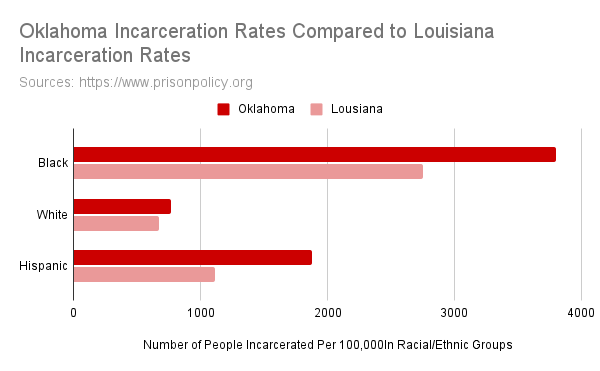
A graph comparing the incarceration rates of Oklahoma and Louisiana. Louisiana and Oklahoma share similar population rates, with about 3.9 million people in Oklahoma and about 4.6 million people in Louisiana.
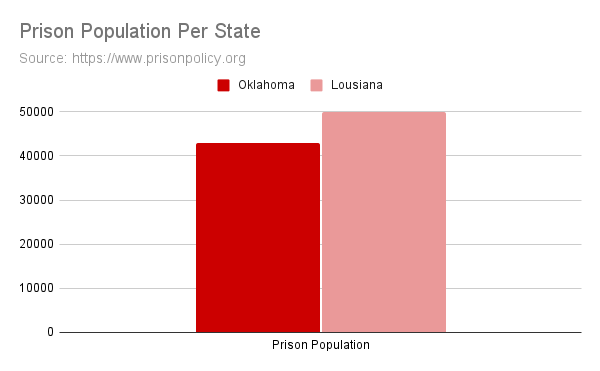
A graph comparing the prison populations of Louisiana and Oklahoma. The two states were compared for their similar population rates, with about 3.9 million people in Oklahoma and about 4.6 million people in Louisiana.
Data from the initiative states that, for every nine people executed, one person on death row has been exonerated in the U.S. Antoinette said it’s difficult to think about how some of these people on death row can be executed wrongly and be found innocent posthumously.
“Once a life has been taken, there's no way to reverse the mistake," Antoinette said.
Jabee Williams, a rapper, community activist and friend of Julius, said he recalls hearing about the case from friends and family when he was growing up. He said he is often reminded in his support of Julius that he is one of many individuals in a marginalized community that is sentenced unjustly.
“Julius knows he's not the only one,” Williams said. “I know it could have just as easily been me.”
Williams has worked with the Justice for Julius campaign and was also involved in “The Last Defense” docuseries. He also participated in a three-day, 131-mile walk through sleet and snow to raise awareness about Julius’ case — which was captured in the documentary "New Year, New Justice.”
Williams also collaborated with Julius on a song titled "Until You're Free." The song features Julius reading a poem he wrote, and the recorded audio came from a phone call shared between Jabee and Julius.
One-hundred percent of the revenue made by the single went toward the Justice for Julius campaign so it could continue promoting Julius’ innocence, Williams said.
As Julius' commutation hearing approaches, both Antoinette Jones and Jabee said they feel hopeful about the future.
"I have to give what I cannot control to God," Antoinette said.
Antoinette said for those in support of Julius to follow their campaign’s official social media platforms and subscribe to their website for updates. She said the campaign prays every Tuesday evening, and people can register at prayersforjulius.com to receive the Zoom link.
"It's our job as citizens to hold our leaders and elected officials accountable because they serve us. We have more power than we realize. Our voices and votes matter," Antoinette said, "When we are silent, when we don't vote, we are making a choice that ultimately helps oppressive systems. As citizens in America, we have a right to speak up, vote, rally, march, petition and be a part of the democratic process."

A graphic from the Justice for Julius campaign wishing Jones a happy 41st birthday.
If the board makes a favorable commutation recommendation for Julius, they will also issue guidance on how the sentence should be modified. After the hearing, Gov. Kevin Stitt has 90 days to grant or deny the application. If he declines to act, the request will be considered denied. Julius' commutation hearing is set to take place at 10 a.m. on Sept. 13.
Supporters can wish Julius a happy birthday here.


