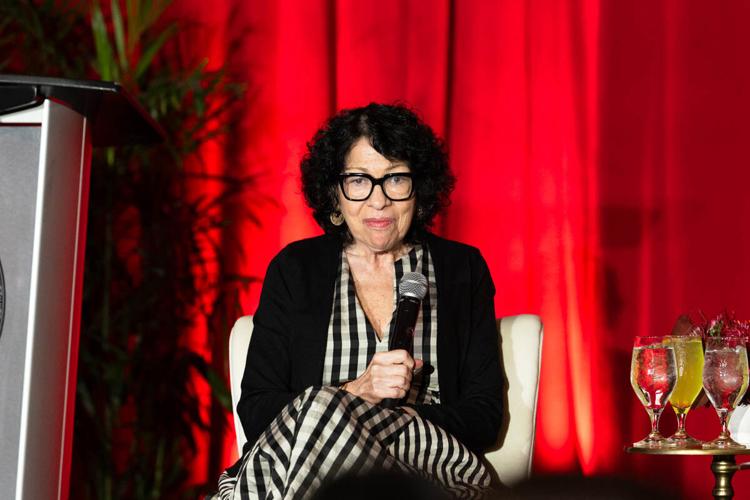
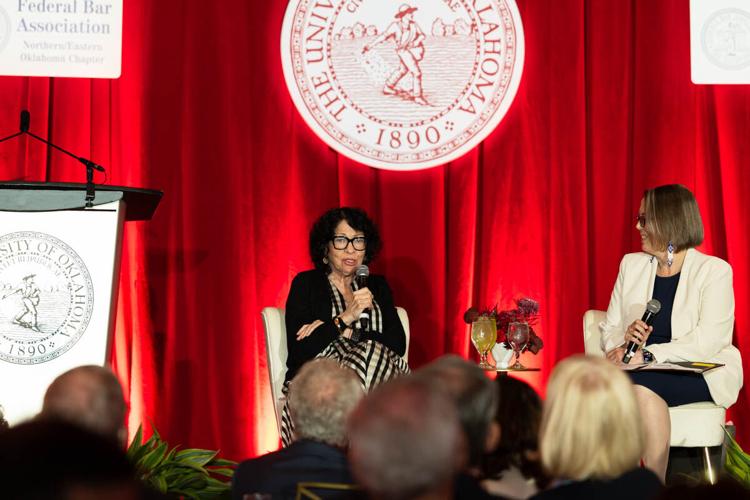
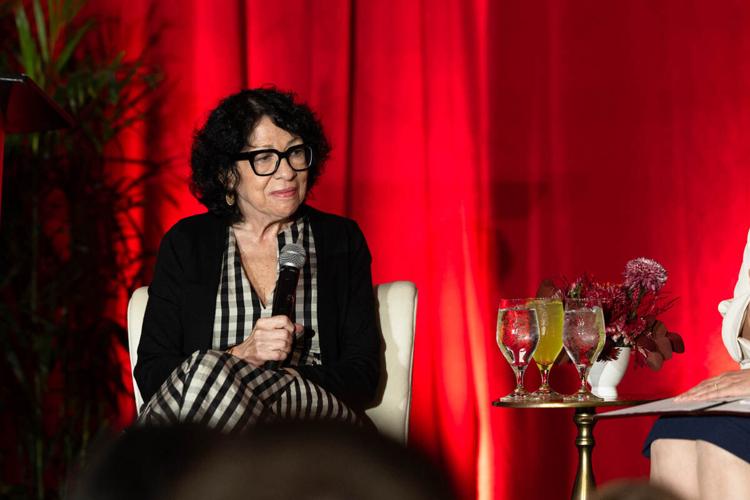

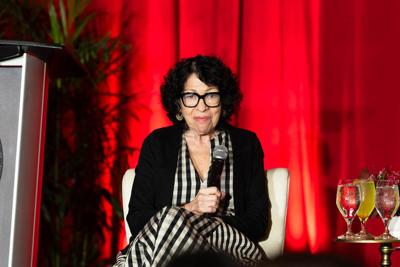
U.S. Supreme Court Justice Sonia Sotomayor took the stage at OU-Tulsa Wednesday evening to discuss civic education and her law journey, with a few pointed comments about her fellow justices.
“All I can do is write what I think is the right answer and explain why, and hope that history will prove either that they’re right or I’m right, but put us on the right course — whichever course that may be,” she said.
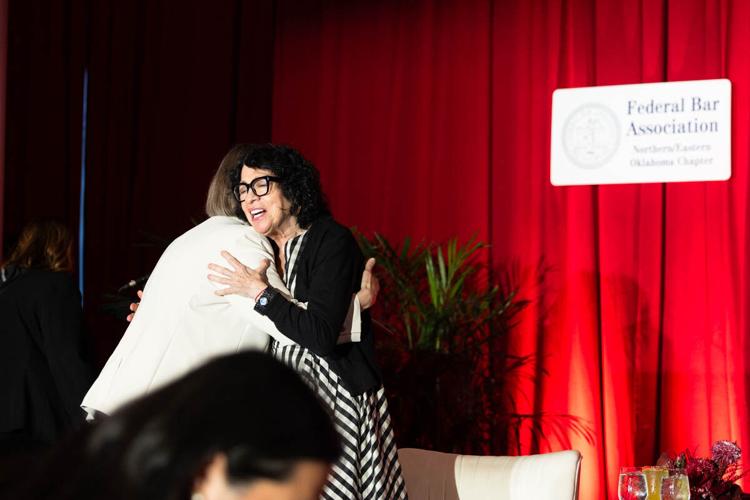
The Northern/Eastern Oklahoma Chapter of the Federal Bar Association hosted the fireside chat at OU-Tulsa’s Schusterman Center, marking the second time Sotomayor visited Oklahoma to speak. OU President Joseph Harroz Jr. introduced Sotomayor to the 250-person crowd, and U.S. District Judge Sara Hill moderated the discussion.

Sotomayor lecture at OU-Tulsa on Sept. 16, 2026.
‘I’m not joking’
After 17 years on the Supreme Court, Sotomayor said her job is still challenging. Unlike other courts where judges decide disputes between parties or about how the law was applied, she said justices consider what the law should be.
This summer, the Supreme Court ruled in a number of contentious cases. Sotomayor joined the majority to uphold birthright citizenship and post-Election Day ballot counting. She dissented in rulings that stated the president can remove Federal Trade Commissioners without cause, and that federal courts can’t review decisions about a country’s protected status, resulting in the removal of protections for Haitian and Syrian citizens.
“I don’t always write ‘I ‘respectfully’ dissent,’” she said to Hill. “But you’re right, I keep dissenting.”

Sotomayor lecture at OU-Tulsa on Sept. 16, 2026.
Sotomayor, appointed to the Supreme Court by President Barack Obama in 2009, is one of the three liberal justices who often clash with Trump and the conservative majority of six.
“When I retire, I’m going to try cases again,” she said. “I’m not going to let my current colleagues overrule me.”
Sotomayor criticized the unitary executive theory, an ideology which states the president should have full control over the executive branch. That includes the power to remove their appointed officials at will, which was upheld by the Court this summer in the FTC case. Sotomayor disagreed, and said the Constitution doesn’t give the president that much power, and doing so would disrupt the checks and balances of government.
She is also concerned about lacking civic education, and said young people don’t understand their government.
“Some of my colleagues don’t either, by the way.” The audience laughed, and she said, “I’m not joking.”
Without civic knowledge, she said Americans won’t be able to maintain democracy. The crux of the Declaration of Independence is that citizens must give their consent to be governed, but Sotomayor fears people have become apathetic.
“We have to work diligently every day to protect our values and to protect our government and its system of government,” Sotomayor said. “It's not something that just happens.”
‘Find my courage’
Sotomayor grew up in a housing project in the Bronx, experiencing her father’s death and neighborhood gang violence as a child.
She was shaped by caring people in the community who looked out for her, she said, and by her extended family in Puerto Rico. During hardship, she said reading gave her hope for the future.
“Real power is in what you can build with words, and that's what books do,” Sotomayor said. “They paint pictures in your mind about possibilities that you often can't imagine for yourself, and that's what books did for me.”

Sotomayor lecture at OU-Tulsa on Sept. 16, 2026.
Sotomayor attended Princeton on a full scholarship, and quickly realized she was different from other students — they came from families making six figures, while her mother only made $5,000 a year. Still, after receiving high awards and graduating summa cum laude from Princeton, she attended Yale Law School.
Sotomayor worked as a prosecutor, district judge and appeals court judge before being appointed to the Supreme Court in 2009. Her notable rulings include joining the majority to legalize same-sex marriage and to include gender and sexual orientation discrimination under the Civil Rights Act.
While in college in the ‘70s, Sotomayor said she faced insults in professional settings over her gender and race. She repeatedly pushed back those discriminating against her, including her professors.
Hill asked how she overcame injustice, and Sotomayor said she was motivated by compassion for others.
“Look at the world not through what affects you, but look at it through the lens of what is happening to others and whether you can play a role in helping others,” Sotomayor said. “That’s where I find my courage.”
This story was edited by Spencer Windholz. Parker Newman and Sophie Hemker copy edited this story.


