

The Sam Noble Museum of Natural History is hosting a new traveling “Sahara Sea Monsters” exhibit, featuring species found in the Moroccan fossil record.
The exhibit showcases life found eons ago when the Sahara desert was a thriving sea swimming with various creatures that are now extinct.
Alexander Mann, marketing and public relations officer for the Sam Noble Museum of Natural History, said the exhibit focuses on ancient life that originated from what is now Morocco.
“The exhibit takes us through some of the different eras and periods that the Earth has been through, starting with some of the very early forms of life and eventually evolving into more complex things, like jawed fish and dinosaurs and eventually mammals too,” Mann said.
The exhibit progresses chronologically, starting in the Precambrian era and ending in the Neogene period. Fossils provide a window into the past, but due to preservation loss, there are potentially a lot of things missing from the fossil record.
Kyle Davies, paleontologist and fossil preparator for the Sam Noble museum, said that the further in the past you go, the sparser the record becomes.
“If you go to the bank and get some rolls of old quarters and start arranging them by date, you’ll wind up with a stack of fairly modern dated ones and they'll slowly diminish as you go further into the past just because they've had to survive,” Davies said. “And that's the same way fossils work, you know. They’ve had to survive.”
Before the Triassic period, the Moroccan fossil record was very limited. Davies said this could be due to conditions that were not right for fossilization.
“As you approach the age of dinosaurs, Morocco was colliding with North America and Europe, which were already combined,” Davies said. “The biggest extinction we know of in the fossil record is actually the Permian, not the one that killed the dinosaurs. Ninety to ninety-five percent of the species alive at the time went extinct. That's just a devastating loss of organisms.”
The exhibit ranges from simple animals like arthropods found in the Ordovician period to ones such as the spinosaurus from the Cretaceous period.
“The Spinosaurus is one of the most famous specimens here in this exhibit,” Mann said, “made most famous by the second' Jurassic Park' movie, where he had a big role. And that's probably what most people know him from, it was one of the largest predators alive.”
Mann said that the exhibit has a lot of creepy displays.

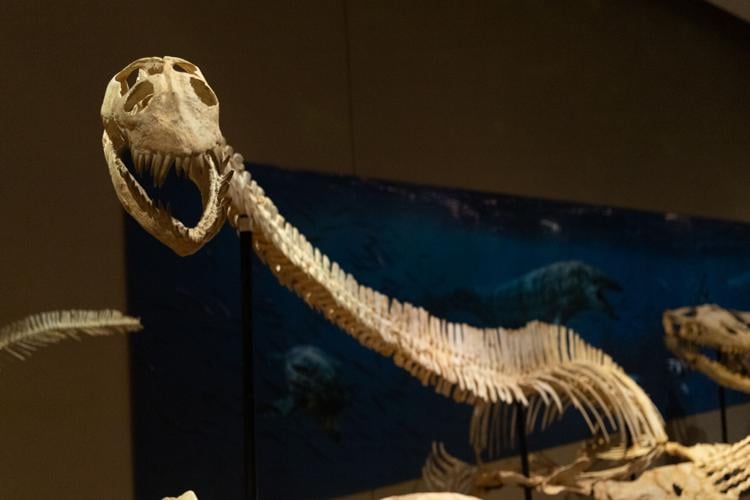
A fossil at the Sam Noble Oklahoma Museum of Natural History's "Sahara Sea Monsters" exhibit on Nov. 2.
“A lot of the animals were kind of alien-looking, like not what you would ever expect to see on planet Earth,” Mann said. “But eventually, a lot of them did go extinct, and new forms of life took their place.”
David Wright, curator of invertebrate paleontology at the museum, said that the exhibit captures the rise and fall of biodiversity through time.
“If you start at the beginning and go to the end, then you've really walked on a journey of more than 500 million years of Earth’s history,” Wright said. “So there's like half a billion years of Earth’s history that's all folded up into this one little exhibit."
Wright said that visitors can appreciate the ecological diversity of the ancient ecosystems represented.
“The exhibit documents some of the major patterns of life and the evolution of life through time,” Wright said. “Almost every major part of the animal tree of life is represented in some way.”

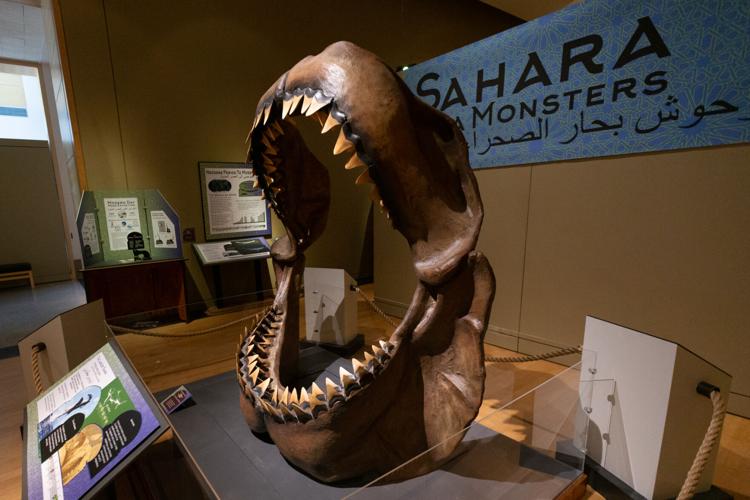
A megalodon fossil at the Sam Noble Oklahoma Museum of Natural History's "Sahara Sea Monsters" exhibit on Nov. 2.
The megalodon jaw on display represents the largest, most fearful shark recorded in history and is a distant relative to the great white shark. Due to the megalodon’s massive size, whales would have been their preferred prey.
“A number of the specimens on display tend to be scary in a sense that many of them are major predators of the time in that interval of Earth's history, and so there is like an emphasis on sort of the monster level,” Wright said.
At the end of the exhibit, a display addresses the decline in biodiversity in the modern day. Earth is currently in the middle of its sixth mass extinction, caused by global warming, ocean acidification, a rise in carbon dioxide and more.
Wright said that it's worthwhile for visitors to not only admire the dinosaurs, but also to reflect on the mass extinctions caused by climate change and habitat destruction, something that still happens today.
“Not as fun to think about, but it is a lesson from Earth’s history that I think is very relevant for society today,” Wright said.
The exhibit will be open until February 12, 2023. Tickets are free for OU students, $6 for children and $10 for adults.


