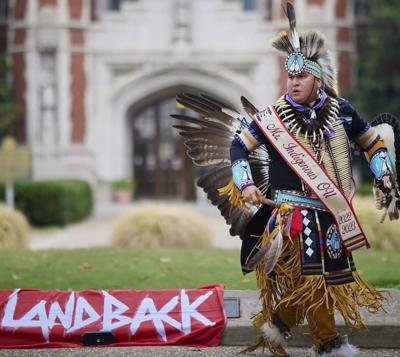

Asa “Ace” Samuels, OU senior majoring in biology and minoring in Native American studies, is a member of the Cheyenne and Arapaho Tribes and a relative to the Choctaw Nation of Oklahoma.
Samuels advocates for other Indigenous people, especially students, and hopes to help and inspire others through what he does.
A little over four years ago, Samuels struggled with alcoholism. He was living in and out of his mother's home, living job to job. Once he got help, something that inspired him was the Osage people's influence on Tallgrass prairie preserve in Osage County and the wildlife that thrived there.
“It was one of the first times in my life that I actually got to appreciate the Creator's creation,” Samuels said. “That's what drives me going into this field and really seeing it from a cultural standpoint.”
Now, Samuels is involved in many organizations on campus and in the Indigenous community, and he is devoting his time to helping and educating people.
“From four years ago, having nothing, to being where I'm at now, to me, is a huge accomplishment,” Samuels said.
Samuels said that Indigenous people are underrepresented everywhere. While there are over 500 Tribes recognized in the U.S, there are over 300 others that are not. Less than 1 percent of all academic students are Indigenous, and only 28 percent of those Indigenous students actually graduate. As Mr. Indigenous OU, Samuels hopes to bring awareness to these factors and promote Indigenous inclusion.
“How do those people get recognition?” Samuels said. “How do they get help? I ran for Mr. Indigenous to put down the foundation, or really the platform, of Indigenous inclusion. So that’s really putting Indigenous inclusion into every part of academia, all across the board, whether it's athletics or science or engineering. That's why I really wanted to excel on that and try to spread our awareness in that way.”
Samuels said that academics were not created with Indigenous people in mind. He hopes to help them push past that and participate in the academic world.
“How can we be recognized in every way, shape and form possible, and not just existing as a native person?” Samuels said. “We may have the blood, but how do we represent them and ourselves? How do we represent our tribes broadly? That's my passion, is to incorporate a lot of that into what we do today.”
Samuels said that the traditional knowledge of Native people relates to all sorts of academic subjects, such as geography, astronomy, architecture, biology, botany, and agriculture. He said that Indigenous people have been studying and working on these topics for thousands of years, and their insight should be heard.
“I think the traditional knowledge of Native people holds the key to all the answers to the questions that we're asking today,” Samuels said. “… It's kind of sacred knowledge, you can't really share that type of thing. But if you can let us lead the way, we can fix things up.”
Samuels said that the Indigenous community needs to be brought into more conversations at OU, especially when concerning athletics, homecoming, or Rah! Rally. He said that the Indigenous community should get to present themselves the way they want to, not the way OU wants them to.
“Just because we are able to carry flags out onto the field during a football game, or during a basketball game or softball, to us, we don't necessarily see that as an honor,” Samuels said. “We see it more as, this is OU showing their diversity to the public. And then once those curtains are closed, then we are shunned out, then it's like, ‘we (OU) don't care about the Native community.’”
Samuels is a dancer, and said that dance is one of the ways he is able to tell his story and how other Indigenous people can as well. He said that Indigenous people deserve to display their culture in ways like that at OU.
“I danced at the Baylor game last year, I danced on the OU logo right in the middle,” Samuels said. “I was up there by myself. I was dancing before with my people. That's what it was for. A healing dance. It's me telling my story.”
Additionally, Samuels said that the public has many misconstrued ideas of how the Indigenous communities live their lives. He said that while some may still live traditional Native lifestyles, many live just like everyone else.
“There are a lot of people that think that we still live in tipis and that we're not educated, and that we're not living in this modern lifestyle like everybody else is,” Samuels said. “But we drive cars, we live in homes, we have salaries, we have kids, we have shoes, we wear name brand stuff, we're just like anybody else. I think OU needs to do a better job of putting that out there.”
The American Indian Student Association is the main organization on campus for Indigenous students to come together and connect. Samuels serves as the Cultural Affairs chair for the organization.
He also currently serves as Mr. Indigenous OU for AISA. Those who hold the title serve as an ambassador for the University, and are representative of the Indigenous people not just at OU, but across the state. The role means you are the face of the American Indian Student Association, and are the driving force on issues.
“All of our contestants this year, they all have a reason to run for Mr and Miss Indigenous OU, and their platforms are all courageous and very relatable to the Native country,” Samuels said.
Samuels is also a member of Iota Gamma, the only Indigenous fraternity at OU. He said that the fraternity focuses on cultural preservation, spirituality, physical fitness and academics. Most members are Indigenous, but don’t have to be.
Samuels said. “It’s really a brotherhood where we hold each other accountable, and we push each other to be the best that we can be and strive to be a great Native person.”
Samuels is a member of the American Indian Science and Engineering Society where Native students can find community with other Indigenous students interested in STEM. He is also a part of the Genomics and Ethics for Native Students research program for Indigenous students at OU. The program was created as a way for Native students to work collaboratively and advance their knowledge in these topics. Samuels said that even Native students who don’t study genomics are allowed to join.
“We come together and we eat and share our insights on health-related issues,” Samuels said. “They also take us on trips to have workshops. We just went to Alaska back in June, it was awesome.”
Samuels also works as an undergraduate research assistant at South Central Climate Adaptation Science Center, researching different species of animals and plants, looking at his research from an Indigenous perspective. This work gave him the opportunity to visit places such as Washington, and present with the Native American Fish and Wildlife Society to talk about climate change and tribal engagement in state wildlife action plans and Recovering America's Wildlife Act of 2021.
“I'm working on a journal article that's gonna be on Traditional Ecological Knowledge: Wildlife Conservation with the Indigenous perspective,” Samuels said. “We’re a very small population, but we really care about our natural world, we relate to it.”
Samuels said that overall, his mission is to help others and better the community. He wants to make sure others are taken care of before he worries about himself.
“Being selfless is a very key thing that you need to do in order to make things work out for the better of everybody else, and not just yourself. The three things that I have taken from Kalani Souza: Are the children fed? Are our elders comfortable? Are the women unafraid? These questions are very important to me. And this is what I ask myself at all times.”
Samuels said that now and in the future, he wants to focus on conserving and preserving the Indigenous land and culture, and promote change through his practices of helping others and his career in biology.
“I'm not even close to being done at all,” Samuels said.
This story was edited by Silas Bales and Emma Blakley. Nikkie Aisha copy edited this story.


