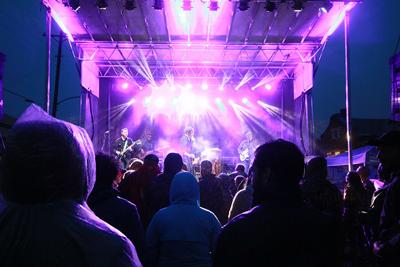

Norman Music Festival returns for the second year since the pandemic and is expected to have 100,000 attendees and generate $4 million in financial activity.
Norman Music Festival Executive Director Shari Jackson said that festival costs $250,000 to produce, and that the 2022 festival generated 4 million dollars in economic activity, money that went from the hands of one person to another.
“Any time you generate activity, you generate sales tax revenue, you generate revenue for your local businesses and create economic activity between three and a half and $4 million on the weekend, which we think is a great return on our quarter-of-a-million dollar investment,” Jackson said.
Norman’s oldest bar, the Bluebonnet Bar, is situated just yards from one of the Norman Music Festival’s main stages. Tanner Miller, co-owner along with his wife Michelle Miller, said that the $4 million figure generated by the festival is significant to the downtown area.
“That's huge numbers for downtown,” Miller said. “Obviously downtown does not get the game day traffic that campus gets, we usually get the ‘befores’ or ‘afters,’ so it's a big weekend for us financially.”
Performing artists of all kinds are often asked to share their work on a volunteer basis or with the offer of exposure as a form of payment. Though the festival got it’s start on a volunteer basis, Jackson said that it is not a sustainable way to build a tradition.
“We're trying to lead the charge a little bit,” Jackson said. “Generating this much economic activity and not compensating the people who are doing the work to make it happen is just not right. When this thing started it was a bunch of musicians and people who loved music, so they invited all their friends, who were happy to join in the effort to make a festival happen. But now that we're 15 years down the line, that's not a sustainable practice.”
Last year, the festival succeeded in compensating every band that played on a Norman Music Festival stage. The 2023 festival marks the second year to accomplish it.
“Too often artists of all stripes, whether it's a visual artist, a performing artist, a band member, very often get asked to show up and play for the experience: ‘It's only an hour,’ that kind of thing,” Jackson said.
The concept of a “free” performance is somewhat of a myth. Between hours of rehearsal and the cost of instruments, equipment, and travel, Jackson said that an unpaid band is a band paying to perform.
“If you don't compensate a band, it costs them money to come play. You have to put gas in the car,” Jackson said.
Bluebonnet Bar participates in Norman Music Festival, but is also a business that supports local art year-round. The bar hosts live music six days a week, and is among a handful of venues in the area that prioritize local music as part of their routine. Miller said that he hopes the festival serves as a reminder to local administration of the importance of arts in the community.
“Norman has really made a point to incorporate arts, from the Norman Arts Council and to have free concerts and free festivals and to support local music,” Miller said. “I feel that with anything nowadays it's, ‘Oh, we don't really need that, it's not necessary.’ I hope that people look to the festival as something saying that this put us on the map, besides the people that play football down the road.”
To develop a thriving arts economy, in which artists are consistently paid for their work, Jackson said there needs to be a physical infrastructure to support it. Though there are spaces in Norman such as Bluebonnet Bar, the Deli and Opolis that consistently have live music, Jackson hopes for the development of larger spaces.
“One of the biggest hurdles to being able to be in a place where a lot of arts organizations can pay is not having venues or spaces to operate in where you could sustainably bring in crowds,” Jackson said. “If you could do that, you can put performances up all the time. When you're struggling to find a space and you're trying to get 40 people crammed into whatever space that you've managed to get a hold of, it's very, very difficult to create an economic model.”
For the work of artists to be consistently valued, there needs to have a thriving arts economy. Jackson hopes that the return on investment from the Norman Music Festival will serve as an example of how beneficial the arts can be, both as a community building event and as a financial bonus.
“The more we can collaborate with each other as arts organizations and arts endeavors, the more we can try to work on an arts economy and get the sector taken seriously,” Jackson said. “Being able to collaborate, trying to get our state or municipalities and others to help invest into infrastructure that might boost the arts the same way they do business.”
Norman Music Festival runs April 27 through April 29. The festival will showcase artists from a variety of genres and backgrounds, over 90 percent of whom are from Oklahoma.
This story was edited by Silas Bales. Alexandra Powell-Lorentzatos and Nikkie Aisha copy edited this story.


