
Norman is home to a vibrant gardening community, with veteran and rookie growers helping each other build a sustainable and quality food future.
One collection of these growers is a community garden network called Regenerate the Earth, a group of community gardens and supply organizations committed to helping one another in their gardening endeavors.
Jacki Saorsail is a long time Norman resident with two decades of gardening under her belt. She began her gardening journey in the early 2000s when she started helping with the garden belonging to The Earth Cafe and Deli. She currently partners with Loveworks Leadership Inc., The Earth Cafe and Deli and Red Dirt Collective, and uses her two decades of knowledge to help educate growers and maintain the community gardens.
The Earth Cafe and Deli was established in Norman in 1969. It has a menu accessible to those who are gluten free, vegetarian and vegan, and features an online catalog of organic and sustainable products.
The garden at the cafe is situated behind the restaurant. It supplies the deli with food and is a place for community events and gardening days. Saorsail currently runs the garden at The Earth Cafe and Deli. One of her goals is to encourage people to help with the garden and gain followers of the project.
In her early gardening years, seeing sustainability in action while working at the cafe inspired Saorsail’s personal endeavors.
“I was buying all organic food from (the cafe) and just wanted to try growing some of my own,” Saorsail said.
She works to use social media as a tool for getting people interested in gardening.
“I've just been setting up a website and social media accounts, and I've been making videos. … We're making little TikTok videos and posting them and making blog posts and putting out a newsletter,” Saorsail said. “So there's lots of ways that people can follow what's going on.”
The Regenerate the Earth coalition comprises six partner organizations. Red Dirt Collective, The Earth Cafe and Deli and Loveworks Leadership Inc. are all groups who have community gardens. Prairie Dirt Solutions and Eco Wood Solutions have resources for gardeners. Regenerative Dynamics helps organizations in making a sustainable business model.
Regenerate the Earth has a blog that keeps up with the progress of each garden and calendar of events that gives the times of community gardening days and events. It also contains how-to videos on composting, planting and fertilizing.
While social media is a wonderful tool to get people involved, it can also bring about disconnection. In the age of the internet, a true sense of reality can be hard to come by. Working on the ground with other community members can bring about rare and much needed connectivity, Saorsail said.

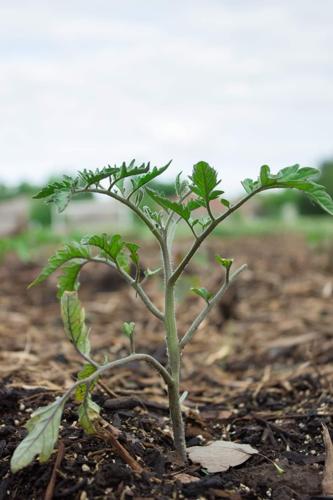
A sprout growing toward the sky. Photo provided.
Saorsail said that working with the ground is a place for connection with humans as much as it is a place for connection with nature.
“I think today a lot of people are in the cloud, online, so much of the time that they lose touch with reality,” Saorsail said. “So you come out here, not only are you in touch with physical reality, life and death reality, you're also in touch with other people. You get to actually talk to people face to face.”
Another of Saorsail’s current projects is her work with the garden and youth at Loveworks Leadership, Inc.
Loveworks Leadership, Inc. is a program focused on guiding the youth of the Norman community in their leadership skills. In 2020, despite the pandemic, Loveworks reached 1,067 students through virtual and in-person programs, helping them build better habits and strengthen their mental health. Since 2011, Loveworks has reached over 14,000 students.
Loveworks hosts a community garden as part of its after-school program. The program, geared toward fourth to eighth grade students, is maintained by hundreds of volunteers and mentors.
For Saorsail, the educational aspect of gardening, rather than the product, is what makes the endeavor worth her while.
“Typically, when you're working with volunteers, you’ve got to consider they're going to make a lot of mistakes, so I'm not really trying to maximize our crop production,” Saorsail said. “If nobody shows up, I might just throw out some cover crop seeds and call it good because I'd rather spend my time educating than just doing a bunch of gardening by myself.”
Saorsail also lends her knowledge to the Red Dirt Collective garden, which is in its second growing season in plots in the corner of Colonial Commons Park. It is situated near a playground and soccer field and is open for anyone at any time to help cultivate the ground and taste the produce.
Another important outcome of a community garden is the landscape it creates, especially in a public area. Beautifying a space by creating a garden where there once was only grass can be a catalyst in getting the community excited about growing, Saorsail said.
“I think it's a matter of … optics,” Saorsail said. “If you look around and there's gardens then it inspires people to do more gardening and just makes it a lot more pleasant to live here.”
Red Dirt Collective is an organization built for the purpose of helping the community. Their motto is “helping each other through our crisis.” RDC focuses on the working class in Norman, working to provide mutual aid, organizational strategies and policy solutions.
RDC has a variety of programs in addition to the gardens geared toward the Norman community.
RDC hosts bimonthly mutual aid fairs, which recently have been held at the Irving Recreation Center and are gaining a reputation in Norman as an enjoyable community event and reliable source of resources. Community members can pick up personal resources such as food and clothing, and have the opportunity for free bike and break light repair and free haircuts.
RDC also sponsors three food pantries in town, two of which are outdoors, to provide 24/7 access. Keeping these pantries full has helped inspire their gardening vision.
Ashley Creed and Bethany Sipe are both lifelong Norman residents and co-founders of RDC, along with their husbands. Creed is the director of mutual aid for RDC and Sipe has recently been named the garden director.
Gardening is a new endeavor for both Creed and Sipe. Nevertheless, they have created and established the RDC community garden while simultaneously developing their skills and knowledge.
The inspiration for starting a garden comes from a desire for fresh produce and community outreach. Colonial Commons Park is situated in Ward 1, which is also home to RDC’s community pantries. Creed said that much of RDC’s work centers around Ward 1, making it a prime location for the garden.
A desire to supply their pantries with fresh food is another catalyst for RDC’s gardening.
“With the pantries, a lot of people were talking about wanting fresh produce and eating healthy is sometimes really expensive,” Sipe said. “It seemed like a cool way to have produce that was something that people didn't have to go out and buy.”
The garden is a place where people can meet one another and connect over mutual hardships, with the ultimate goal of working together for a better future.
“One of our organizational goals is connecting people to each other that are experiencing the same hardships and same problems,” Creed said. “I think that's another way that we're hoping that the garden can be used, just connecting people during conversations. … How can we work together to solve that or fight against some sort of oppression?”
RDC’s garden may be in its second growing season, but the organization has a prolific vision for its future.
“We’ll have open plots for the community (so) that they can have access to really great food. … They can just come to the park and say, you know, I need some herbs for this meal or some vegetables,” Sipe said.
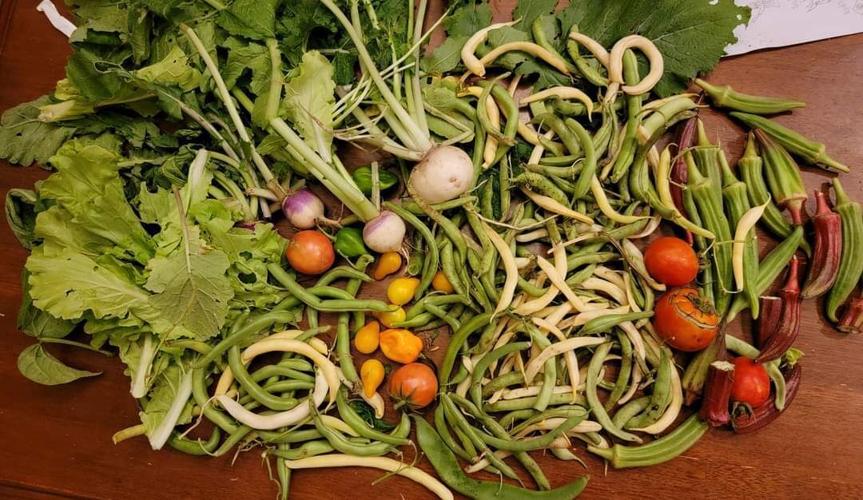
The current garden is composed of two plots and a handful of fruit trees.
Sipe said that the goal is to make a “food forest” on the edge of the park. Creed said that she hopes with crowdfunding they will soon be able to build a shed for tools and supplies.
"It's going to take a while but we have an idea of making a big food forest in the back where the trees are so it’ll be kind of layered,” said Sipe. “You'll have your biggest canopy with the biggest fruit trees and nut trees and then you'll have smaller fruit trees and all the way down to the bushes and the vegetables growing on the bottom of it.”
Red Dirt Collective meets every Sunday at 10 a.m. in Colonial Commons Park to work on their garden. They are always eager to have people come volunteer and learn about the garden, Sipe said. The Earth garden hosts workdays some evenings behind the cafe. Loveworks is always open to volunteers and hosts garden hours as well.


