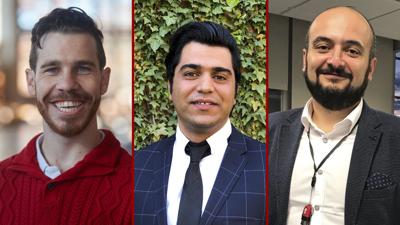

As the coronavirus pandemic has changed the lives of many OU students, it has also given others interesting research opportunities in multiple areas of study.
Doctoral students in Norman are working toward unique findings about COVID-19 in their respective fields. Understanding misconceptions about the coronavirus and how those might change, learning how to detect COVID-19 in pneumonia patients and analyzing the pandemic’s effect on pop culture are just a few of the many OU-led research studies that have taken place since March.
Murat Turk, a learning sciences doctoral student and Fulbright scholar, said even before OU and other U.S. colleges closed down for the spring semester, he began planning his research study. The study, led by Turk with a team of two others, focused on people’s misconceptions about COVID-19 and how likely it was for them to change what they believed.
“Back in February, we decided to think about those misconceptions because on social media, we realized that people were sharing lots of misinformation,” Turk said. “Those misconceptions about such serious issues like a pandemic may result in certain negative consequences.”
Turk’s team surveyed 202 people — sourced through a mass email and social media posts — first asking them questions about the coronavirus to gauge their knowledge or beliefs about the virus. Then each person was given an informative passage that answered the questions they’d been asked; they were then given a second chance to answer the questions to analyze if any misconceptions changed after being presented with the correct information.
One of the results from the study — which Turk hopes to have published in the American Educational Research Association's peer-reviewed journal AERA Open — showed people were more likely to experience conceptual change if they found the information personally relevant to them, Turk said. Those who thought the information conflicted with any part of their culture were less likely to experience conceptual change.
Turk said these factors were determined by assessing cognitive engagement indicators, like personal relevance and culture, through the Conceptual Change Cognitive Engagement Scale. The scale was developed, tested and validated by OU’s Benjamin Heddy in 2018. Heddy was also on the team led by Turk.
“That has lots of important implications for (educating the public),” Turk said. “Our personal relevance should be given some priority in terms of preparing those public education programs or interventions. Because … then people become more likely to restructure their misconceptions.”
For Turk, contributing to a body of knowledge is what he strives to do every day as a researcher, and he said it was especially important during the pandemic.
“As part of this large (academic) family, I'm trying to do my best to contribute to that knowledge base through my scientific research,” Turk said. “My research is just a drop in the ocean, but that drop is what makes the entire ocean.”
In the School of Electrical and Computer Engineering, doctoral student Morteza Heidari led a team of five other researchers in studying how X-ray chest images could be used to detect COVID-19-infected pneumonia. The study, which took place from March to May, developed a new computer-aided diagnosis scheme that had 98.6 percent accuracy in detecting COVID-19-infected cases.
The purpose of such programs is to provide radiologists with decision-making support tools, according to the study. Heidari’s main research focus during his Ph.D. has been studying how X-ray technology can predict breast cancer, inspiring him to do something similar for COVID-19.
“A physician is a human,” Heidari said. “Maybe he's tired, and that tiredness may influence his performance. But a computer is not like that — a computer all the time does the same thing over and over and over.”
Heidari said his team chose to focus on X-ray imaging because these machines are cheaper and easier for doctors to have access to, especially in countries outside the U.S.
“(When COVID-19 emerged), I was thinking about, ‘Is it possible that we as engineers can be helpful or not,’” Heidari said. “When I can see that the research that I'm doing is … helping those new companies, high-level companies, to even come up with better results … it makes me feel satisfied."
Heidari’s study has been submitted to the International Journal of Medical Informatics, and he said it has passed the reviewing process to be potentially published in the next two months.
Communications studies doctoral student Caleb Hubbard joined a team of three others in OU’s communications department to study how 20 celebrities used their Instagrams to talk about COVID-19, quarantine and how they were staying safe. Half of the celebrities were the 10 celebrities with the most Instagram followings, and the other half were 10 celebrities who were known to have contracted COVID-19.
Hubbard said the team analyzed every Instagram post from March to April. The majority were pushing for mask-wearing, staying home and being respectful to others, Hubbard said, and those who had contracted the virus themselves were more likely to share information about the virus.
“But we also found … they were welcoming us more into their home,” Hubbard said. “A lot of them used their platforms to show us how they’re everyday people, just with a lot more money and a bigger house. So they were baking with their kids. They were doing all the same things that we were doing, and they were also working from home.”
Hubbard said he has always loved to study popular culture and this study came out of a curiosity about what celebrities would do and say in the midst of a global pandemic.
“Something that started me off thinking about this is people were saying, ‘If the pandemic has taught us anything, it's that (celebrities) are people that are not essential,’ and I disagreed with that,” Hubbard said. “How many of you did not watch TV at all, did not listen to the radio, did not binge on Netflix? … If we did not have that, a lot of people would have been going even crazier than they are.”
Hubbard’s team submitted their study to the Atlantic Journal of Communication in hopes of publishing.
And for Hubbard, participating in research relating to a global pandemic almost felt ordinary.
“Since I study current stuff, if the world just stops, and there's nothing going on in the world, I literally won't have things to research,” Hubbard said. “During my lifetime, I'm hoping there's not going to be another global pandemic. So I can say, I was able to act fast while it was going on.”


