
In the 50 years leading up to 2014, 63 of 142 countries studied by the World Economic Forum have had a female head of government or state, according to the Pew Research Center. The U.S. is not one of those countries, and the media’s representation of women leaders could be to blame.
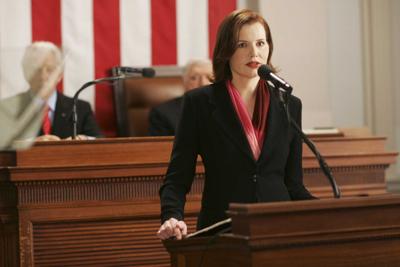
An example of the media’s portrayal of women leadership takes form in ABC’s former television show, “Commander in Chief.” Actress Geena Davis, often equated with well-known movies such as "A League of Their Own" and "Beetlejuice,” also starred in the lesser-known, short-lived television show. The show aired for a single season from 2005-2006 and centered around the U.S’ first female president, Mackenzie Allen, portrayed by Davis. With the exception of HBO’s "Veep," such depictions of women in the Oval Office are rare in TV shows and films.
There is no doubt that the media often guides people’s thoughts, according to professor Ralph Beliveau, the creative media production and professional writing head of Gaylord College of Journalism and Mass Communication.
“I think the media’s enormously influential in terms of constructing ideals of what leadership looks like and how leadership works,” Beliveau said.
Elaina Fees, women’s and gender studies and public and nonprofit administration freshman, agrees that what we see on TV can affect our view of the world.
“Let’s say on TV, you’ve never seen a woman who is a CEO. You’re always going to associate men with CEOs,” Fees said.
Jaime Loke, professor of journalism in Gaylord College, said the media is often inadvertently sexist by obsessing over a woman’s looks instead of her actions.
“I don’t think any journalist goes out and says, ‘I’m going to cover this person in a different way because they’re a woman,’” Loke said. “But there are underlying biases already that we need to overcome, like talking about what Hillary Clinton was wearing. Why does it matter what she was wearing? Who cares? It’s really about her policies. We don’t talk about what Donald Trump was wearing.”
The media can influence an audience’s perception of women by simply using certain words. Talk of Hillary Clinton’s stamina is a good example of this rhetoric.
“All we’re hearing from people is that she doesn’t have the stamina, which is a word that you automatically associate with sex,” Fees said. “So it’s all very sex-based and sex-driven. Even if it’s not a sexual thing, that’s still kind of the undertones that you get.”
In addition, women are often pressured by the “double bind” of having “to be feminine and then strong to conquer the workforce but still be a good mother, wife, parent,” Loke said, and the media perpetuates this pressure.
Loke said it’s obvious Clinton feels the need to remind people that she is a mother and a grandmother.
“If you look at the portrayal of Hillary Clinton, she had to soften her image when she started campaigning,” Loke said. “She was on the cover of People magazine wearing a pink coat and talking about being a grandmother. Donald Trump, in comparison, has never felt the need to say that he is a grandfather and father,” Loke said.
Beliveau believes that representations of women can be traced back to who’s behind the scenes in media production—and the people behind the scenes are overwhelmingly male, he said.
“Generally speaking, it’s still a question of who controls how the representations are constructed, and by and large the representations are constructed by organizations that are still by and large run by men. So there really isn’t a balanced notion of gender in terms of construction of those representations,” Beliveau said.
The Women's Media Center, a nonprofit, nonpartisan organization was founded in 2005 by actress Jane Fonda, writer Robin Morgan and feminist activist Gloria Steinem. The organization's mission is to "raise the visibility, viability and decision-making power of women and girls in media and, thereby, ensuring that their stories get told and their voices are heard."
“Men writing for film accounted for 85 percent of all screenwriters, in 2012, while women accounted for 15 percent,” according to the Women's Media Center 2015 status report.
In addition, there were seven Oscar categories in 2015 in which there was not a single woman nominated for “directing, original screenplay writing, adapted screenplay writing, cinematography, visual effects, original music scoring and sound mixing.”
“The problem is, when we think of a hero, for you to picture a woman in that role is unusual. The male hero is sort of like the default setting,” Beliveau said.
Fees sees evidence of this in her own life. Even though she is a feminist, Fees said, she was recently surprised to find herself making an assumption about someone’s rank based on his or her gender.
"It’s just how my brain works because I’ve been conditioned as a result of watching TV,” Fees said.
Progress has definitely been made in the portrayal of women in the media, but we still have “such a long way to go,” Loke said.
“I think we’re seeing an improvement with raising our daughters to be strong women now. But I think we’re still so far away from giving the same sort of welcome to women who have made it,” Loke said. “For girls, it’s easy to encourage it because they’re not there yet, but when they become Secretary of State or the next President, suddenly they’re threatening the norm, they’re threatening the status quo.”


