
Nowadays, Ted Roof rocks a black leather jacket, but not so long ago, he was keeper of Georgia Tech's imposing "Black Watch."
In the early 1980s under coach Bill Curry, Tech’s unique defensive system tormented opposing offenses. Yellowjacket defenders had to earn the Black Watch designation as they were not automatically in the club. If initiated, a black stripe was drawn in the center of the white and gold helmets. Roof, a former All-American linebacker, chose who was in the Black Watch and who wasn’t.
Some opportunities, like joining the inner circle of a nightmarish defense, cannot be declined. Similarly, Roof couldn’t decline the job offer he received when his phone rang last December. On the other line was Brent Venables, Oklahoma’s recently-hired head coach, asking Roof to join him in Norman as defensive coordinator. Venables once held the position himself from 1999-2011.
Roof, a 35-year veteran coach, has been at 13 different places, including Duke, where he was head coach from 2004-07, and Auburn, where he won a national championship as defensive coordinator in 2010.
But he had never stepped foot in Norman.
In fact, Roof’s lone connection to OU was meeting Barry Switzer many years ago. He was also aware of Bob Stoops’ menacing defenses at Florida and was friends with Jay Wilkinson, son of legendary Sooners coach Bud Wilkinson, from Jay’s time playing at Duke.
However, Roof knows the defensive struggles that have plagued the Sooners for the last decade. The 58-year-old journeyman is ready for the challenge of getting the Oklahoma defense back to what it used to be, perhaps even to the heights of his vaunted Black Watch alongside Venables, who he served under as an analyst at Clemson in 2021.
After achieving great success as a defensive coordinator for multiple teams across the country, while also enduring some tough times, including going 0-9 during a short stint at Vanderbilt in 2020, Roof is ready to prove he can lead a defense at a storied program once again.
“I have so much respect for the coaches and the players that have come through here before,” Roof said of OU back in April. “Wherever you go and whatever you do, you want to make an impact and you want to leave it better than you found it.
“Because of the history of Oklahoma, there’s a responsibility that goes with it and it’s one I’m ready to embrace.”

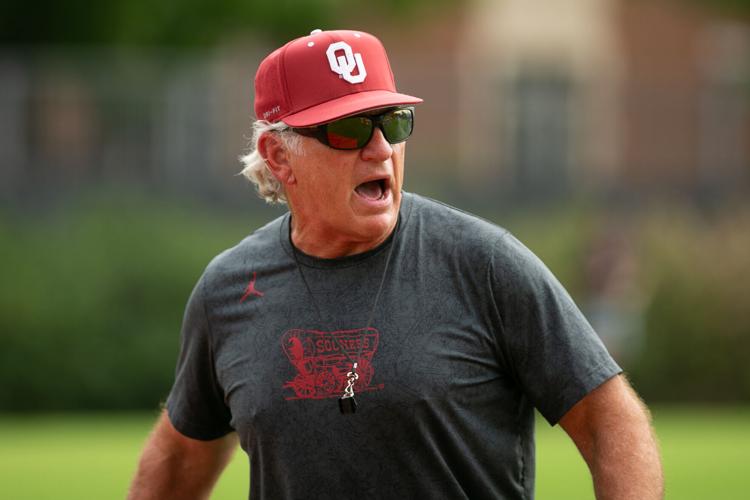
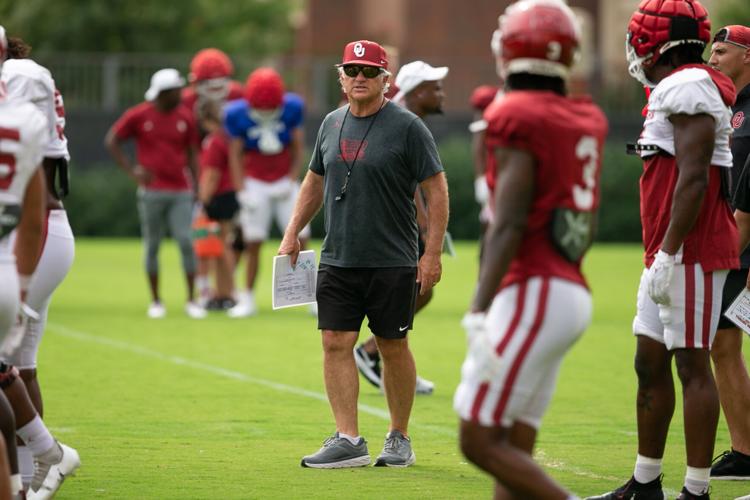
OU football defensive coordinator Ted Roof during Sooners’ fall open practice on Aug. 23.
‘He played every down like it was going to be the last'
Bill Curry still remembers recruiting Roof in his family living room in Lawrenceville, Georgia. The standout linebacker at nearby Central Gwinnett High School had one question for his potential future coach.
“If I come to Georgia Tech,” Roof said, “are we going to win? That’s all I care about.”
The Georgia Tech coach stated the importance of attending class and how graduating with a degree from the highly-respected school would pay off for Roof.
At the time, the Yellowjackets' calling card was their academics, as they had accumulated just two total wins in the first two seasons of the Curry regime from 1980-81. However, he was building something he believed to be unique, and knew he needed Roof, the 1982 Gwinnett County Defensive Player of the Year, who earned 13 varsity letters while at Central.
Roof was just the second freshman to start a game for legendary coach Tally Johnson, whose career in Georgia high school football spanned 30-plus years.
“I would say this about Ted: He's only got one speed and that's wide open,” said Johnson, who was inducted into the Gwinnett County Sports Hall of Fame in 2015. “He never did take a play off. He never did rest a play. When he played, he played every down like it was going to be the last play in the world.”
Johnson recalled a game during Roof's ninth grade season in 1978 where the Black Knights trailed 27-7 at halftime. Thinking the contest was out of hand, most parents emptied the stands and went home early.
But no game was over with Roof coming off the edge.
In the second half, Roof, who was at the time a defensive end, scored on a fumble recovery for a touchdown to lead his team to a 28-27 victory.
Johnson remembers parents approaching him the next morning at church and asking to see the game film so they could relive the miraculous comeback they abandoned. He told them he would have to charge them since they decided to leave early.
“(Roof) had a big part in that game as a freshman,” Johnson said. “That was the start of his career and he got better and better.”
Ultimately, Roof trusted the vision for the program Curry led and decided to attend Georgia Tech after high school. It didn’t take him long after arriving on campus in Atlanta to become the leader on defense.
Roof's first two seasons were disappointments, as the Yellowjackets finished a combined 9-13. Prior to the 1984 season, Curry hired Don Lindsey as defensive coordinator, and the two had a new defensive system they were excited about.
There was just one problem: What were they going to call it?
Before the rigorous season began, Curry took his family on a vacation to the United Kingdom. One of the attractions they visited was Edinburgh Castle, an 11th-century military base in Scotland.
As they approached the monument, Curry vividly remembered seeing a man dressed in black standing on a hill near the castle. According to the retired coach, the shadowy figure had calves the size of milk jugs and was built like a bodybuilder.
Curry asked someone, “Who is that?”
They responded, “Him? That’s the Black Watch.”
The Black Watch was the name of the Scottish military forces in the 1700s.
Curry picked up the phone and called Lindsey with the title of their new system. The Black Watch defense completely transformed Georgia Tech for the next two seasons, making the Yellowjackets a national championship contender.
“I wanted a special group within the group,” Lindsey said. “It was going to be chosen by the players, not the coaches.”
The players voted overwhelmingly for Roof to be keeper of the black stripe and lead the defense. Under the guidance of Lindsey, Roof broke out in 1985, earning a First Team All-ACC selection and leading the Yellowjackets to a 9-2-1 record with a win over Michigan State in the Hall of Fame Classic.
He also recorded a whopping 25 tackles against rival then-No. 16 Tennessee on the road.
“It looked like he was making every tackle,” Curry said. “We should’ve won the game. I just hated it for all of us, but especially for Ted. We played our guts out and it was all led by him.”
Although the contest ended in a 6-6 tie, Roof’s performance against the Volunteers remains one of the best individually in Tech history and ranks second in single-game tackles. What made the showing more impressive was the scare Roof’s team experienced the night before.
Georgia Tech’s hotel in Knoxville caught fire, forcing all the players and coaches into the cold October night in their boxer shorts.
“We had to get our whole team out of their rooms and out of the hotel into the parking lot, and they were standing there in their skimpies. I'm serious,” Curry said. “It was really cold so it had been a traumatic trip before we ever took the field.”
Roof powered through the sleepless night to deliver the best performance of his playing career. The lessons he learned throughout his high school and college days, with the knowledge he gained from two hall of fame coaches, positions Roof to become the right person to lead Oklahoma's defense in its new era.
‘He invested in me as a person beyond just the Xs and Os’
After graduating from Georgia Tech in 1986 and briefly pursuing an NFL career with the Tampa Bay Buccaneers, Roof entered the coaching ranks.
When Curry was named head coach at Alabama in 1987, he gave Roof his first job as a graduate assistant for the Crimson Tide. The then-23-year-old was surrounded by familiarity in his first job, as he also worked under Lindsey, who Curry brought with him from Atlanta to be his defensive coordinator.
“Ted was smart, he was aggressive and he wanted to know everything he could about linebacker play,” Lindsey said. “He was just everything that a coach could wish for. He was a student of the game.”
The short time Roof spent in Tuscaloosa with Curry and Lindsey paid dividends for his career moving forward, and the two coaches knew Roof would get his shot to lead a defense eventually.
Six jobs later, Roof was hired as the defensive coordinator at Duke in 2002 before being promoted to head coach in 2003. But things were bleak in Durham when he arrived, as the team finished winless the year prior. Roof received the task of not only putting together a new game plan on the field, but trying to establish a better culture.
Kenneth Stanford, a Blue Devils player from 2001-04, bought into Roof from the moment he stepped foot on campus.
“He did a lot to just try to invigorate a culture of toughness, of accountability,” Stanford said. “He just was really big on us being accountable and responsible for our assignments and just having a strong camaraderie within the group. That was really what he preached, was effort.”
While Duke still finished with a losing season every year Roof was there, the team became more competitive and won more games. One of the things that stood out to Stanford then about Roof was how he created a family environment and how he treated his two young sons, twins Terrance Davis and Michael.
“You could just see them soaking it in as his sons, but also, you could see that it was just a part of who he was as a person,” Stanford said. “The things that he was trying to instill in us as young men, you can see he preached the same thing with his boys.
“It wasn't an act. It wasn't a show he was putting on just in front of us. That was who he was as a person, and I think that's why he came off as genuine. And it was something that resonated with the team as a whole.”
Now, almost 20 years later, Terrance Davis Roof, who goes by “T.D.” is a linebacker at OU under his father, while Michael Roof, a former quarterback at Charlotte nicknamed “Mic,” is also an OU student.
Having played football in the ‘70s and ‘80s, Roof has earned a reputation as an old-school football coach. Nevertheless, he’s also revered as a players’ coach, a combination that rarely goes hand in hand.
Few people can own a rugged personality and get the most out of players while still being encouraging, something Stanford notices Roof excels at to this day.
“He’s a caring guy, but he is an old-school guy,” Stanford said. “He’s got that old-school linebacker, hard-nosed way about him, but I think what allows him to do that is that it’s genuine, therefore it resonates with the guys. But I think he’s also found a way to connect with the younger generation.”
One of the ways Roof related to his players at Duke was by bringing a speaker to practice. What probably seemed like a small gesture to Roof meant something more to the players. Before he arrived, music wasn’t played during Duke football workouts or practices.
“He was open enough to understand that he needed to make sure he bought a connection with us as individuals but also as a team,” Stanford said. “And for me, he and I were close when I was there. We would talk about life. We would talk about football. He invested in me as a person beyond just the Xs and Os, and I think that's why I still have a fondness towards him today.”
Stanford has watched Roof go on to coach at various schools, including joining Bill O’Brien’s staff at Penn State in 2012 following the termination of Joe Paterno amid the school’s child sexual abuse scandal.
While the situation in Happy Valley was more unharmonious than any situation Roof had been through before or has been through since, it’s telling he took the job in the first place. Stanford believes the experience helped prepare Roof for what lies ahead of him with a new coaching staff and roster at OU that are attempting to go from good to great following Lincoln Riley’s departure for Southern California.
“He’s been in situations where there has been turmoil,” Stanford said. “He’s demonstrated an ability to handle those situations and I think he’s prepared. That will allow him to take that burden of uncertainty and change on himself and in return, he’ll exude confidence and structure within the team.”

OU football defensive coordinator Ted Roof during Sooners’ fall open practice on Aug. 23.
‘It’s going to be great fun to play on that defense’
Roof has fully unleashed the energy and toughness he’s known for during Sooners’ fall camp.
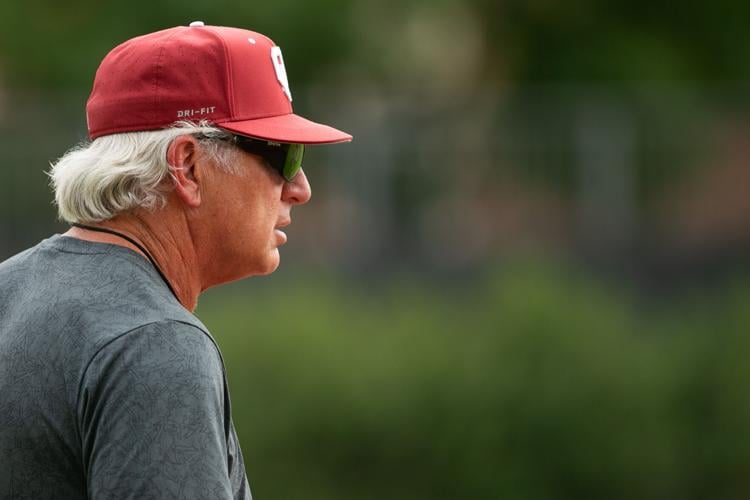
The former Black Watch captain often hopped into drills, working up a sweat and showing he still has it while his white hair flowed from his signature fitted OU baseball cap. Players seem to feed off the enthusiasm he brings to practice on a daily basis, while still being pushed to the limit.
At the outset of camp, Roof said Oklahoma’s defense was “lightyears ahead” of where it was in the spring after summer workouts, but it still had some work to do with pads on during preseason practices.
“I think it just goes back to maximizing your teaching,” Roof said. “When you have meetings, to be prepared, to be organized, to be detailed and know exactly what you want to get done. Because every defensive call has a strength and every defensive call (has) a stress point to it.”
The Sooners’ defensive coordinator also laid out some important position battles prior to camp, which included T.D., a journeyman much like his old man who was trying to make his mark at his fourth school in six years. However, Venables announced on Aug. 16 that the Appalachian State transfer suffered a season-ending biceps injury that will require surgery.
While the father-son duo were looking forward to a new adventure together, T.D. will now be forced to watch from the sidelines. A possible medical redshirt would allow T.D. another year with his father at Oklahoma, but it’ll be up to T.D., who has taken a physical toll everywhere he’s been via effort not unlike his father’s.
“We'll look at what all the options are,” Venables said. “He's been through a lot, been at multiple schools and nothing's been easy for him, so we'll see. We'll give him all kinds of opportunities based on where his heart is… And so we'll give him another day or two before we figure all that out.”
Through all the successes and failures in Ted Roof’s career, the one constant has been relationships and family, something he has emphasized since he arrived in Norman.
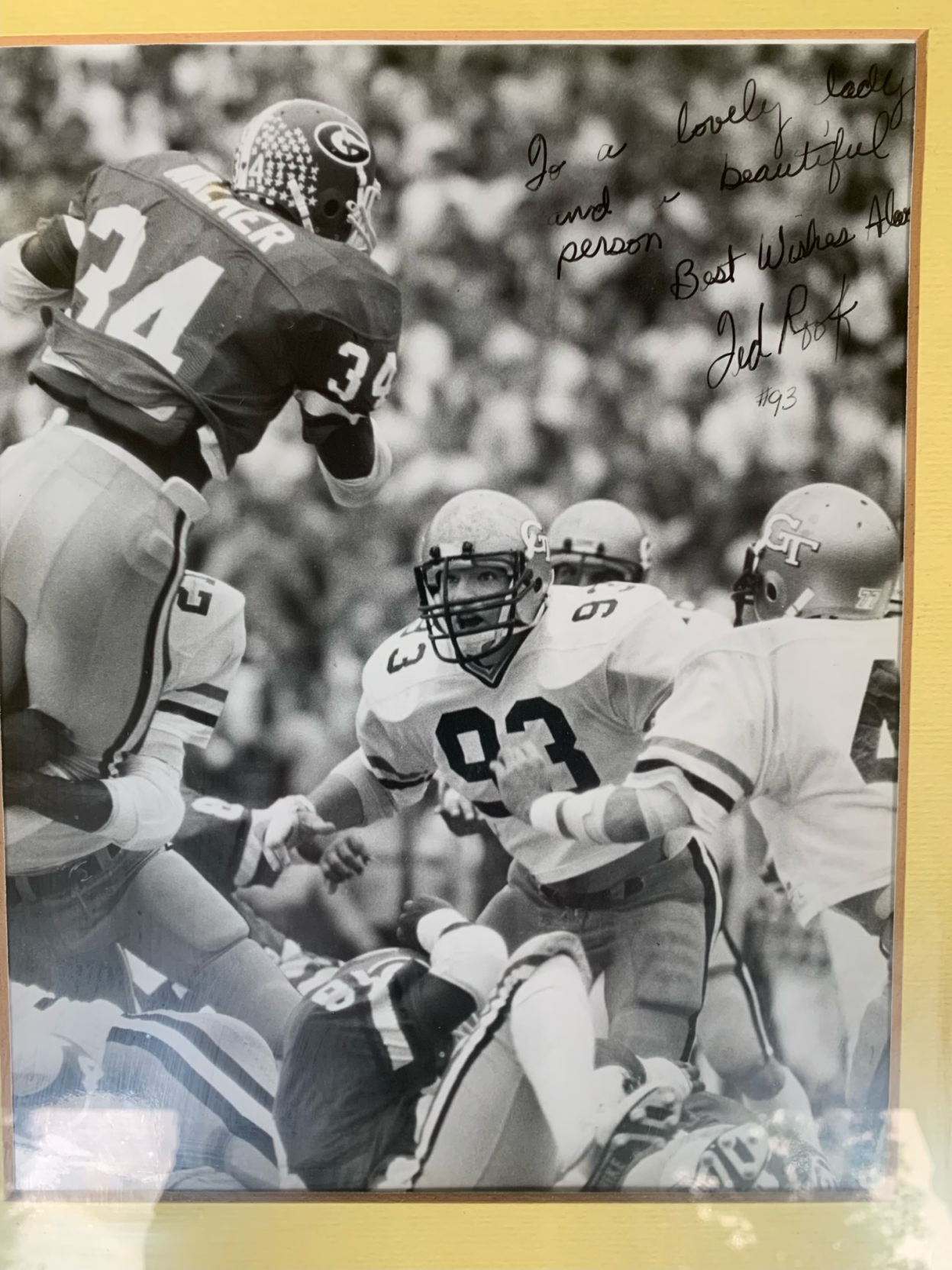
Oklahoma defensive coordinator Ted Roof, then a linebacker at Georgia Tech, prepares to tackle star Georgia running back Herschel Walker in 1982.
To this day, Johnson and his wife have a picture at their house of former Georgia star Herschel Walker leaping over defenders while Roof steadies to engage the hall of fame running back. Roof even signed it and penned a meaningful note to Johnson’s wife that reads: “To a lovely lady and a beautiful person.”
Roof still keeps in touch with all those who shaped him into the person and coach he is today. Even as he’s busy getting the Sooners ready to take on UTEP Sept. 3, he takes the time to text his old coaches.
Unquestionably, the people closest to him will be tuned in and rooting for him to have success at the highest level of college football once again. Curry, in particular, let out a loud chuckle as he pondered what OU’s defense might be capable of under Venables and Roof.
“Venables and Roof on the same staff with the great athletes that Oklahoma has, it's really not fair to anybody else,” Curry said. “And maybe that's raising expectations too much, but you know what that does to an old jock like me? It doesn't make me want to coach, it makes me want to play linebacker for those two guys. It's going to be great fun to play on that defense.”


